The Epiphany Phase

6p9eg8

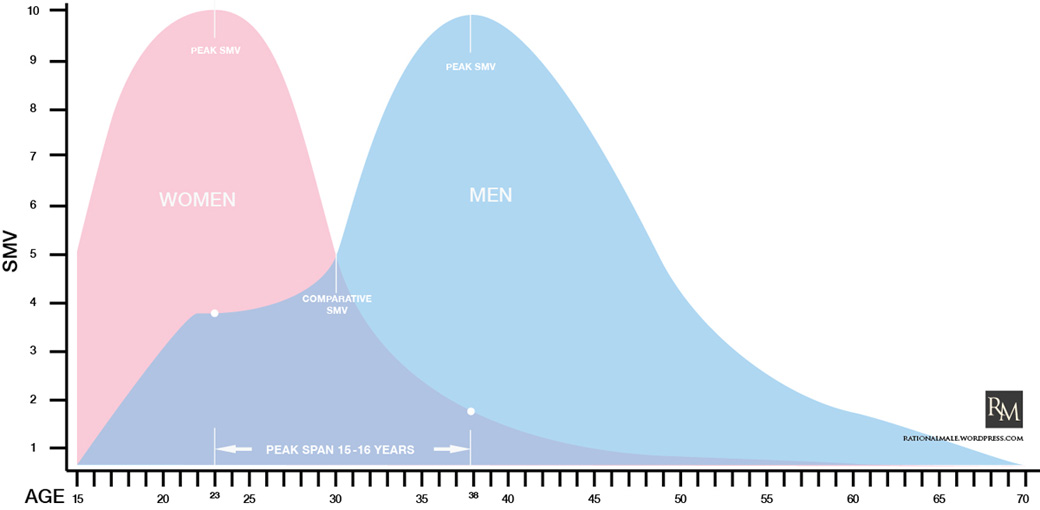
When I was detailing the landscape of our contemporary sexual marketplace in Navigating the SMP there comes a point on women’s SMV (sexual market value) progression where she becomes cognizant of her SMV decline and impending date with The Wall. Generally this occurs in women’s late 20’s and possibly early 30’s but as a rough estimate on the graph I provided in that post, this is the point of transition at which women realize their decaying capacity to hypergamously compete with women in their sexual primes, and the point at which men are beginning to realize their own increasing SMV potential. I dubbed this intersection the point of Comparative SMV. It’s also important to note that this phase conveniently coincides with the social convention of women’s mythical biological clock. (more on this later).

The Epiphany Phase

I’ve previously described this phase as a parallel to men’s feminine-redefined midlife crisis. This is a precarious time for women, usually the years between 28 and 30, where she makes attempts to reassess the last decade of her life. Women’s psychological rationalization engine (a.k.a. the Hamster) begins a furious effort to account for, and explain to her reasonings for not having successfully secured a long term monogamous commitment from as Alpha a man as her attractiveness could attain for her. Even women married prior to this phase will go through some variation of self-doubt, or self-pity in dealing with the hypergamic uncertainty of her choice (“Is he really the best I could do?”)

It’s during this stage that women will make radical shifts in their prioritization of what prerequisite traits qualify as ‘attractive’ in a man and attempt to turn over a new leaf by changing up their behaviors to align with this new persona they create for themselves. Since the physicality, sexual prowess and Alpha dominance that made up her former arousal cues in a Man aren’t as forthcoming from men as when she was in her sexual prime, she reprioritizes them with (presumed) preferences for more intrinsic male attributes that stress dependability, provisioning capacity, humor, intellect, and esoteric definitions of compatibility and intimacy.

For the spiritually inclined woman (which is to say most women) this may manifest in a convenient return to convictions she’d disregarded since her adolescence. For other’s it may be some kind of forced celibacy; a refusal to have sex under the hypergamic auspices of her ‘party years’ in the hopes that a well provisioning male (the ones not realizing their own potential SMV as yet) will appreciate her for her prudence – so unlike herself and all of the other girls who rejected him over the last decade.

The self-affirming psychological schema is one where she’s “finally doing the right thing”, when in fact she’s simply making the necessity of her long term provisioning and security a virtue she hopes men will appreciate. And if they don’t, then there’s always shaming them to think they’re ‘less-than-men’ for not living up to her eating her cake once she’s had it.

The Shifting Point

Case in point Hephzibah Anderson, author of the book Chastened, The Unexpected Story of My Year Without Sex. Here we have a graphic insight into the inner workings of women’s rationalization at the crossroads of acknowledging her decaying SMV, the need for long term male security, provisioning and intimacy, and realizing the necessity for a new psychological paradigm to justify her shift in behavior.

It’s easy to dismiss this interview as just another 3 women allowing their hamsters to colate on camera, but when you view this clip in a red pill context a surprising amount of information is revealed about the Epiphany Phase women experience.

We begin here with the now clichéd Kate Bolick Brand® former boyfriend-in-love regretfulness as the catalyst for Hephzibah’s newly gained insight. He’s serendipitously buying a ring for his new fiancé and the Alpha Widow mojo takes root in her psyche, “some girl found him valuable enough to marry.” She then proceeds through the predictable, “I’m 30 and need to reprioritize my life” boilerplate that’s made more than a few women authors a good deal of money writing for The Atlantic.

As I noted earlier, this phase also coincides with a woman’s sharp decline in fertility and childbearing capacity, so the instinctual urgency to breed, reinforced by the myth of the biological clock contributes to this internal crisis. All of this coalesces into some amazing feats of rationalization hamster acrobatics.

I’d thought those thoughts once or twice, but it would never have occurred to me that I’d actually go ahead and voluntarily eject sex from my life. It took a bizarre serendipity, a torrid affair and a chance anecdote to make me realize that the kind of sex I was supposed to be cool with as a post-feminist, 21st-century Western woman — a casual sort of intimacy without intimacy — was not working for me.

Better late than never right? Unfortunately no. While I’m sure this realization will seem ennobling to the more moralistically predisposed  mindset, what you see now is the expectation of a new appreciation for her insight which was prompted by her need, not a genuine introspective. It’s kind of ironic in that the Chastening Hephzibah is so proud of was prompted by her own necessity.

All right, in most circumstances it’s still just about required for life’s perpetuation, but we can lead perfectly healthy and, indeed, happy existences without nooky, whoopee or bonking. People can — and do — go decades without sex. Some live their entire lives without it.

Side Note: In Girl-World a woman can electively forego sex for an entire year and it’s recognized as a sacrifice worthy of writing a book to be published by a major print publisher, while the only way a man can be recognized for his 40 year celibacy is when he enters a fitness center and guns down 7 women in a pilates class. As I’ve stated before, when a woman tells you “I don’t understand why sex is sooooo important to guys“, she’s telling you the literal truth.

Elizabeth I was known as the Virgin Queen, and there was nothing metaphorical about the title, history assures us.

Robert Dudley and a long list of the Queen’s confirmed lovers disagree. What follows here is an attempt by Hephzibah’s rationalization engine to affirm what she’d like to think is her radical decision to go abstinent – plenty of luminaries from the past have gone without and lived perfectly fine lives. What she’s in denial about is the necessity of sex in a mature human experience. Sex is the glue that holds a relationship together; without sex a woman becomes a man’s mother, sister, daughter, aunt, friend, but not his lover, and certainly not his wife. Deemphasizing the importance of sex, actively desexualizing yourself in the hopes that it will make you more sexually arousing is an effort in self-defeat.

What follows here is yet another overwritten self-examination of a woman facing the Wall and attempting to reconcile a past of eschewing offers of genuine intimacy with (albeit probably beta) guys and her own hypergamous impulses during her 20’s. When a pre-Wall Anderson makes a conscious effort to remove sex from the equation in order to bring her more “clarity” about a man’s long term value what she’s doing is attempting to dissociate hypergamy from that process. In doing so she devalues the important sexual aspect of a relationship and turns off the men she’d probably fit well with because she believes that sex is the foil in her past failures, not herself, not her ego-investments, not the delusions the feminine imperative has saddled her with. Sex isn’t her problem, her innate hypergamy will eventually reveal this to her, but it’s how she’s been doing it and the late hour at which she’s come to her “new” epiphany with all of its urgency.

Hephzibah is easy pickings for the manosphere Men with a bent for shaming women about riding the Cock Carousel (she even alludes to this in the article). That’s a given, but it’s not the operative issue I’m on about here. What her story illustrates for us is the psychological machinations behind the reconciliation of her unfulfilled hypergamy and her need for future intimacy, security and provisioning.

For red pill, Game-aware Men, this is a supremely important stage in women’s maturation to consider. A woman in the Epiphany Phase is looking for a “fresh start” for a much more visceral reason than some newly inspired sense of self. This motivation prompts all kinds of behavioral and social conventions to facilitate a man’s commitment to forgiving her past indiscretions. As Roosh has pointed out more than once, it’s women in this phase of life (or the mothers of women in this phase) who most vocally complain about men’s lack of interest in committing to them. As Hephzibah is painfully aware of, women in their peak SMV years don’t complain about a dearth of marriageable men– “Man Up” is the anthem of women in the Epiphany Phase.
Shouting in the Wilderness

Hat tip to reader BoxerRearZenith for bringing this to my attention:

Rollo, I’ve been a reading your blog since it’s inception. I love how eloquently everything is written and presented; therefore, I’d like your written opinion on this following Youtube video, if possible. It’s from ESPN First Take that was shown yesterday and Stephen A Smith was discussing Red Pill rhetoric (Being Anti-Oprah, lol) on a national platform. It was based off Chad Johnson and his wife Evelyn Lozada. And I had this similar discussion with friends who are also fans of this show and they couldn’t understand Stephen A’s point; even though, he illustrated and demonstrated his points so well. I tried to explain his position and why he went off but I got berated so I let it go. Is there anywhere to simplify his point of view to where my guy friends would somewhat understand? Btw, these are blue pill guys trying to figure why women are the way they are. Basically trying to find the red pill but not knowing to look for it if that makes any sense.

I’ve used the end summation of Stephen A Smith’s opinion here just for brevity’s sake, but if you have 15 minutes the entire clip is well worth watching, I’ll start by saying that it’s good to see even a marginally red-pill aware Man make a statement like this. We’re told all the time how football is really the last refuge for masculinity, but I’ve never agreed with this, and Smith’s bold and confrontational words here illustrate exactly how deep fem-centrism has saturated into even the most male of arenas. Smith is attempting to provide just a marginal consideration for a male perspective here and the reactions by Skip and his female co-host Cari Champion are an excellent example of how efficiently the feminine imperative shuts down that perspective. While Smith is obviously agitated and raises his voice, not once is he fumbling for words, nor does he slip and use expletives. He knows his perspective, has done his due diligence and is ready to express it.

And express it he does, but like most Men making public declarations attempting to bring awareness to fem-centrism, Skip and Cari, both obvious Fem-Matrix plug-ins, look at Smith as if he were speaking a foreign language. They can’t believe what’s coming out of his mouth. So saturated into our social fabric is feminine primacy that the thought of expressing a male-centric consideration, even as measured as Smith’s, is alien to those steeped in it.

Even Smith is guilty of this conditioning in his feeling it necessary to constantly footnote his perspective by repeating that he’s not endorsing violence against women. He has to do this because, like any other Man attempting to vocally expose fem-centrism, he’s learned that the first, reflexive response plugins will acuse him of is misogyny. So he must preface his words repeatedly or be dismissed as an evil patriarch. This constant qualification is necessary because the first resource of fem-centrism is to associate any perspective counter to the feminine imperative, no matter how remote, as an act of violence against women itself. Even women expressing a male perspective critical of fem-centrism are subjected to this association.

White Knights of the Feminine Imperative

For all of Smith’s intensity his message is entirely lost on an avowed white knight like Skip Bayless. Skip’s reaction is that of a well conditioned male in the feminine Matrix. As I wrote in Enter White Knight:

Every random chump within earshot of your conversation about Game, about your ‘changed’ way of seeing inter-gender relations, about your most objective critical observations of how women ‘are’, etc. – understand, that chump waits everyday for an opportunity to “correct” you in as public a way as he’s able to muster. That AFC who’s been fed on a steady diet of noble intent, with ambitions of endearing a woman’s intimacy through his unique form of chivalry; that guy, he’s aching for an opportunity to prove his quality by publicly redressing a “villain” like you for your chauvinism.

If you watch the full clip, Skip’s calling Chad Johnson to the carpet about his domestic violence and impending divorce is exactly what I’ve come to expect from white knight Beta Game. Skip’s provocation of Chad isn’t about his desire to ‘get to the bottom of things’, but rather to establish himself as a champion of the feminine imperative – and by association make himself more attractive to women by being the tough male advocate for women everywhere. Guys like Skip look for opportunities to appear like upstanding responsible Alpha men by scolding true Alphas like Chad in as public a way as possible. Essentially they use the same shaming tools of the feminine imperative in an effort to better align and identify themselves with the women they subliminally hope to impress – and yes, even the married ones.

A beta game response is what I’d expect from this mentality, but I think what red pill viewers of this clip need to understand is the subconscious fluidity with which this reflex occurs. Chad was ready to lay Skip Bayless out on the studio floor, but this doesn’t even occur to Skip until after he’s embroiled in the confrontation. White knights seldom realize the real danger they put themselves in until that white knightery backfires on them; that’s how internalized the mentality is, it overrides a capacity to see danger cues.

Redirect

Cari Champion’s reaction is also a predictable, feminine-centric response. Where Skip will fall back on the convenient excuse of wanting to ‘get to the bottom of things’ Cari will do what most women will – presume that any man declaring a male-centric counterargument to the feminine ‘has issues’ with women. He’s “expressing a lot of anger” about women, even when the issue isn’t about women, but the societal circumstances of men. Then, as is the standard feminine reflex, Cari makes attempts to reframe Smith’s point to be individually specific to women. Smith makes a good effort of not allowing this reframe, but notice that in order for him to stay on point he must once again reiterate that ‘he’d never harm a woman’ just so he can get back to it.

Recently there’s been some great discussion over at Sunshine Mary’s blog regarding the validity of the feminine imperative as a concept in and of itself. Unfortunately it’s easier to show examples of the feminine imperative than it is to definitively describe it. I think Smith’s efforts here are an attempt to make plugged-in people understand just what the feminine Matrix is. But no one can tell you what the Matrix is when you’re in the Matrix. So when you see the lone man shouting truths in the wilderness, it isn’t what he’s saying that’s important, but who is listening.

To answer Boxer’s question, I’m not sure there is a way to simplify Smith’s message. Your friends aren’t going to understand it because they have no frame of reference to relate his message to. Everything is fem-centrism for plugins, and the feminine imperative already has long established social contingencies (like the one’s observed in this clip) to dissuade any real awareness of it. I have no doubt that Smith’s inbox was filled with the hatred of countless plugged in men and women arguing for him to seek therapy for his misogyny – which ironically was exactly the point he was trying to make. One of the most effective social conventions the feminine imperative ever established was disqualifying those critical of it from ever having credibility about it.

Unfortunately Boxer, your friends, like most men, will have to learn from harsh experience to ever be open to seeing the feminine imperative as Smith does.

Friends Like These

RT, I just finished reading Playing Friends and I was wondering, what would be a good way to tell a woman that you don’t accept her “olive branch”?

Should I ever encounter this situation, I would like this tool in my arsenal. The best reply I can think of would be “That’s not a good idea” and walk away.

Any better phrases out there? What is the ideal “level” of confrontation to use?

As I said in that essay, when you do decline a LJBF a certain amount of tact has to be involved. Any overt ‘in your face’ response will prompt an equally overt confrontational response. The trick is to convey your non-acceptance of her offer in as covert a fashion as possible, but still courteous or at least “business-like.”

The first obstacle men have to get over is that LJBFs are rejections. They are not genuine offers of some kind of enduring friendship. This goes back to what I’ve written about intergender “friendships”, and a lot of AFCs get it into their heads that they’re going to buck a trend and actually be ‘besties’ with their LJBF girl. I’ve already covered most of this in that essay so I wont go back over that, but the natural inclination for most men when faced with a rejection – that most often comes after a very long period of “sniper mentality” – is to opt for the path of least resistance and certainly the one which will make him and her the least uncomfortable. Women know this. This is precisely why a LJBF has been proven so effective for generations. It gives both parties an acceptable out, or on his part, an out that at least blunts the rejection.

The Process

The problem with all this is that the LJBFed guy is caught in the process without ever having understood that he’s playing a predictable part in a feminine social convention. So he sees the LJBF as an event rather than what it really is, a feminine-approved socially permissible mechanism for rejection. As a guy gets consistent LJBFs he begins to see the process, but all this comes after having had exclusively invested himself in the LJBF girl up until the point of the rejection. This is where the “frustrated” part of AFC comes from; his investment.

That’s the first part; a man has to recognize the LJBF for what it is. This is part of the learning process because a guy has to also do some very important self-analysis at this point. Most chumps will self-evaluate and try to find flaws in their sniping. “She might have accepted me if I had done X, Y & Z to prove I’m worthy of her.” Rather, a guy ought to self-realize why he was in a potential LJBF situation in the first place. I’ll tell you now, if you got a LJBF rejection, odds are you went about the process wrong. You sniped, you pined, you most certainly placed yourself into a position of qualifying yourself to her and thus handed her the frame from the outset. As I’ve mentioned in some previous essays, you most probably believed the lie about “women needing to feel comfortable with a guy” and jumped past the uncomfortable sexual tension of attraction directly into the comfort of rapport and familiarity.

Now, I’m outlining all of this again to emphasize that any response you can give a woman issuing the LJBF rejection should be done so from a position of complete awareness. It’s not the actual words you say so much as you understand how you got to the point of a LJBF rejection. In other words you are most likely, at least partially, responsible for allowing it to get to the point of you having to counter-reject her LJBF.

“No, thanks.”

So then how do you go about it? Some have offered the blunt “I have enough friends” line, but you’ll deal with the social fallout of such an overt counter-rejection and most likely get the “you’re an asshole response”. Depending on how comfortable you are with that I’d say it’s fair game, but don’t expect her not to behave like this. Women’s easiest recourse at that point would be to think all you were interested in was fucking her. I realize how shitty that seems, particularly when most guy’s getting the LJBF are there after having tried for months to get to the point of pressing the issue of intimacy and applying all the effort and personal investments (not limited to just missing other better opportunities). How could she possibly come to the conclusion that all you wanted was to get in her pants? It’s her only social acceptable, ego-preserving recourse, despite all you did to “prove” yourself up to then.

There’s couple of better ways however. One is allowing her to deliver the LJBF and let it roll off. You don’t have to be a prick and say “thanks, but no thanks.” You could simply let the rejection go and strategically withdraw – so long as you think you can do so. Cut off all contact and move on to spinning plates as you should have been anyway. This is simple pragmatism, if not a bit introverted, but the end result is the same – she gets the message that you’re no longer wasting yourself on her as a cause.

The other way is a the assertive counter rejection. This is not an overt “I have enough friends” response, but rather a drawing of attention to the social contrivance she’s using and explaining it to her in direct terms.

After her LJBF, you can say, “I really wish I could be your friend, but I’d really thought we meant more to each other than that after so long, and honestly, I’m looking for more. Sorry, but I guess I was wrong about you.”

I wouldn’t use this verbatim as some kind of script to follow, but this approach effectively puts the onus of the rejection back on her and makes her aware of the LJBF as a rejection. It’s very similar to a neg hit in that it puts her into a position of not qualifying for your own intimacy. The idea is to defuse any “he just wanted to fuck me” ideas and draw attention to it as a rejection. The problem with a LJBFs as a social convention for women is that it’s gotten to a point where it’s a default, autonomous response, and not a real rejection of intimacy. It’s become such a useful tool that women no longer understand the latent function of it. When they’re made aware of it, in a responsible way, recognizing the rejection aspect is unavoidable. In a rational world it’s a Man’s responsibility to approach, initiate, be decisive, etc. with a woman, it should be incumbent on a woman to give him a straight rejection or acceptance of his approach. Unfortunately not all of us are mature enough at any given stage to do so, so we develop social contingencies to cope with uncomfortable circumstance.

Go Dark

All this said, even after delivering an assertive counter, you MUST stick to your choice. You can only walk away with your self-respect and her own respect for as far as you’re willing to follow through with it. Cut off attention, focus on other things, take some time for yourself, analyze how you came to be in the LJBF position, etc.

She will try to get you back as a friend (see: beta orbiter), for her own ego preservation if nothing else. Do not allow this. It’s not her punishment, it’s not spite, it simple utility. The longer you entertain her the longer you will be paralyzed. You will be in limbo because you refuse to see her behaviors are her message, not her words. When extinguishing a behavior, in behavioral psychology, subjects universally attempt novel behaviors in order to reestablish a previous reward / reinforcer that prompted the prior behavior. This is called an Extinction Burst. People will do this too. The AFC will step up his efforts in new ways in order to prove his merit for intimacy, and women will be flirtatious and accommodating in ways they never thought necessary in order to reestablish prior attention levels they enjoyed before a takeaway. Be prepared for this.

*This post dedicated to my ever-growing reddit following.

Boys will be Boys

There is an interesting subset of men that has evolved in our feminized social environment over the past 60+ years. I can’t quite refer to them as Betas since that seems too broad, and though Roissy’s initial coining of the term “Herb” (as in ‘herbivorous’) seems useful, these ‘men’ are something belonging to that set, but actively embracing and advocating for the feminine imperative. “Vichy Males” is probably a good starting point; men who are so invested in the conditioning of the feminine imperative that, unaware of how it affects their own interests as men, actively collaborate with and promote the feminine imperative’s social reengineering of masculinity.

These ‘men’ are not the oblivious blue-pill guys that the manosphere takes efforts to unplug from the feminine Matrix. They are the advocates of gender realignment, the male feminists, the men whose perspective it is that a more “equal” society is one in which masculinity is redefined to better convenience the feminine imperative. These are the ‘men’ who emphatically define “healthy masculinity” in a feminine framework where the results of testosterone and all of the innate traits that make one male are character flaws that disturb a feminine defined ‘equality’.

For the better part, Vichy Males are more or less oblivious to the feminine imperative that’s conditioned them. Whether this is a willful denial or simple indifferent ignorance is debatable, but in either case these men take the identification schema of Beta Game to the logical extreme. In some instances I’m certain the most successful amongst them make a livable wage from their dependent feminist evangelism (the feminine imperative rewards only the most Alpha-like crusaders who tow the feminist line), but for most, their advocacy is really an extreme form of identification-for-intimacy Game. In a world of White Knights, to seem unique requires a greater devotion to the feminine imperative.

Social Engineering

I had originally intended to use The Frisky’s most recent ‘feminizing boys’ article as my example for today’s post. It certainly raised the hackles of a few commenters from yesterday’s Chauvinism post, but unfortunately it’s too easy a target – it’s an incomplete beginning that doesn’t show the inevitable result of the feminization of boys. Women are encouraged to teach boys to be more like girls, teach them to pee sitting down, embrace their emotionality, cry on demand, and basically act less like little boys have an innate knack for, etc., but this is only half the picture. Those boys grow up into the gender-confused feminized men women later despise.

For the other half of the picture I present to you the most recent gender-fare from (once again) The Atlantic – The End of Violent, Simplistic, Macho Masculinity. Kudos to The Atlantic for its gender neutrality in allowing a Vichy Male like Thomas Page McBee to join the ranks of Kate Bollick, Hannah Rosin and Sandra Tsing Loh for their monthly serving of feminist triumphalism. McBee and his male-apologist sympathizers are the end result of “teaching boys to be feminists.”

While McBee is barking up the Hugo Schwyzer tree, this article reads like an exposé into the mental reasoning of a fully feminized Vichy Male. It’s more or less what I’ve come to expect from masculine apologists but I thought I would highlight the parts of it that give us an insight into the conditioning of the feminine imperative.

From the opening sentence we get an overview of how the Vichy Male’s perspective aligns with his feminine assimilation.

Boys aren’t supposed to do a lot of things: show fear or pain, compassion or tenderness; but of course men feel a full range of emotions, whether we’re “supposed to” or not.

There’s never a question about the dynamic of boy’s / men’s expectations of restraining their emotionality. The main presumption that the feminine imperative indoctrinates in its adherents is that gender is a social construct, and as such the “supposed to” aspect of this assertion is really a presumed societal expectation. Not even an afterthought is given to the idea that perhaps men aren’t wired for emotions in the same way as women. This of course might give pause to the idea of a blank-slate people-are-people equalism so the imperative conditions those questions away from any critical analysis.

However, even if this were the case, and gender was a social construct, might there have been a good reason that boys were  taught in the past to suppress their emotionality and rely more on rationalism and determination to endure pain? Perhaps it led to better, more pragmatic decision making? Again, these are question the imperative can’t afford to have concrete answers for.

The other is more personal. I know that if you are a man, you’re reading this with awareness or resistance, that how you interpret these men says a lot about the type of man you are. It’s easy to pretend to be objective, to describe a movement as if I’m not invested in its outcome, but as I researched this story I realized that I couldn’t tell the truth without exposing all of it: healthy masculinity as a sea-change, and why I want my own counter-narrative to be part of the turning tide.

Here we have a man parroting the standard male-shaming the feminine imperative conditions into women. The circular argument goes like this; if you’re a Man with a different interpretation of masculinity and this redefinition offends you it’s because you are insecure in your masculinity. This is a standard trope feminism has bred into the past 4 generation of men and women – “if you don’t agree with the feminized interpretation of masculinity it’s due to your insecurity in your own masculinity.”  Ergo, you’re less of a man for disavowing the interpretation. And this interpretation of ‘healthy masculinity’ is one which more perfectly aligns with, and doesn’t inconvenience, the feminine imperative.

He points to data: Generation Y men do more housework and are more involved fathers than any generation in American history. They also have more cross-sex friendships, which Kimmel suggests means that young men see women increasingly as true peers—equals—in life and work.

Again, more feminine-centric presumptions about male intent. Nowhere is there a consideration given towards motive or the socio-economic variables that may have led to these data.

He lists some of the words the men at the summit used to describe healthy masculinity: nurturing, kind, positive, good, caring, courage, confident, inclusive, courageous, honest, accountability, and respect. Not your father’s Marlboro man—but maybe closer to the reality of your father. Which is the point. “We have an exercise we do where we ask men and boys to name the strongest man in their life and then talk about what it is that makes him strong,” McGann says. “Most of the time, it’s their father or a counselor or a minister, and the ways in which they care for them. Or it might be about integrity, or it might be about their willingness to stand up for what they believe in, their compassion, all those kind of qualities—which are much more qualities of character. Those are always the things that we’ve associated with healthy masculinity.”

Here we see the feminine imperative evident in the qualities that should make for a “healthy masculinity.” Dropping a few of the more subjective qualities on this list, you could easily describe women having a “healthy femininity” with these characteristics. The aspersion of the ‘Marlboro Man’ is simply one more caricature of masculinity that’s been a go-to derision of the feminine imperative for decades.

The main problem with the Vichy Male characterization of a new “healthy masculinity” is that their comparative definition of ‘traditional masculinity’ has been so distorted by the feminine imperative over the past 60 years that it’s become a straw man parody that’s easily knocked down. The former “masculinity” they oppose is the ridiculous, beer swilling, fart joke, boob mesmerized, borderline abusive masculinity that’s been reinforced in pop-culture courtesy of feminization. A masculinity that requires a uniquely feminine correction is the mental image these men cling to while establishing themselves as the perfected, new and feminized version of masculinity. In other words, masculinity can only be positive in a feminine defined social framework.

The toxic narratives of unhealthy masculinity are often unquestioned, and they start very young. “There are no four more depressing words in educational policy circles then ‘boys will be boys,’ ” Kimmel says. “Because when do we say that? We say that when we throw up our hands in resignation that we can’t do anything. Why don’t we say ‘boys will be boys’ when a man wins the Noble Peace Prize?

Because doing so would give unique credit to masculinity as being the source of a man’s ability to achieve a Nobel Peace Prize through sheer determination – and that’s a credit the ‘equalist’ agenda can’t afford to have men think about. Boys will be boys and truly, despite the feminized bleating, women wouldn’t want it any other way. Boys will take risks, boys will injure themselves, boys will leave the security of the safe side of the sidewalk their mothers forbid them to leave, because that’s what boys do.

Compassion might be a place to start, for yourself and others. “Trying to hold men accountable connects to unhealthy masculinity,” McGann says. “I’ve said for years that one of the things about unhealthy masculinity, or dominant stories of masculinity, is that men are socialized to push past pain, ignore pain, like it doesn’t harm you in any kind of way, you’re not vulnerable. If you can’t really recognize and experience your own pain, then how can you do it with anybody else?”

Men push past pain for good reason – it is the key to growth into a healthy maturity. Men push past pain, not just a social expectation from other men, but because of the same expectations from women. It’s by necessity, not social pressure.Very few men fail to recognize their own pain, but a feminine mindset determined to vilify masculinity would rather we believe that not expressing that pain is always a net negative. The irony this mindset is oblivious of is that at the first mention of a man’s pain, at the first expression of his own self-concern he is accused of bitterness. “You must’ve been really burned to think what you think.” This is the root of the Male Catch 22.

Like a lot of guys, I had a shitty dad. He was uneasy in himself, abusive, shut down. Being a guy to me seemed located in his hamstrung emotions, his uncomfortable displays of drunken vulnerability. I remember him singing Frank Sinatra in this mournful voice, how I pitied and hated him, how I never wanted to become him.

“No Luke, I am your Father.”

“That’s not true!,….THAT”S IMPOSSIBLE!!”

I suppose I should mention here that virtually all Vichy Males are Promise Keeper.

Whether or not men know the phrase “healthy masculinity,” signs of changes are blooming everywhere. I think about Kimmel, who says the roots of the shifting gender roles are a movement away from rigidity. Feminism allowed women to unlock the parts of themselves society kept from them, and now men are doing the same. He posits that a cure for what ails us that sounds familiar to me, the work I’ve done to become my own man embodied: “I don’t see us as becoming a more masculine culture or a more feminine culture, I see us becoming a more balanced culture,” he says. Look at the last election: men helped vote women into power all over the country, including a transgender woman in New Hampshire.

Mark Minter, paging Mark Minter, please report to the comments section, thank you. One element I find interesting in feminist men is a desire to experience the same so-called liberation from a masculine gender role assignment that feminist women claim to have. It’s as if the feminine identification isn’t complete unless they can tap into that same gender straightjacket indignation release women do – they can’t be ‘equals’ unless they suffer a similar (albeit self-constructed) gender role release. This is the level of conviction Vichy Males strive for.

One part I do agree with though, “Feminism allowed women to unlock the parts of themselves society kept from them, and now men are doing the same.” The tragic irony of women’s innate Hypergamy’s unfettered release on men is entirely lost on McBee. And yes, Men, Alpha Men, are now released from the same previous constrictions.

Men are embracing a more nurturing fatherhood with zeal, from Michael Chabon to the super-engaged, former stay-at-home dad Chris on Up All Night. And Modern Family‘s dinosaur patriarch, Jay, is as old-school as they come, especially next to his touchy-feely son-in-law, Phil. In a reversal of past tropes, however, Jay’s blundering inability to connect to his feelings makes him the joke to be tolerated and Phil’s the man of the moment. More techy than macho, he’s thoroughly nonplussed when he realizes he’s on a gay date just as he’s being kissed.

As I stated above, the only model for masculinity these ‘new men’ have for comparative purposes are the distorted archetypes of masculinity that a feminized pop-culture and media has characterized for them, and here we have the perfect example of this. When all you’ve ever had representative of a masculine archetype has been ridiculous cartoon characters of men, it’s not such a daunting task to “be a better man” than them. In fact, the episode McBee describes here not only props up a “dinosaur patriarch” archetype, but also knocks him down with a character he identifies with in being the ‘new’ definition of masculinity. Yay, for team ‘new man’!

You can read the article in its entirety if you have the stomach, but it essentially ends on the same note as my last highlight here.

Positive Masculinity

Our popular conscious perspective of masculinity has been remolded by the feminine imperative and fed back to the likes of Vichy Males like McBee here. I wish I could say he was an outlier, but he’s not. He’s one more crab in the barrel pulling frustrated, confused and conflicted men back down into feminization. Maybe unwittingly, maybe as a form of Beta Game, but men endorsing and evangelizing the feminine imperative are the most effective ambassadors of the imperative. It’s men, and particularly ones other men respect, who make the best tools for feminization – in fact men’s participation is an integral part of the imperative’s effectiveness in social engineering.

One aspect of McBee’s misgivings I do agree with is the need for a Positive Masculinity. A masculinity not predicated on the social interests of the feminine imperative. One defined by uniquely male standards that embrace our natural capacities for focused agression, that accepts rather than derides the effects of testosterone as a constructive (and yes, destructive) part of our natures. We need a masculinity that recognizes women’s innate arousal and attraction to it as something that sets men apart by its difference from women, not one that attempts to homogenize and androgynize it to be more palatable to women. A masculinity that is respected for being the predominant driving force in what our species has become as a result of it. A masculinity that is unapologetically dominant and beneficent.

We don’t need men to get in touch with their feminine sides, feminization has reinforced this for far too long. Masculinity isn’t about ‘men behaving badly’ in a feminine context, nor is it about parodies of men rediscovering “manly pursuits” pre-manufactured by what the feminine imperative laughs at men for.

Masculinity is about Boys being Boys, and Men being Men.

Chauvinism

chau·vin·ism

1: excessive or blind patriotism — compare jingoism
2: undue partiality or attachment to a group or place to which one belongs or has belonged
3: an attitude of superiority toward members of the opposite sex; also :behavior expressive of such an attitude. Compare male chauvinism.

I had an interesting conversation over the long weekend about my Shallow post with a few red pill friends. The topic of NLP (neurolinguistic programing) and how select terms are ‘owned’ by the feminine imperative was discussed. It’s interesting to dissect how the terminologies of certain feminine social conventions have entered our contemporary lexicon as the ‘official’ definitions we simply take for granted in our blue-pill ignorance.

The subjective nature of terms like “Shallow” and “Superficial” are easy examples of this feminine repurposing, but then you get to “Misogynist”, “Sexist” and of course “Chauvinist” and you can see how these ‘official’ terms evolved into what they are today. In fact, “Sexism” was so universally defined as male-specific, Websters needed a new word to describe a female form of sexism, “reverse-sexism.” And of course “Misandrist” still gets the red underscore of a misspelled word in my WordPress spellchecker.

Chauvinists

The problem I see is in defining ‘Chauvinism’, particularly as opposed to ‘Misogyny’ – they’re practically synonyms in the lexicon of the feminine imperative. The biggest fallacy I think most AFC guys and all women I’ve read write on Chauvinism subscribe to is that women own this term. It is absolutely possible to describe a woman as a Chauvinist, but in a modern context it has been uniquely defined in the masculine. In fact, to get down to the roots of the term when it was defined as a masculine attribute, the original terminology was “male chauvinist pig” courtesy of Gloria Steinem and the militant feminist movement of the 1970s.

However, more important is how the term has become synonymous with masculinity. For the past 40 years it’s been developed in westernized society that masculine = chauvinism and that any uniquely masculine trait, behavior or characteristic is at the very least suspect, if not outrightly so, chauvinism.

Why is this? Why should a man be labeled ‘chauvinistic’ for expressing his masculinity? Masculinity and the behaviors that are derived from it are no more negative than those expressed in the Feminine depending upon individual conditions. But it’s the masculine that is vilified by both sexes (at least in the last 60 years).

Positive Masculinity

Why can’t the masculine be a positive? The underlying theme for Rational Male is an effort to get back to a positive definition of masculinity. Thatt’s not advocating a wife-beating, caveman ideology, rather it’s a move back to defining the masculine in terms that don’t equate it with chauvinism. The difficulty occurs in attempting to relate to both men and women a need to unlearn this pre-described terminology, that even our own parents helped brow-beat into cultural consciousness. Chauvinism as masculinity has been parroted constantly for so long now that a new generation of AFC sons from AFC fathers now resort to internalizing this doctrine and ego-investing themselves in avoiding anything even remotely construed as masculinity in a desperate attempt to identify with what other women repeating the same ideology (masculine equals domineering opression) have been socially conditioned to accept as what a man should be to achieve the ‘gift’ of their intimacy.

Then men are ridiculed (even by their own) for even prompting the thought that something might not be entirely equitable in gender relations when behaviors consistently don’t match ideology. The man to even subtly point out inconsistencies in women’s behaviors is automatically a Chauvinist for exposing a feminine weakness in their argument. And now we come full circle and hear a constant bemoaning from feminized pop-culture, “Where are all the REAL men these days?” Why can’t we have Superman again? All in complete, blissful ignorance of the history and circumstance that have lead to the decline of positive masculine males.

The only reason men outside the sphere have any impression that the manosphere is based in Chauvinism is because they have no grasp of the true definition of the terem, nor do they understand the engineering which evolved the term to what it is now. It’s far easier to engage in misguided attempts to identify with the feminine; to spit back the rhetoric women say they approve of as a condition for their intimacy while simultaneously contradicting themselves with their own behaviors.

For far too long young men have bought the basic Carl Jung psycho-babble women have repeated since the 60’s – “Men need to get in touch with their feminine side” as if this were the ultimate in female identification and an avenue to their intimacy. In fact the opposite is true – men need to rediscover their masculine sides and be unafraid of the consequences. In my experience the manosphere makes the single best attempt to do this in modern culture, without resorting to actual misogyny.

It’s time to stop buying the lie that masculinity is laughable, ridiculous or definitively negative. The world desperately needs Men. Men with strength of will to pass the meta-shit test of a feminized popular culture when it tells him he’s pitiable because he’s been poisoned with testosterone and the traits that make him masculine are to be controlled as character flaws.

Shallow

Recently Vox had a not unexpected run-in with the ladies over at Aunt Giggles’ Beta Emporium regarding one of my favorite feminine social conventions. There’s a very definitive feminine ownership of certain terms that the feminine imperative uses to maintain its primacy. Like any good ideology, control of the messaging is vital to perpetuating the feminine social frame. Thus terms like “shallow” and “superficial” are contextually defined from a feminine perspective and, through shaming, serve to enforce feminine primacy.

There are a lot of applications women will use “shallow” for, but the primary use is to shame men’s natural arousal/attraction cues being based on physicality. As I detailed in The Wall, women have a life long relationship with the impending decay of their only real agency over men – their physicality and their sexual access.

Why should physical appearance be a criteria for anything? The operative question; Why should the importance Men place on the physical always be characterized as “superficial”? Why is it that a man is “shallow” for following his biological imperative, while a woman seeking commitment is considered “prudent”?

Because women are only acting on behalf of their own biological imperatives when they do so. Like all feminine social conventions, if men can be made to believe that a woman’s best interest is actually his own, she retains control of the frame. How do they effect this? Repeat it over and over until men identify with it and it becomes a societal norm. This then places men into a state of internal conflict – they’re not supposed to want hot women for fear of being deemed “shallow”, but yet they always seem to find themselves attracted to, and aroused by, the most physically ideal women they encounter.

Controlled Selection

So, how, and why, then does this social convention work? Why is it necessary? The simple answer is that the latent purpose of shaming men into denying their own biological imperative better serves to maintain women’s control of hypergamous sexual selectivity.

The cold hard reality all women face is that, in the sexual market place, they are always a depriciating asset. In a biological sense, a woman’s sexual marektability decreases as she ages, but even when this isn’t universally the case, the insecurity that comes from realizing ths decline is still present for women. With effort, a woman can be sexually desirable at 40, but the internalized anxiety she experiences from having to remain sexually competitive with women 20 years younger doesn’t diminish – at some point she’ll lose her edge.

In order to counter this dynamic a social mechanic had to be developed. Men would need to be shamed for their biological preoccupation with younger, sexier, more sexually available women that they naturally, and observably, prefer. If men could be socially and psychologically convinced that physicality (their primary determinant for attraction & arousal) was less important than intellect, integrity, or any other esoteric, moralized virtue (or the perception of it at least), this then (theoretically) levels the playing field of intra-sexual competition among women. By making his importance of physicality “shallow”, women of all shapes and sizes could be instilled with “inner beauty”. It’s what’s on the inside that counts and any man to disagree is “shallow”, “superficial” and thus undeserving of their intimacy.

With this social convention in place women can have their cake and eat it too. Sexual selectivity in their youth and a realitive assurance of that same selectivity in securing a long term commitment of male provisioning as they age. Social convention circumvents biology and women retain the frame. It’s only when “scientists” such as myself pull back the curtain and show you the Wizard of Oz that men are labelled “misogynists” or “superficial.” It’s the perfect convention; one that even in revealing it still shames the one doing so – or at least calls into question his motives for doing so.

“Shallow” at Home

How important does the role of attraction play in a relationship? The funniest thing is you can apply the same idea to women with regards to a man’s level of success. If a guy cheats on his girlfriend or wife after she ‘lets herself go’ and puts on 20 extra pounds he’s called ‘shallow’, yet if a woman leaves a guy who’s out of work and/or lacks a certain level of ambition she’s just “being prudent” or doing what’s in her best interests and her children’s. It’s a man’s biological imperative to mate with as many fit and attractive females, while it’s a woman’s imperative to choose the male who is best capable of satisfying hypergamy and providing her with long term security, and by default to ultimately share in parental investment. But, feminized society calls a man ‘shallow’ and a woman ‘wise’ for embracing the sexual strategies and arousal cues nature has dealt for them. So it’s my advice that we stop accepting this epithet of ‘shallow’ as some kind of punishment for simply being a man.

I can remember a poll thread on SoSuave we started that went something like, “What do you notice first about a girl?” and went on with physical attributes like Boobs, Ass, Legs, Hair, etc. The thread basically devolved into a ‘you’re just shallow’ flame-fest, but it was fascinating to see the pre-set responses from the teenage male members. Answers that didn’t even apply to the topic like, “I’m really only interested in her ‘great personality'” were common from the more plugged-in responses. This idea of not coming off as ‘shallow’ even in a relatively anonymous forum just proves how endemic this notion of ‘shallowness’ really is.

Embrace your testosterone, really, it’s OK. No one faults a woman for not being attracted to an ambitionless, unsuccessful guy. You shouldn’t feel guilty for admitting to a preference for a girls ass or the size of her chest.

Mid-Life Crisis

After watching last Friday’s video a few times I thought about how ironic it is that a man should be made to feel infantile, or “less than responsible” for indulging in his own wants. For certain a surprise sports car purchase may be an extreme example, but sometimes over-exaggeration is necessary to illustrate a larger point. That larger point is the nature of defacto personal and social control women exercise over men. It’s part of the feminine Matrix to think that ‘responsibility’ should be uniquely framed in what best serves the feminine. We literally don’t know any other way to interpret it most of the time.

When a man begins to ‘go rogue’ the feminine imperative has many pre-established social conventions to mediate this. Obviously designating ‘responsibility’ to serve the feminine frame is the social control, but there are other powerful conventions that the imperative uses. One of these is the Myth of the Mid-Life Crisis.

A lot of hokey comedies have been produced covering mid-life crises. Usually the main characters are cast as overweight schlubs trying to recapture their by-gone days. In real life men are ridiculed, usually around age 40, for losing their mojo and acting ‘irresponsibly’ or ‘erratically’ in some silly gesture of reclaiming his independence. However, this masculine shaming hides a more desperate latent purpose for the feminine.

The SMV Crossover

The most stereotypical mid-life crisis occurs for a man around age 40. It’s important to remember that a man’s SMV really begins to peak between 38-42. It’s at this point that men have the best chance to truly unplug from the Matrix; and it is also at this point that the Threat of a man becoming self-aware of his now fully developed SMV has it’s greatest urgency for women to repress him from realizing it. Even life-long blue pill men generally come to an understanding that their wive’s SMV has dropped and their own SMV is greater. For the first time in his relationship history, he faces the Cardinal Rule of Relationships from his own perspective – women need him more than he needs women.

The feminine imperative has come to expect this awakening. In decades past, before there was a formalized Game, before there was the connectivity we have today, the feminine imperative relied upon social controls that limited a man’s becoming aware of his SMV. Through pop-culture and mass media men were taught to expect this ‘crisis’, even enlisting men to promote the idea. However, the imperative cast the ‘crisis’ as irresponsible and juvenile. It relied upon the time-tested shaming of masculinity in the hopes men would self-regulate when the time came that his SMV outclassed that of the women in his life. So we got hokey movies, and ridicule of men wanting to trade-up their wives for ‘trophy wives’.

Mid-Life Awareness

Probably the most common story I experienced when I did peer counseling back in Nevada was the disillusioned married guy. Most of these guys were professionals, mid to late 30’s and all their stories were the same; “I feel like I’ve done everything anyone ever expected of me for the past 10-15 years and I get no appreciation for it.” These guys “did the right thing” and either their wive’s were unresponsive to them or they still viewed these men as a “fixer upper” project that they were constantly working on.

This experience is what helped me to better understand the myth of the Mid-Life Crisis. Men, in most western culture’s do in fact experience a mid-life crisis, but this isn’t due to the trivialized and oft ridiculed by pop culture reasoning. Women, and feminization, would have us believe that men experiencing a mid-life crisis need to buy a sports car or divorce their wives in favor of a ‘trophy wife’ due to some repressed need to recapture their lost youth. This of course fits into the feminized myth that men are egoisitic, simple creatures and masculinity is infantile in nature, but this only serves to reassure women that they “still got it” at 40.

The truth about men’s mid-life crises isn’t about recapturing youth, it’s about finally understanding the trappings they’ve been sold into through their 20’s and 30’s and coming to terms with that often horrible truth. Some men do in fact buy the sports car, get the new hottie wife or act in some fashion that appears reckless and irresponsible. This isn’t due to infantilism, but rather new understanding of their own position as men. They’ve “lived responsibly” for so long and for so little appreciation that when that true realization is made they feel the need to move. They’ve become respected, put in the hours, the sacrifice, the censoring of their own views. They realize now that they’ve sold off true passions in favor of maintaining what others have told him was his responsibility – whether it was his choice or not. And all for what? A fat wife? A shrew? Maybe even a fantastic marriage and a wonderful family life, but also a nagging doubt about not seeing enough of the world by 40 because of it.

I worry about men who don’t come to this crisis, these are the men who are truly lost. These are the guys who remain life long AFCs, happy in their ignorance.

Glitches in the Matrix

Every so often there’s a visible glitch in the feminine Matrix. Usually these come in the form of some notable men making an obvious push back against the fem-centric social undercurrent. When these ‘glitches’ are brought to the notice of femcentrism the predictable social response is to resort to the standard shaming schemas and brandings of ‘misogyny’ of the offenders and moving on.

I was going to use super bowl commercials as a convenient illustration, but in the recent decade even these have been sanitized and reformatted to serve the feminine imperative. But this commercial is something else. Naturally it’s a european TV spot; the thought of doing a spot like this would never enter the minds of fem-centric American ad agency creatives.

A few years back Harley Davidson brushed the surface of the dynamic this commercial taps into. They had a campaign with the tag lines of “Go ahead, we’ll wait ’till you ask your wife.” and “Your wife called, she said it was OK.” all referring to men purchasing a new motorcycle. In Harley Davidson’s instance the sales motivation was male shaming with the intent of questioning the men’s “manhood” in who really makes the decisions for them. Women get a knowing snigger from it, and men are pressured to buy with the reminder of how truly controlled they are by the women in their lives.

Where the Harley campaign had an element that women could positively relate to, this commercial pushes past this dynamic and exposes in no uncertain terms the ugliness of fem-centrism. I can’t be sure, but my guess is that most of the reactions these men’s wives had were genuine. With the exception of the woman at the end smashing the windshield (dramatization) it looks as if most reactions were shot unbeknownst to the women. The producers wanted a visceral effect and they got far more than they probably bargained for. The commercial has since been excoriated by women, the advertising community, and was of course pulled by Toyota. Women didn’t like what the mirror reflected back at them.

The dichotomy here is that hypergamy propels women toward the most dominant, decisive, Alpha their capacity to arouse can afford them, but their need for long term security conflicts with entrusting a man with decisions that directly affect her. The solution then is to socially limit or eliminate a man’s ability to make decisions based on his (a masculine primary) frame. When one woman in the clip screams, “You are so selfish!!” you’re seeing the visceral reflex of the feminine imperative clashing with the masculine imperative.

If and when a new masculine-primary social paradigm evolves, expect the feminine social reaction to be equally as hostile.