Can’t Buy Me Alpha

Buy_Alpha

I can’t imagine most of the manosphere, to say nothing about MRAs, haven’t read about the latest feminist triumphalism in a recent Pew study that’s determined that 23% of women now out-earn men. The ironic inconsistencies are an easy mark for most red pill men, but I imagine they’re particularly galling for MRAs:

Moms now earn more than dads in almost a quarter of all U.S. families, the highest level in history. It’s a huge leap from 50 years ago when only a handful of moms were bringing home the bacon, according to a study released Wednesday by the Pew Research Center.

Overall, women – including those who are unmarried – are now the leading or solo breadwinners in 40 percent of U.S. households, compared with just 11 percent in 1960, according to data from the U.S. Census Bureau analyzed by Pew.

Cue the MRA rage posts about unmarried women receiving uniquely feminine social benefits and entitlements men have no access to, not to mention state enforced male child support for unmarried mothers and remarried mothers. I get it, really I do, but my emphasis here isn’t so much about the factual information being skewed by the feminine imperative, rather its neurolinguistic delivery of  those distortions.

That’s both good news and bad news, depending on which end of the scale you examine. At the top level, educated women are catching up with men in the workforce. But at the bottom rungs, there are more single mothers than ever and most of them are living near the poverty line.

Bear in mind this report by Amy Langfield was what hastily replaced this report by Bill Briggs – For Richer or Poorer?, When wives make more, some men’s health suffers – on NBCs frontpage. As I’ve written before, the feminine imperative will never allow even its own message to be sullied with a male perspective.

When wives bring home more bacon than their husbands, household budgets surely may sizzle but in some cases, men may pay a price. Some guys who lose their role as primary earners are known to lose sexual steam and may deal with insomnia and other issues, researchers say.

In relationships where women’s wages become slightly fatter than what their spouses pocket, scientists have determined that men are about 10 percent more likely to require prescription pills to combat erectile dysfunction, insomnia and anxiety, according to a recent study by Washington University in St. Louis’ Olin Business School.

Naturally the comment section is rife with feminine ridicule and accusations of men’s masculine insecurities being made manifest in not being able to get it up when wifey makes more money. The apex fallacy is a helluva drug for the feminine imperative.

“There is a powerful social norm for many men that it’s important to make more than their wives and, essentially, when that social norm is violated, what this does is make them feel emasculated,” said Lamar Pierce, a professor of strategy at Olin who completed the study in February, working with colleagues in Denmark. Other research has shown that men with wives who earn more are more likely to cheat. 

It’s going to be important to read that linked 2010 article about men who’s wives earn more being more likely to cheat, because this is the crux of who gets to decide what emasculation feels like for men. Lamar Pierce’s assertion, as with most blank slaters, is that masculinity is the result of “powerful social norms”  and not the result of a culmination of what millennia of biological and psychological evolution physically made of men. The nuts and bolts get discarded when the feminine imperative defines the terms of what men feel and why they do.

The problem here is that the nuts and bolts are about the physical male sexual response. What is it about women earning more money (excluding for single mother bonuses) that makes them less likely to pass the boner test? If the feminine imperative is to be believed, it’s due to men’s fragile egos and masculinity being defined by his ability to provide. No mention is made of women’s lack of femininity, physical sexual attraction or simple logistics when she’s the one tasked with bringing home the bacon. No mention is given about women’s desire to even be in the position of being the sole or majority breadwinner.

Buying Alpha

The main problem with women earning more than their men is far more hardwired into both gender’s psyches than the experts consigned by the feminine imperative will ever be allowed to relate. It’s not very complimentary to the imperative because it reveals far too much of its real inner workings and exposes its social engineering to effect them.

On the feminine side we have the cruel reality of feminine Hypergamy that’s constantly reminded that the man she’s paired with (or would pair with) isn’t capable of, or is less capable of, the provisioning her Hypergamy ultimately demands of him, and which she can provide for herself. For the single professional woman this imbalance results in their constant search for a man they consider “her equal”, and is the cause for many post-Wall women’s common lament of not being able to find the guy she thinks she deserves.

By this distorted logic, professional women subscribe to the social convention that they can ‘buy Alpha’; that their credentials, financial and social status ought to be the deciding factor for men’s intimate estimations of them, and any man not abiding by these conditions is by definition “infantile”, has a “fragile ego” and is “threatened by successful women”.

Feminine Operative Social Conventions are the meta-hamster of the gestalt consciousness of the feminine imperative.

On the masculine side the problems are twofold. The first comes from men’s evolved subliminal understanding about how being a provider is his last, best, resort of securing a mate who will send his genes on to future generations. Once this capacity is removed, he becomes conscious of his vulnerability to the predations of his wife’s Hypergamy.

If men met their future wives when the women already were the bigger breadwinners, “they never have any problems later on,” Pierce said. “The problems are all coming in marriages where the guys are making more, they get married, then their pay slips (below their wives’ salaries).” The study was published in the Personality and Social Psychology Bulletin.

Since mass media is rooted in a fem-centric reality, we’re spared the gory details of women’s Hypergamic re-estimations of their husbands. Rather, we’re left to believe that it’s the husbands who have an inability to cope with their wives making more money (due to fragile egos remember?) and suffer from a masculine insecurity that’s making their cocks go soft. No mention is made of men’s now-impassable Hypergamic shit-tests women demand of men affecting their previously stable marriages.

For the majority of Beta men, their cow-eyed confidence and reliance on being able to at least provide an equal contribution to a woman’s wellbeing as part of his Beta-Game sexual strategy gets flushed down the toilet when she out earns him. For Beta men, men’s primary sexual market value is derived from performance – unfortunately Betas are beginning to be outperformed by women and their wives. Once that outperformance is actualized for women, only Alpha dominance defines men’s SMV since it’s the other remaining side of women’s Hypergamy and their pluralistic sexual strategy.

The Bought Alpha

The second masculine issue is the bought Alpha. When a woman is in fact capable of her own provisioning all that’s left wanting for her hypergamy is Alpha dominance. Most breadwinning women are condemned to being frustrated by this dynamic. The majority of elite earning women simply lack the feminine grace and physical appeal to attract this Alpha dominance. Fewer still have the capacity to surrender to that Alpha, but the upper 1% of elite earning women can, and they illustrate the dynamic here. I realize it’s an old article but have a quick read – Guys more likely to cheat on high-earning women.

In fact, men who were completely dependent on their partner’s income were five times more likely to cheat than men who contributed an equal amount of money to the relationship, according to research presented at the annual meeting of the American Sociological Association.

You’d think such men wouldn’t want to risk their meal ticket. But lower-earning men may be self-medicating their inner macho guy, says Cornell University sociology graduate student Christin Munsch, who conducted the study.“Having multiple sexual partners may be an attempt to restore gender identity in response to these threats,” she writes. “In other words, for men, sex [outside their relationship] may be an attempt to compensate for feelings of inadequacy with respect to gender identity.”

Despite the masculine shaming threaded throughout the article, what’s not being addressed is women who make substantially more money, or all the money, in their relationships have flipped a dangerous gender script. As elite earners, women tend to want to pair off not with the the guy who’d otherwise be a loyal, respectable Beta provider under other conditions, but rather the men they feel they ‘deserve’. The provisioning part of their Hypergamy has been satisfied, so the visceral part is all that’s left wanting. Thus they gravitate to the Alpha cads they’re aroused by, and they ‘deserve’ by virtue of their earning ability and status. These women’s Game is a reflection of Beta men’s Game – they believe that their provisioning alone will be the lynchpin in keeping their spouse loyal.

An Alpha guy (like Jesse James from the article) grows tired of being his wife or girlfriend’s accessory, and as is the Alpha nature, he’s happy to have the financial backing to fund his infidelity. An inverse of this would be Tiger Woods’ marriage and his indulgences. The marriage becomes a means to an Alpha end (or a hinderance for Tiger), and our rich, empowered wife duplicitously loves and hates that her Man is so desired by other women, but can’t balance her Hypergamic nature any other way.

The Evolution of Game

evolution

If you ever need a reminder as to how you came to a particular belief or set of beliefs, the best way to consider (or reconsider) that process is to write a book about it. As most of my readers are aware I’m in the process of publishing my first book based on the writing of the past ten years of my involvement in the manosphere. It wasn’t even known as the ‘manosphere’ back then.

For the men (and women) who’ve read my ideas since the inception of the SoSuave forum almost 12 years ago, I expect they’ll find the book kind of remedial – like going back over old classics they’d internalized and take for granted now. If I make a reference to Hypergamy or the Feminine Imperative, for most, there’s a standard level of pre-understanding about the elements associated to each of these and many other concepts. However, a problem of familiarity arises when I, or anyone else familiar with red-pill awareness makes an attempt to educate the unfamiliar. The Red Pill reddit community makes a good effort of this, but after going through 2 revisions of my book it’s become evident to myself and my editor that familiarizing the uninitiated is a major obstacle to reaching the men who’ll benefit most from unplugging (yet another manosphere term).

Familiarity

The majority of the requests I’ve received over the years for a comprehensive book of Rational Male ideology has come from readers expressing the desire for a condensed version in book form which they can give to family and friends (mostly male) in the hopes that they’ll better understand their need for emancipation from their fem-centric mental models. Of course that’s always been my goal from day one, but it presumes that a large part of those reading will be unfamiliar with common terms and concepts I, or familiar readers, will already have a grasp of.

Another issue I often run into is the presumption that readers new to my blog or commenters on other blogs have a familiarity with my work. I often find myself having to link back to articles where I covered a specific topic that a critic or an inquisitive reader might want to take me to task about. For the most part I make a conscious effort not to repeat something I’ve addressed, sometimes years, before, but that’s simply a part of this medium. For convenience I’ve recently added a new page to the top of the blog with all the relevant links I think cover most of my basics from the Year One post.

It’s a difficult enough proposal to unplug men from their blue pill conditioning, but leading them to an understanding of principles they mentally have a resistance or aversion to is a particular challenge. My editor is only peripherally familiar with these principles which is kind of a blessing and a curse. In one sense it requires me to revise old posts and concepts to be more ‘noob friendly’, but it also challenges me to review how those concepts evolved over the years to be what I and other red pillers now consider common foundations. For instance, while I might rigorously debate the Feminine Imperative with those familiar with it on Dalrock’s blog, I had to spend over an hour defining it further with my editor after he’d read my seminal posts about it.

Game

Of these concepts the one I return to the most frequently is that of Game. My editor asks, “Just what is Game?” Throughout the upcoming book, this blog, and virtually every major manosphere writer’s blog there’s a constant presumption that readers will know exactly what Game is when it’s referred to. Game has been lifted up to an almost mythical state; like some panacea for the common guy struggling with achieving women’s attentions and intimacy. It’s gotten to the point where familiarity with Game has become a flippant aside for manosphere bloggers – we have varieties of Game, we have internalized Game, we have ‘natural’ Game, direct Game, Beta Game etc., but defining the term ‘Game’ for someone unfamiliar with the very involved intricacies, behaviors and the underlying psychological principles on which Game is founded is really tough for the uninitiated to wrap their heads around in the beginning.

For the unfamiliar, just the word ‘Game’ seems to infer deception or manipulation. You’re not being real if you’re playing a Game, so from the outset we’re starting off from a disadvantage of perception. This is further compounded when attempting to explain Game concepts to a guy who’s only ever been conditioned to ‘just be himself‘ with women and how women allegedly hate guys “who play games” with them. As bad as that sounds, it’s really in the explanation of how Game is more than the common perception that prompts the discussion for the new reader to have it explained for them.

At its root level Game is a series of behavioral modifications to life skills based on psychological and sociological principles to facilitate intersexual relations between genders.

Early Game

In its humble beginnings, Game was a set of behaviors, learned, adapted and modified with the express purpose of bettering a guy’s prospective sexual ‘success’ with the women he had only limited (if any) access to. Game was defined as a series of behavioral skills and techniques observationally experimented with, and developed by the burgeoning PUA culture of the early 2000’s. While there was a peripheral acknowledgement given to the psychology that made these behavior sets effective, the purpose was more about the result and less about the head-mechanics that made the result possible.

This introduction was many of the current manosphere’s first contact with ‘formalized’ Game. The quality of the Art in pick up artistry was (and still is) really left up to the practitioner’s capacity to understand the basics of behavioral psychology (with regards to women) and refining a deft ability to adapt and react to his target’s changing behavioral cues on a given environment and/or context..

If this were the only extent of Game it would understandably be very short sighted and limited in scope. In the beginning Game had a utility in that it helped a majority of men lacking the social intelligence to approach and develop a real, intimate rapport with women they fundamentally lacked. The problem was that beyond Game’s “in-field” uses it wasn’t really developed past the point of ‘getting the girl’, and left even the most socially adept PUAs unprepared to deal with the real psychology motivating women on a greater whole. It was just this feminine meta-psychology that drove men, unaccustomed to enjoying and then losing the affections of women formerly “out of their league”, to depression and suicide.

Game was a wondrous tool set of skills, but without the insight and foresight to deal with what these tools could build, it was potentially like giving children dynamite.

Evolving Game

From the earliest inception Game was more or less viewed as a solution to a problem. Game has been described as a logical social reaction to the women that the past 60+ years of feminism, social feminization and feminine primacy has created for the men of today. Courtesy of modern connectivity, the internet and collectivized social media, evolving Game or some variation of it was inevitable for men.  Despite the public social stigma and ridicule attached to men attempting to understand the psychologies of women, privately the internet facilitated a global consortium of men comparing experiences, relating observations and testing theories.

The behavioral psychology that led to Game which prompted the desired reactions in women began to take on more import for men. Sure, the now classic Game techniques like being Cocky & Funny, Amused Mastery, Agree & Amplify, Neg Hits, Peacocking, etc. were effective in their own artfully used contexts, but the latent psychology that made those behavior sets work prompted the questions of why they worked.

The psychological aspects of effective (and ineffective) Game began to take on a new importance. Through this broader exploration of the role biological, psychological and sociological factors affected Game sprang new ideas, theories and experimentative models leading to new behavioral sets and the abandonment of less effective ones.

As connectivity grew, so did the knowledge base of the Game community. No longer was Game exclusive to the PUA pioneers; Game was expanding to accommodate the interests and influences of men who’d never heard of the earlier version of Game, or would’ve rejected it outright just years before due to their feminine conditioning. Married men wondered if aspects of Game could reignite the sexual interests of their frigid or overbearing wives. Divorced men embraced the Game ridiculed when married to improve their potential for new sexual interests, but also to relate their experiences and contribute to that Game knowledge base. Men, not just in western culture, but from a globalizing interest began to awaken with each new contribution not only about how women were,  but why women were. Game was making the unknowable woman knowable. The enigmatic feminine mystique began unraveling with each new contribution to the Game knowledge base.

Game was becoming something more. Men could now see the code in the Matrix: we knew the medium was the message, we began to see the  feminine social conventions used to control us, we began to see the overarching reach of the feminine imperative and fem-centrism, and we came to realize the insidious, but naturalistic, influence feminine hypergamy had wrought in both men and women. Game was prompting Men to push back the iron veil of feminine primacy and see what made her tick.

Predictably, fem-centric society sought to cast the rise, and expansion of Game as a modern version of the ridiculous macho archetypes of the 50’s-70’s. The threat of an evolving, more intellectually valid form of Game had to be ridiculed and shamed like anything else masculine, so the association with its infamous PUA forerunners was the obvious choice for the feminine imperative. The feminine standard appeal to the Masculine Catch 22 was the first recourse: any man who desired to learn Game was less than a man for that desire, but also less of a man for not already knowing Game (as approved by the feminine imperative). Any guy actually paying for, or personally invested in, Game was associated with the PUA culture that was characterized as a throw back to the ‘Leisure Suit Larrys’ of the 70’s.

Contemporary Game

For all its marginal efforts to shame Game back into obscurity, the feminine imperative found that the Game movement wasn’t being cowed as easily as it might have been in the mid 1990’s. The Imperative was falling back on the reliable tropes and social conventions that had always pushed the masculine back into compliance. At the apex of fem-centrism in the 90’s these social constructs worked well on an isolated, shamed and ignorant masculine imperative, but with the evolution of the internet, by the late 2000’s Game was snowballing into a threat that required new feminine operative conventions.

Game evolved beyond the behavioral sets, and beyond the psychological and sociological mechanics that underlined women’s psyches and larger socializations. While still encompassing all that prior evolution, Game was becoming aware of the larger social meta-scale of the feminine imperative. Game began to move beyond the questions of why women are the way they are, and into piecing together how the intergender acculturations we experience today are what they are. Game asked how did we come to this?

Game branched into specific areas of interest in its scope to answer these broader questions and solve more expansive problems. While we still have all of the prior iterations of Game, we have expanded into christianized Game, married Game, divorced Game, socialized Game, high school Game, etc.

However, underpinning all of these areas of specialization was still the need to internalize and personalize Game in a Man’s life. Game was the path to male re-empowerment; an empowerment that even women today still feel men should Man-back-Up to. Game required a reinterpretation of masculinity towards something positive, beneficial and competent – something entirely apart from the negative, shameful and ridiculous archetypes 60 years of feminization had convinced women and men of. Call it Alpha, call it Positive Masculinity, but Game necessitates the reimagining of the importance of the masculine imperative. Game needs Men to change their minds about themselves.

Needless to say, even in its most positive of contexts, the male re-empowerment that Game led to was a Threat too great for the feminine imperative to allow. Controlling the intrinsic insecurities that the feminine imperative is founded upon has alway depended on men’s ignorance of their true value, and true necessity to women. Men have to remain necessitous to women in order for their insecurity to be insured against, and the feminine imperatives control to be insured of.

The well of knowledge and awareness that Game represented had to be poisoned. The social conventions the feminine imperative had relied on for decades was no longer effective. The continued expansion of Game into the social, psychological, evolutionary and biological realms was evidence that Game was something those old convention couldn’t contain, so the imperative evolved new tacts while reinventing old ones.

Shaming and ridicule were (and still are) the rudimentary tactics that the less intellectual of the feminine imperative would resort to, but the expansiveness of Game needed something more distorting. Proponents of the feminine imperative began to concede certain universal points that Game had long asserted about feminine nature (and the FI had long rejected) in an effort to co-opt the social momentum Game had taken over a decade to develop.

The Feminine Imperative couldn’t argue with the extensive validity of the tenets of Game, so it sought to reengineer Game from within and modify it to its own purpose. The Feminne Imperative wants just enough male empowerment to return men to an improved (really an older) state of usefulness to its ends, but not so much that true male emancipation from the imperative would threaten its dominance. In co-opting Game and conceding to the truths it finds less threatening the imperative hopes to build better betas – men who believe they are empowered by Game, but are still beholden to the Feminine Imperative.

True emancipation from the imperative threatens its dominance, so Men with the vision to see past this are labeled Dark, Sociopathic and Deviant by the imperative. It wasn’t enough just to infiltrate Game and sanitize it fot its benefit, the Feminine Imperative had to categorize Game for itself – Evil vs. Good Game. The good of course being characterized with whatever aspects benefitted the imperative and the bad being whatever ‘selfishly’ benefited the masculine. The Feminine Imperative doesn’t care about the various branchings of Game – natural, internalized, marriage, etc. – it only concerns itself with what aspects can be distorted to its advantage and what aspects cannot.

This brings us to Game as we know it today. Game is still evolving, and had I the prescience to see where it will go next, I would veture that it will come to a real emancipation with the FI. Not an emancipation from women, but an emancipation from their imperative. Not a ‘men going their own way’ negligence of women in the hope that they’ll come around to behaving as men would like being given no other choice, but a true Game driven emancipation from the control that fem-centrism has maintained for so long.

Make no mistake, the Feminine Imperative needs men to be necessitous of it, and it will always be hostile to the Men attempting to free other men from that necessity. In this respect, any Game, even the co-opted Game the imperative will use itself, is by definition sexist. Anything that may benefit Men, even when it associatively benefits women, is sexist. Freeing men from the Matrix, breaking their conditioning and encouraging them to reimagine themselves and their personalities for their own betterment is sexist.

Encouraging men to be better Men is sexist.

It’s Their Game

george-3

http://live.huffingtonpost.com/r/segment/why-do-girls-date/5154ae1878c90a511200016b

As glad as I am to see George from 3rd Millenium Man grab the manopshere colors and go to the front lines, I’ll admit I’m a little disappointed with this. Roosh has predicted 2013 will be the year the manosphere goes mainstream, but my concern is less about the exposure and more about the representation. The MSM is the feminine imperative.

I understand the host here is contracted to the Huff-Po so the context begins in terms of what entertains women’s need for indignation. No indignation, no audience. George is hamstrung from the outset: we have the ubiquitous 50+, “I’m ok with the beta provider I married after fucking my spell of bad boys and learned my lesson so you gals should learn from my mistakes” woman (aka the Aunt Giggles, Kay Hymowitz archetype). Next we have the prerequisite “clinical psychologist” who looks like one of the mothers on Dance Moms, and rattles off the feel good humanist psychology truisms clichéd in the 1990’s. After that we have Nathan the self-identified White Knight who’s only purpose is to bolster both women’s feeble positions to better identify with any woman in the hopes that she might be watching and, God willing, anonymously seek him out to potentially hook up with him for being such a team player.

That’s a tough cast to work with so I will commend George on his effort, however, his dropping the ball here is less about his grasp of red-pill wisdom (I know and read his blog regularly), and more about the context that the MSM will allow the manosphere to be represented in. Learn this now red-pill literati before you venture into the MSM – the feminine imperative will gladly make you the red meat for the indignation that sells their advertising to women.

As I said, Roosh predicts that the manosphere will surface in the MSM this year, and I will concur, the manosphere will come to the attention of the greater whole of western society, but don’t think for minute it will be for the positive. With any luck it will reach out to a few blue pill men ready to realize the truth, but my trepidation is about the overall image the manosphere will be molded to by the Feminine Imperative. Men are simply not allowed to have any legitimate insight into intergender dynamics – as I’m sure George is realizing now. In girl-world, women are the sole arbiters of relationship wisdoms – men are simply foils for their legitimacy, even in the best of pretenses.

I don’t write too much specifically about the manosphere with good reason – the ‘enlightenment’ is still evolving. As I’ve been quoted many times before, unplugging guys from the Matrix is dirty work. It’s triage, and the greater majority of men aren’t ready or even in a mental position to be unplugged when you’re in a personal, one-on-one context. So when you extrapolate that to a larger context it’s easy to see how the feminine imperative will readily use men’s default lack of legitimacy for its own purpose. The greatest Threat to the Feminine Imperative is men becoming self-aware of their own sexual market value and the dissemination of information about how the imperative uses this lack of awareness to perpetuate itself.

The first recourse to prevent this is male-specific ridicule and derision for even attempting to explain the social constructs of the feminine imperative.

In a large public forum like this Huff-Po video we don’t see the underlying feminine social urgency and anxiety about men becoming aware of the mechanisms of the feminine imperative because for decades women’s unknowability has become synonymous with the feminine mystique. So it’s made laughable by default that any man would have a legitimate understanding of women – they are just unknowable, so men’s perspectives and insight about the psychology of women starts from a position of ridicule, even when it patronizingly agrees with women’s perspectives.

But underneath the Dance Mom psychological snark, underneath the accusatory tones 50+ woman uses to burn interview time, underneath the attempts at hopeful beta white knight feminine identification, even in the overall context the host uses to broach the topic, red pill men can see the nervous tension of the possibility of the rational exposure of the underpinnings of the feminine imperative.

When you’re in an isolated social setting, it’s a dangerous topic to venture into – like religion or politics – but you can make an effort without too much social repercussion. You can speak red pill truth and endure the wrath of women (who’ll likely fuck you after the fact) and white knights, but you’ll make a point. You may even open the eyes of a few men. However, the larger, meta-scale feminine narrative will use and distort your red pill awareness to make advertisers rich.

Women sustain themselves on indignation and nothing stimulates that better than a man who publicly declares he knows how women think. The Atlantic has made a very profitable business model for a dying form of media based solely upon this feminine-satisfying indignation. This host, the Huff-Po, are simply following the model. So yes, Roosh is right, the manosphere will go mainstream this year, to the overwhelming adulation of the media that’s discovered this type of feminine imperative indignation is extremely profitable.

Half Plus Seven

Half+7

Last week Dalrock plumbed the dangerous waters of the Eat, Pray, Love feminine social convention for the geriatric crowd in Grannies Gone Wild! It’s an entertaining piece to be sure. If you believe(ed) in the Soul Mate Myth as some article of your personal faith or your internalized  blue pill conditioning, you’re in for a cold bucket of reality when you read the dating escapades of these Golden Girls once their lifetime soulmates husbands die and the Buffers of online dating and social networking are introduced to them by women of the Pepsi generation.

You see gentlemen, hypergamy trumps the soulmate myth, even for the 68 year old sweetheart you met in high school all those years ago. Sort of puts the Myth of the Lonely Old Man into perspective too.

Anyone with some red pill awareness isn’t shocked by this. The Feminine Imperative and the rigors of hypergamy are always a reality men will have to deal with, and even old age wont diminish the drive for optimization. What does change however is the means by which the Feminine Imperative will fluidly adapt the social conventions it embeds into our  social awareness in order to perpetuate itself. Collectively convincing 70+ year old widows and divorcées that ‘they still got it’ is just a new inroad for an old feminine social convention meant to reach the elderly demographic. It’s almost a future reassurance for the 40+ demographic unable or unwilling to live out the ‘Stella Got Her Groove Back’ script. The message is “Don’t worry, if you can’t get your groove back re-optimize hypergamy at 40, 70 looks pretty good too.

With the exception of ‘mature’ porn (not to be confused with MILF porn), the idea of women aged well past their post-Wall expiration date “exploring their options” might seem dubious,..until you read about the rise in sexually transmitted diseases amongst seniors.

Social Convention Fluidity

I’ve written more than a few articles outlining Feminine Social Conventions, but Dalrock’s piece highlighted the adaptability with which the Feminine Imperative will change those conventions to suit its specific purpose. There are many examples of this, but in this particular instance what we’re seeing here is a reinvention of a similarly useful feminine social convention – that is the Half Plus Seven trope made popular by teenage girls and aging spinsters concerned with their competitive edge in the SMP with the younger women men naturally find more sexually arousing. The Urban Dictionary spells this convention out for us:

“Half, plus seven” is the age-old dating rule for dudes. It justifies the dating of younger women, within reason. The formula begins with each dude’s age (for example, 22). That age is halved (22/2 =11), and 7 is tacked on to the divided result. Therefore, a 22 year old male may legitimately date an 18 year old female, a 25 male may date a female of 19.5, and a 30 male may date a female of 22. While there is no technical ceiling on this social anthropological formula, there is a point at which common sense takes over, and it just becomes disgusting. For instance, this formula should not be used to justify a 60 year old man dating a 37 year old female.
Half plus seven examples:

Guy’s age: 20. Formula: (20/2)+7 = Minimum acceptable age of female: 17.

Guy’s age: 25. Formula: (25/2)+7 = Minimum acceptable age of female: 19.5

As with the most useful of feminine social conventions, the feminine imperative assimilates the ‘insensitive brinksmanship’ of men’s sexual strategies and repurposes them to serve feminine sexual strategies. You see while a man is 25 and his ½+7 acceptability is 19.5 this ratio adjust radically when he’s 40 and his ½+7 acceptability is 27. Forty year old never-married or divorced spinsters looking for a second shot at monogamy with their socio-economic rivals equals shriek in unison at the ½+7 rule they embraced when they were in their mid to late 20’s. Not so coincidentally this age ratio aligns almost perfectly with the optimization of male monogamy on the SMP evaluation scale.

I’ve locked horns with Aunt Giggles about the Half +7 theory on a few occasions and generally the debate ends when she agrees to the Roissy maxim that the most solid LTRs are the result of the Man being 1-2 points higher than the woman’s SMV rating, or perceptually so to her.

As an aside, it’s important to remember the Cardinal Rule of Relationships here:

In any relationship, the person with the most power is the one who needs the other the least.

When a woman perceives (legitimately or not) that your SMV is above her own, the power dynamic in the relationship is one of secure attachment. However, boost that SMV beyond 3 or 4 points and the relationship becomes one based on insecurities and fear of loss (for men and women). While dread is an important underlying element in maintaining a healthy relationship, push it too far and too overtly and you lean over into unhealthy insecurity.

As I addressed in The Mature Man, look at this from the half +7 rule, the older a man the greater the impression that he should have matured into a higher SMV than the younger woman, and thereby is perceptually of 1-2 points above her own by virtue of his experience and hopefully affluence. Principles like Amused Mastery are at their most effective when a woman perceives a man’s SMV is higher than her own.

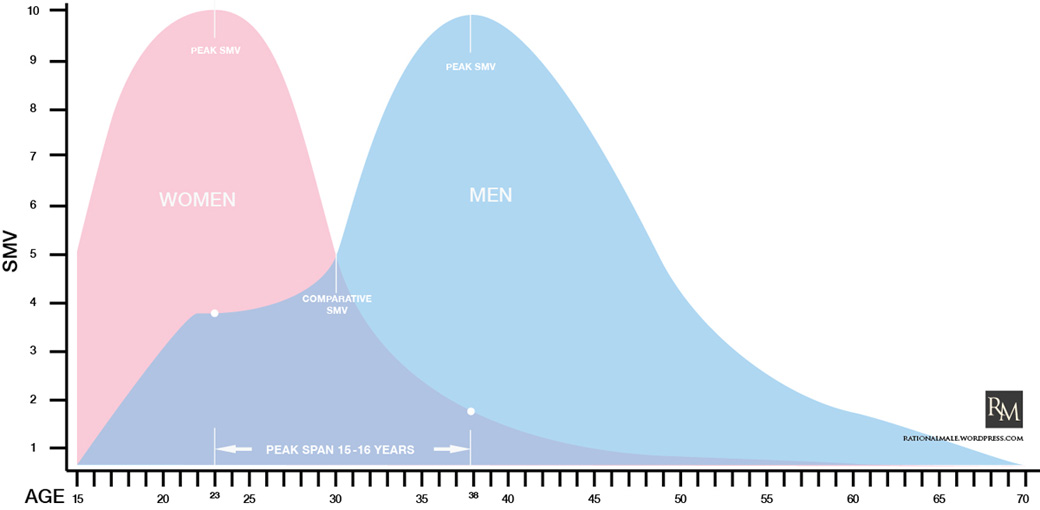
That said, if there is any merit to Half +7 it’s more about SMV imbalance and the Cardinal Rule of Relationships than any feminine social doctrine. So when you look at my SMV graph you can also see the age differential between the points where men’s SMV would generally be 1-2 points above a woman’s (35+) and where a woman’s SMV begins to decline (27+).

Repurposing The Convention

When the age ratios of the ½+7 formula are strategically favorable to the feminine sexual strategy, the response by the feminine is one of enthusiastic embracement. Once that ratio progresses to the point it becomes a sexually strategic liability, or even the source of anxiety, the response is one of scorn and shame for men. In light of this you might think the feminine response would be complete abandonment of the ½+7 canard, but as we see, reinventing the formula from a fem-centric perspective becomes not only a source false empowerment (i.e. the Cougar fallacy), but also the motivation for the Eat, Pray, Love schema Dalrock so ably details in his writing. Thus we have 68 year old women ‘amazed’ by their sunset years desirability, inflated courtesy of technology age buffers, and a built in social convention ready to help them abstract and rationalize away any vestige of guilt they may feel about indulging themselves with (comparatively) younger men.

Hypergamy doesn’t care what age a woman is.

I should add here that any social convention that is a sexually strategic benefit for a woman, which later becomes a strategic liability, will be retrofitted to a man’s shame and repurposed to her strategic benefit under her new circumstances. Another illustration of this is the shifting acceptability of inter-gender friendships with women. Prior to locking down a suitably optimal hypergamous monogamy with a man, women will enthusiastically embrace the idea of men and women being platonic ‘friends’. Once she’s monogamous this acceptability shifts to unacceptability in favor of a cautious, measured jealousy, and again reverts back to acceptability while unengaged with a monogamous prospect. Women having male orbiters, women involved in multiple ‘friendships’ with men, is sexually advantageous to her hypergamous assessment of prospective men – however once that assessment is settled upon, inter-gender friendships (for her man) becomes a strategic liability for her.

The Mother of (Re)Invention

invention

Blog status update: I apologize for the infrequency of my posts of late. I’ve been in the Netherlands and Belgium doing distillery stuff most of last week, but I’ve used my downtime to finish the final draft stages of the book which (I hope) should be on Amazon and other self-publishing venues about mid-March. I’ve never published anything before so it’s a learning process to be sure.

Reader Eric, again, made a revelatory observation in Soldiers:

I get the feminine imperative is what it is. I’m still coming to grips with it on a gut level, but I understand the concept. What I meant with ‘parasitic on masculine values’ was less about judging the nature of FI and more about the extent of its reach into our domain.

Robert highlighted the stark difference. Where I see the military as a repository of masculine values and culture that should be paired with the red pill, he sees a prime example of FI control of men.

The topic du jour at Dalrock’s blog this week is (yet again) the validity of the feminine imperative as a concept. What I find exceptionally ironic about the conveniently christianizing manosphere is this ceaseless droning from holier than thou white knights bemoaning how the feminine imperative is corrupting what the church traditionally should be, but are unable to look beyond how it affects what used to be their comfortable domain.

For all their kvetching they refuse to accept the feminine imperative as a concept. I realize the importance they put on having to reconcile a red pill reality with their faith, but they refuse to look beyond the narrow scope of the effect of the FI on their solitary religious institution. The Soldiers comment thread is an excellent example of another, and much broader, social institution, the military, the FI has both projected feminine primacy on, while ensuring that the beta chumps it depends on stay pliable, ignorant of, and useful to, the feminine imperative.

Reinvention

In Dal’s post Rebuilding the Mound he takes to task a commenter on his blog and deconstructs her reframing of his argument to better align with her feminine-primary interpretation of the feminine imperative. One of the prime successes of the feminine imperative is its ability to reinvent itself to jive with the present environment it finds itself in. The FI has a refined ability to evolve around not only changes in cultural shifts, but also around the the resulting failures it was responsible for.

There are many illustrations of the self-correcting, revisionism of the feminine imperative. Post-Wall spinsters re-imagine the desperation they often find themselves in by making men the culprit of their condition; never is the feminine imperative considered to be the cause. Sexual fluidity is another revisioning that absolves the FI from being the source of a woman’s condition:

The advent of embracing sexual fluidity in women is an attempt by feminized culture to put a bandaid on a lingering problem. As western feminized culture progresses onward from the late 60s, more and more women are awakening to the disillusionment that the choice they made to participate as an ‘equal’ in a masculine world required sacrifices of her femininity. Sacrifices that most come to regret later in life. Between 35 and 45 women are increasingly feeling the repercussions of their attempts to ‘have it all’ or have HAD it all, yet are left wondering why they’re not satisfied in sublimating their expectations – betraying their uniquely female biomechanics – to play the role of the New Woman.

That consensus is growing, even in Oprah-world, so what to do? What feminism has always done, move the goalposts and redefine the game. Men, for any variety of shameful reasonings, are cast as incapable of living up to the standards of being powerful, accomplished, and appealing, but even if you regret having married one, and possibly brought children into the world, you can still have a second chance at ‘having it all’ thanks to sexual fluidity. It’s not him, it’s the undiscovered homosexual you that’s been repressed all this time. Never mind that those infantile men are too preoccupied with youthful sexuality to appreciate your post-wall physique, there’s a world of lesbian women out there ready to deliver on the promise of powerful, accomplished, and appealing masculinity that your man is incapable of. It’s not that neo-feminism was wrong in promising you a satisfying life, it’s just that you were really a lesbian all this time and either didn’t know it, or were a victim of the Patriarchy and were repressed from it.

This is an excellent example of the FI’s unique capacity to morph itself to accommodate changes in culture, even when it was responsible for the negative outcomes. Another example is in Diane Mapes retrofitting her Choreplay message to align with the negative outcomes of a feminine imperative social push that it created for itself only five years earlier:

I can’t end this article without drawing attention to what I’m sure most of my readers are getting about the 5 year shift in attitude with regards to these articles. It’s easy to pass these off as some flighty progression in feminine self-understanding, but remember Diane Mapes draws a paycheck for writing these articles in well read media sources. She’s a media arm of the feminine imperative.

What we’re graphically witnessing is the fluidity with which the feminine imperative can realign itself socially to better effect its propagation. You see in 2008 the message to men (that resonated with women) was Fem-Up; stop being so insecure in your masculinity and do the dishes and laundry – the payoff will be more sexual access. In 2013 the message to men (again resonating with women) is Man-Up; stop being such a house frau and get out int the yard and mow – the payoff will be more sexual access.

In Choreplay the feminine imperative exercised a self-correction for a deleterious outcome of its own creation. Feminism, as a social impulse of the FI, is always a work in progress; it’s always a social experiment, but the Feminine Imperative being the socially correct default gradually evolves the failures of the feminist experiment into revised, intended successes.

People who can’t wrap their heads around the totality of the feminine imperative often conflate it with feminism. This is an easy mistake in light of the social upheaval that feminism has been responsible for since the sexual revolution. It’s easy to point to the glaring evidence that an acculturated feminization has worked into our collective consciousness, but I would argue that feminism is simply the latest, and most aggressive, social effort the feminine imperative has put forth in the last millenium. Feminism is the latest result of an ever reinventing, ever evolving feminine imperative.

If traditional femininity better served the feminine imperative (as it has in past generations) we would see a return to that social paradigm. As it stands in our contemporary conditions, a hybrid social utility of traditional femininity and aggressive feminism are now interchangeable to serve the FI. If gentille charms and a pandering to masculine courtesies serve best, that will be the expectation; if conditioned feminist social doctrines work better, that is what will be employed.

Further reading: The Feminine Reality and Fem-Centrism.

Choreplay

Gardening

One of the more entertaining debates I’ve had in my post-red pill awareness has been discussing the issue of men doing more “chores around the house” so as to more equitably distribute domestic duties amongst couples. The operative beneath this canard is that a more idealized state of gender neutralized bliss can be attained in a couple if only the male partner would feel it incumbent upon himself to assume chores that the female partner feels she’s entirely overburdened with.

Hmmm,..this presents a quandary for the Feminine Imperative; how would a Strong Independent Woman® motivate her live-in lover (sometimes known as ‘husbands’) to pick up the domestic job slack? Why of course, resort to the strategy that worked so well in convincing him to monogamous commitment – bait him with the obligation promise of unrestricted less restricted sex! It’s so simple in its form, so elegant in its function,..enter Diane Mapes’ Choreplay.

Gals make passes at guys who wash glasses.

I had a party not too long ago where a funny thing happened. One of the guests — a 30-something, single straight guy — came out to the kitchen and volunteered to do my dishes. “That way you won’t be stuck with a huge mess after everyone leaves,” he said, filling the sink with hot, soapy water.

As he started scrubbing wine glasses, I glanced over at my guests. Every woman in the room was staring at him with what can only be described as pure, unadulterated lust.

Behold the appeal of the dishy man.

Yes, that’s right gentlemen, Roissy had it all wrong, in girl-world washing the dishes is the undiscovered catalyst for ‘gina tingles. Athol Kay and his MAP? Get the fuck outta here, it’s vacuuming and dusting that inspire “what can only be described as pure, unadulterated lust.”

Side Note: Have a look at the date this article was published (2/13/2008, just before Valentines day) it’ll be important when we get to today’s bonus round.

Are there any benefits, aside from soulful glances and the satisfaction of a sparkling clean floor, that exist for men who share the load (laundry and otherwise)?

That’s hard to say, although there are some interesting indicators. A recent survey by Parenting Magazine found that “choreplay,” i.e., husbands pitching in around the house, was what put 15 percent of moms in the mood.

Ooh, a whole 15%?! Would this mean the other 85% were turned off?

You know, I’ve been married for over 16 years now and in that time, on occasion, I’ve performed many domestic duties for no other reason than it was a necessity. I have changed my daughter’s diaper, I have cleaned toilets, I’ve done laundry, I’ve vacuumed, etc. However, in 16 years never have I had my wife be consumed with an uncontrollable lust to give me a spontaneous blow job or pin me down on the kitchen floor, tear my pants off and ride me to glory after my having put away the dishes. Neither have I ever heard the words, “damn, you looked so hot ironing my blouse yesterday, fuck me you stud, fuuuuhhck MEEE!!” proceed from her lips while in the throes of passion.

And in the interest of being fair, I’ve never been turned on, nor do I consider it foreplay with my wife, when she’s the one doing the chores. I have been greatly turned on by the sight of her in lingerie; sweat pants, a t-shirt and a toilet bowl brush in hand? Not so much.

However some of the most memorable sexual experiences I’ve had with her (and other women in my sexual past) have come after I’ve done something particularly masculine or I performed well doing something that benefitted me with a lot of social proof. For instance, my wife seems to like sex after I’ve had a good heavy lifting day at the gym. She also seems very amorous after social engagements I bring her along to for my work.

So the moral of this story is, as always, base your assessments on a woman’s behavior – NEVER on her words. Any woman telling you you look hot in an apron or she loves how you pee sitting down is selling you something. It’s up to you to determine what she’s selling.

Ah, but what is she selling?

Research conducted by Laurie A. Rudman, a psychologist at Rutgers University, also seems to point to a hot soapy love connection. Her study, recently published in the journal Sex Roles, looked at feminism’s impact on romantic relationships. Among other things, she found that men with feminist partners reported both more stable relationships and greater sexual satisfaction.

“We didn’t ask who was doing the dishes or taking care of the kids,” says Rudman. “We asked broadly about the quality of the relationship and about the agreement of gender roles in the relationship. But we did find that if men were with a feminist woman, they had more sexual satisfaction and their relationship was more stable. Men benefit from having a feminist partner.”

Oh ho ho, that’s it! Feminist women get hot seeing their men in an apron, and boy dothey ever benefit. So you see guys, you’re going about this all wrong; you benefit from locking down a feminist woman and embracing the gender neutral sexiness of traditionally feminine household chores.

Back to the Future!

Ah, 2008 what heady time it was, but unfortunately I need to step back into my phone booth DeLorean time machine and fast-forward to January 30th, 2013 where, not to be outdone by her 2008 assertions of Choreplay, the exact same media has a new take on intergender chore assignments. Take it away 2013 feminine imperative Diane Mapes:

Hey, fellas, put down those vacuum cleaners and pull out the lawn mowers.

Married men may think helping around the house may up their hotness quotient in the bedroom, but what really matters is the type of chore. Heterosexual married men who spend their time doing yard work, paying bills and changing the oil have more sex than husbands who spend their time cooking, cleaning and shopping, according to a new study on the subject of housework and sex.

“Households with a more traditional gender division of labor report higher sexual frequency than households with less traditional gender divisions of labor,” says Sabino Kornrich, lead author of a study that appears in the February issue of the American Sociological Review. “Housework is something that people use as a very important way to express gender, masculinity and femininity. We weren’t surprised to think that sex might be more tied to this type of gender expression.”

So, let me get this straight, the yard work, manual labor, auto maintenance, home remodeling and pressure washing hotness that I replaced with soapy dish washing, ironing boards and laundry detergent was actually what inspired “what can only be described as pure, unadulterated lust?” Whoda thunk?

You mean to tell me all that shit I ate in 2008 about being a neanderthal 50’s throwback for expressing that Men’s work is what women really find sexy was all just horse shit slung from the feminine imperative?

I realize I’m goofing on this, but I remember reading Mapes’ first article in 2008 and started thinking about why a man doing “woman’s work” would be in any way sexy or at all arousing for a woman. As usual it’s always a good start to reverse gender roles in order to get a better understanding of any social contrivance or perceived “double standard”. The equalist mindset can never logically stand up against this reversal.

Would a guy get sexually excited to see a woman doing traditionally masculine housework? In 16 years of marriage I’ve never had my wife do, much less offer to do, things around the house (on a regular basis) that I assumed as a husband from day one. I get the dirty jobs. I mow the lawn, clean up the dog shit in the back yard, I have trash duty, clean the pool/spa, install the nice new acrylic sinks and marble countertops she picks out, plunge the toilets when they back up, install the garbage disposal, fix what I can on her car, wash the cars,…you get the idea. And of all those (with the exception of maybe seeing her wash my car in a thong bikini) I can’t say as I’d get turned on by seeing my wife do any of that. So what is the intrinsic appeal of seeing a guy doing the dishes Mr. & Mrs. Gender Equalist?

The role reversal of putting a man into a traditionally feminine role doesn’t have real arousal value. It has a power value for sure, in that it temporarily casts a man in a submissive role, but after the novelty of having a guy perform those behaviors repeatedly wears off, does it still have that arousal value? My wife doesn’t wear lingerie for me every night, but she does so often enough that the arousal value of it still turns me on. However doing the dishes is something so mundane and so monotonous that any thrill that might be associated with it wears thin in a month.

The Mapes Effect

I can’t end this article without drawing attention to what I’m sure most of my readers are getting about the 5 year shift in attitude with regards to these articles. It’s easy to pass these off as some flighty progression in feminine self-understanding, but remember Diane Mapes draws a paycheck for writing these articles in well read media sources. She’s a media arm of the feminine imperative.

What we’re graphically witnessing is the fluidity with which the feminine imperative can realign itself socially to better affect its propagation. You see in 2008 the message to men (that resonated with women) was Fem-Up; stop being so insecure in your masculinity and do the dishes and laundry – the payoff will be more sexual access. In 2013 the message to men (again resonating with women) is Man-Up; stop being such a house frau and get out int the yard and mow – the payoff will be more sexual access.

Don’t be fooled into thinking that this is just another example of women’s fickle duplicity. A lot has happened socially in the five years between these articles; the End of Men, Kate Bolick, feminine triumphalism, men “checking out”, kidults, ‘late term’ spinsters unable to find “acceptable” men, etc. and a whole slew of other gender shifts occurred between both these articles. What Mapes’ most recent article represents is the feminine imperative reworking an outdated feminine social convention to accommodate women’s Man-Up needs in 2013 that it actively extinguished itself in the Fem-Up years leading up to 2008.

The New Thin

new_thin

My Reddit Q&A on Monday generated a lot of good questions:

Ever notice on Facebook, when ever an average/fugly/fat chick post’s her picture you have like ten women (only women) chime in with their comments under the picture saying stuff like “HOT!” “you’re so pretty!” “damn you look good” when in fact she isn’t?!

Are women trying to make their not so attractive friend feel better about herself?! Or is there another scheme involved here of setting the bar low in order to boast their own attractive scale up.

I see, hear and read this constantly. What we’re observing however is a carefully constructed feminine social convention, and a feminine-combative one at that. By tacitly reinforcing the “good looks” of an obviously overweight woman with positive compliments, the latent message is that she doesn’t need to improve her looks to attract men. The truth of course is that she could be semi-fuckable after dropping another 15 pounds, but in telling her she’s hot ‘as-is’ the idea, in the form of an encouraging compliment, is to get her to relax and stay fat. Thus the complimenter(s) simultaneously feel relaxed in their fat.

It’s really a socialization attempt by less physically appealing women to regulate the sexual market in favor of themselves.

I can remember experiencing this firsthand long before the advent of social media. In the days I worked in the resort casino industry, I was in the lunchroom with the largely (heh) female advertising department and the conversation came up about how some woman in accounting was “too thin” or she need to gain some weight. I emphatically disagreed; I knew the woman they were going on about and she could’ve lost 10 pounds and still been overweight. The ladies lost their shit when I said she could stand to lose a few pounds and hit the gym more often. The hens practically pounded the table with their fists and the accusations of misogyny, and the old chestnuts about men’s “shallow” desires for the physical all flew wild and furious.

You see all the women at the table were as heavy if not heavier than the woman in question. I had insulted the herd by association.

The funny thing about body image is that most people tend to judge obesity based on their own physique. If you’re overweight and your regular peer group is fatter than you, you tend to think you’re “normal”. It’s similar to eating a donut from a box someone’s brought to work for all to enjoy. If one person is eating a donut it tacitly gives others “permission” to enjoy one too.

I was once at a distillery in Panama with a group of Dutch people I work with and a stunningly attractive Panamanian secretary asked me if I was Dutch. I told her, no, I was American and she said “oh, you don’t ‘look’ American. I laughed at this for a minute and asked her what an American ‘looks’ like and she said, “well, they’re all fat.” I took it as a compliment, but I had to agree with her.

Books and Covers

You can’t judge a book by it’s cover, but more often than not, it’s a good indicator of what the story’s about. An attractive cover should make the reader want to read it.

Women have far more rigid prerequisites for what makes an acceptable man for an LTR than men do for women. Women base their estimate of a man on his confidence, status, affluence, looks, humor, intellect, creativity, ambition, determination, decisiveness,..and the list goes on. Men’s requisites for intimacy? Looks and sexual availability, that’s it. Beyond that, you can make a case for any ephemeral quality that convinces you the girl’s worth your long term investment, but if she’s not hot enough to keep your physical interest, you’re going to look elsewhere to make up for it.

Yet what is the single most common shaming tactic women use for men? Painting them as ‘shallow‘ for requiring her to maintain a good shape and be sexually available. Men have far too much on the line in the long term NOT to be concerned with demanding the highest standard from a woman for an investment that goes beyond anything she could hope to genuinely appreciate or match by other means. For all of the personal investment a man must make in himself to meet women’s ‘attraction prerequisites’, it only makes pragmatic sense that his (physical) standards for women be strict and exact.

It’s really up to you to make the judgement call, but by no means should you allow accusations of superficiality influence your decision in that. As a Man, you are well within your rights to expect a maintained physique from a woman, considering the far greater sacrifices she expects from you. Would you leave her if she got fat? Damn right you would. Would she leave you if you went beta-listless-unemployed-alcoholic? Damn right she would.

All that said, what it really comes down to is the reason why this girl lost the weight. There are plenty of fresh divorcees frenetically working out at Planet Fitness in the hopes of reconditioning themselves enough to attract another husband – only to fatten up again once she finds the guy who “loves her for who she is”. Women who once were fat, who slim down are prone to this. That’s not to say there aren’t women who make a definitive lifestyle change and go from being a walrus to a Fitness America Pageant contestant and parley that into modeling or  personal training career, but these are the most rare and notable exceptions.

I should also point out that it’s a uniquely White Knight habit to publicly defend a woman’s body image insecurities in order to get the identification / affirmation strokes they believe endears them to women. I hear these guys parrot back the same lines women self-affirm when talking about their body shape or trying to disqualify a sexual competitor, in an effort to be more ‘like’ the women they hope to get with. The idea is that they believe they’ll be rewarded for taking the “fat acceptance, love-who-you-are” tact and be perceived as more modern or up with the right conventions, and that guy’s who actually have the temerity to say they prefer a tight body are the neanderthals – again, to disqualify their own sexual competitors.

The Mechanics of Sexual Selection

Whenever the ‘fat is OK’ debate pops up all it does is serve to further illustrate yet another feminine social convention. All of these conventions are sociological and psychological methodologies with the latent purpose of securing breeding opportunities for less than physically optimal women.

  • Point 1: Women know on an instinctual, biological level that, overall, men generally base their breeding selection on the physical conditions of a female. Hips to waist ratio, breast size, facial symmetry, fullness of lips, youthful appearance, etc.

  • Point 2: In order to compete with similar women in meeting the physical standards of a given demographic of men, women must create physical methods in order to compensate for this deficit. Thus they have make up, cosmetic surgery, high-heels, hair dye, etc.

  • Point 3: Failing this, sociological and psychological constructs are necessary to ‘level the playing field’ in the sexual marketplace. Thus, fat, out of shape women attempt to convince men to feel ashamed for wanting a physically superior female by converting that desire into shame. It becomes superficiality. Likewise, older women who’s sexual marketability wanes with every passing year, must create social constructs that praises the sexual prowess of older women.

Women have been trying to convince themselves for centuries that there ought to be more to sexual attraction for men than physical appeal, and for centuries this method has been thwarted by simple male biology. Rather than play the game better, they attempt to change the rules of the game to better fit their own limitations in a variety of ways.

The problem with the idea that “it’s what’s inside that counts” is that it’s what’s outside that arouses. All the “feeling good about your body” that a fat woman can muster is NEVER going to be an aphrodisiac or a substitute for having a great body that men are aroused by.

Nice Like Me

NGOKC

Lib Arts Major:

“Generation AFC” has done a great job of producing Brevik, Cho, Laughner, Sodini, Holmes, and now recently Lanza among scores of others who never got a bodycount high enough to make the news.

Here’s to a new generation of defects.

Or should I say products working as intended?

Furious Ferret:

This is just standard way of tearing down beta males. Most of the guys that are nice are geniuely nice guys but being guys they still want to fuck. They were taught by women that being nice and respectful lead to being attractive so they were brought up to behave this way. It’s no uniqueness or virtue for a woman to call ‘nice guys’ as really horrible digusting perverts while rewarding the bad boy.

Mumtaz elaborates in response to a female commenter:

‘ From my own personal experiences, I’ve found that being nice does not equate to attraction from men. ‘
Actually, it’s being nice man that doesn’t equate to attraction from women. Nice woman means sweet and pleasant , that is attractive.

‘ Nice is boring. ‘
That’s exactly what women think.

‘ And the average person appears to NEED drama or kaybe just more vivacity. ‘
No , it’s average WOMAN who seeks drama . For a man , coming home after day of hard work , drama is the LAST thing he wants…

‘ It seems that a lot of men look to women for something akin to entertainment ‘
Again, swap sexes and it rings true.
Also notice anecdotal evidence…

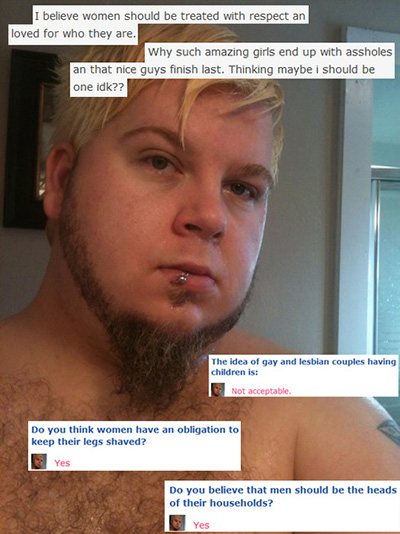
When I wrote Play Nice I elaborated upon the recent fem-centric trend of ridiculing self-professed Nice Guys. The notion of Nice Guys only using the monicker as a ruse for an assholish reality has been a staple response for Alpha-burned women for decades now. However, an interesting threshold is being crossed when a globalized internet society begins a campaign of mass ridicule of Nice Guys.

Nice Guys of OK Cupid is one such effort.

While I’ve come to expect women’s rationalizations about Nice Guys as foils for their attention needs, what NGOKC illustrates is an escalation in beta male in-fighting. Some have called this ridicule cyber-bullying on a global scale, but there’s more to this than that. The progression from rebuking forum white knight to online attack blogger is evidence of a new comfort level the femosphere has in sowing discord amongst the beta orbiters they rely on for fem-centric male affirmation.

NGOKC is really a clever new twist on Dalrock’s proposition of “lets you and him fight.” In viscerally exposing OKC Nice Guy profile pictures and pairing them up with subjectively contradicting statements about being ‘nice guys’, NGOKC is (perhaps unwittingly) attempting to define what makes a guy genuinely “nice” based on the terms that indicate feminine supremacy.

If you peruse the sampling of ‘nice guy’ case subjects on the blog you’ll begin to see a pattern form. A, most likely out of context, declaration of ‘Nice Guy-ness’ paired with some horribly incongruent statement about expectations of women’s legs being shaved or men being the head of the household. The social experiment that NGOKC is involved in starts with its efforts in qualifying ‘Nice’ as being compliant with what best serves the feminine imperative. Do you like the feel of a woman’s smooth legs that she painstakingly shaves 7 times a week? You’re not a Nice Guy. Do you believe that men should be confident, decisive, heads of the household? You’re not a Nice Guy either. In fact if you indicate on your profile any belief that is inconsistent with absolute, equalitarian gender neutrality, you’re not a nice guy.

For all the semantics debates the manosphere gets into over the proper usage of “Nice” for men, the binary nature of the femosphere is definitive; if a belief is contradictory to the feminine imperative, it is decidedly “not nice”.

Beta Fights

Being that beta men constitute the vast majority of men in modern society, one of the larger problems of being an abject beta is the sheer volume of sexual competition they experience from other betas. When a beta chumps is AMOG’d by an Alpha there’s an almost tacit understanding by the beta that the Alpha held an advantage over him. The Alpha had the physical, Game and status tools the beta does not. However, put two (or more) betas in contention with each other and they will resort to ever escalating feats of greater beta qualification amongst each other. When all you know is Beta Game, only more intense applications of that game is the natural response to competition within Beta Game.

NGOKC is one such escalation in the Beta Game arms race. From Enter White Knight:

Every random chump within earshot of your conversation about Game, about your ‘changed’ way of seeing inter-gender relations, about your most objective critical observations of how women ‘are’, etc. – understand, that chump waits everyday for an opportunity to “correct” you in as public a way as he’s able to muster. That AFC who’s been fed on a steady diet of noble intent, with ambitions of endearing a woman’s intimacy through his unique form of chivalry; that guy, he’s aching for an opportunity to prove his quality by publicly redressing a “villain” like you for your chauvinism.

By essentially doxxing the Nice Guys on OKC, NGOKC is a blog dedicated to beta white knights attempting AMOG other betas while the women of the femosphere egg them on. The social impetus behind the blog is one of beta men jockeying for feminine approval by ever increasing declarations of being more suitable, more feminine identifying betas, than the so-called fraudulent Nice Guys they hope to expose. They’ve made a game of qualifying for the approval of the femosphere by looking for chinks in their competitor’s beta armor:

“I’m a nice guy,..”

“Charlatan! You want to oppress women by expecting to be the head of the household! I’m the real nice guy,..”

“STFU rape apologist, says here you’re open to first date sex, and what type of guy has tats and piercings like that? Rapists, that’s who! I’m the real nice guy,..”

“Misogynist, looks like you expect women to shave their legs,…FOR YOU!,..only fucking patriarchs think women should make themselves ‘acceptable’ for men,..I’m the real nice guy,..”

The feminine influence naturally loves the beta dystopia between guys they’d never want to fuck otherwise because it primes their need for indignation while simultaneously satisfying a woman’s need for attention and affirmation of her own imperative.

Obligation

One of the things that solidified this beta in-fighting for me was reading Hugo Schwyzer’s Jezebel endorsement of NGOKC.

Hugo Schwyzer has a rightly earned reputation in the manosphere for being a manboobed captain amongst the vichy males feminization has made so common through its selective breeding efforts . The lengths to which he’s ego-invested his life, career and personality into a feminine identification schema is truly grandiose. Hugo’s gender self-loathing is a monument to the dictates of the feminine imperative – he is what feminized men would ultimately become in a society defined by the feminine imperative.

While I have patience for the likes of Manboobz and even the information deficient members of the PUA Hate forums, Hugo is a step beyond their simple mockery.

What’s on offer isn’t just an opportunity to snort derisively at the socially awkward; it’s a chance to talk about the very real problem of male sexual entitlement. The great unifying theme of the curated profiles is indignation. These are young men who were told that if they were nice, then, as Laurie Penny puts it, they feel that women “must be obliged to have sex with them.” The subtext of virtually all of their profiles, the mournful and the bilious alike, is that these young men feel cheated. Raised to believe in a perverse social/sexual contract that promised access to women’s bodies in exchange for rote expressions of kindness, these boys have at least begun to learn that there is no Magic Sex Fairy. And while they’re still hopeful enough to put up a dating profile in the first place, the Nice Guys sabotage their chances of ever getting laid with their inability to conceal their own aggrieved self-righteousness.

Nice Guys of OkCupid provides an excellent opportunity to reiterate a basic truth: there is no right to have sex.

This represents the basic disconnect that a feminine conditioned male like Schwyzer can’t grasp. He’s very concerned that self-avowed Nice Guys harbor this endemic, deep expectation of obligatory sex in lieu of ‘being nice’, yet remains willfully ignorant of the nature of exchange inherent in the sexual marketplace. Of the hundreds of self-professed nice guys I’ve known or counseled, not one of them expressed an expectation of reciprocal sex. In fact the genuine ‘nice guys’ are so self-sacrificing that the idea of a social contract of reciprocal sex is alien to them.

The new popularity of Nice Guy demonization that Hugo and the predictable, gender trend vultures piling on at The Atlantic isn’t about expectations or entitlements it’s about the underlying and unspoken reciprocal nature of the sexual marketplace being exposed. When a ‘nice guy’ does express some angst over his sexless and solitary life, or does bring his Savior Schema to the surface in a public fashion it becomes an ugly reminder for the feminine that the SMP is actually that, a marketplace. A fem-centric society doesn’t like the idea of a visceral resource exchange, because it ruins its humanist/equalist social pretense. Solution? Ridicule and marginalize the one doing the exposing.

Besides the near-universal sense that they’ve been unjustly defrauded, the great commonality among these Nice Guys is their contempt for women’s non-sexual friendship. They rage about being “friendzoned,” and complain about the hours spent listening to women without being given so much as a hand job in return for their investment.

Because Hugo has been so well conditioned by his feminization he lacks any frame of reference to understand the reflexive rage these “false-flag nice guys” experience. This rage response isn’t the disappointment of some societal masculine influence convincing these guys of a sex-debt obligation, it was the entirely feminized influence which convince them of myth of Relational Equity:

…I’ve repeatedly read men relate to me when they say how unbelievable their breakups were. As if all of the investment, emotional, physical, financial, familial, etc. would be rationally appreciated as a buffer against hypergamy. The reason for their shock and disbelief is that their mental state originates in the assumption that women are perfectly rational agents and should take all of their efforts, all of their personal strengths, all of the involvement in their women’s lives into account before trading up to a better prospective male. There is a prevailing belief that all of their merits, if sufficient, should be proof against her hypergamous considerations.

For men, this is a logically sound idea. All of that investment adds up to their concept of relationship equity. So it’s particularly jarring for men to consider that all of that equity becomes effectively worthless to a woman presented with a sufficiently better prospect as per the dictates of her hypergamy.

Hugo’s preoccupation with the sex-debt obligations for being ‘nice’ is a convenience for his inability to address the concept of relational equity. In a sense he’s correct, men should never presume that anything they do, any personal sacrifice, any emotional investment they make for a woman will EVER be appreciated, much less reciprocated, because hypergamy doesn’t care about any of it.

If these ‘nice guys’ are guilty of anything, it’s in their ego-investment in the lie that any woman might have the capacity to appreciate his investments in them. That rage isn’t about the disappointment of not getting an expected lay, it’s the self-rage associated with the disillusionment of a belief in a relational equity that women (often times the same women they want to become intimate with) continue to convince them of. It’s a rage that comes from the loss of investment and being ridiculed for ever having invested by the same women who convinced them to invest.

So thank you Hugo, you’ve unwittingly made the manosphere, Game and red pill wisdom all the more attractive for ‘nice guys’ with your exposé. The obvious moral to this story is to drop the pretense of being a ‘nice guy’ and embrace a self-concerned Game perspective. In other words, unplug. Drop any expectations of a mutual respect, shared purpose or infantile visions of an idealistic love – because you have no ‘right’ to something women fundamentally lack the capacity to reciprocate. Your idealized relationship doesn’t exist in a feminine frame, it only exists in a positive masculine frame of your making. The only thing ‘nice guys’ have to lament is not embracing these truths before they posted their profile pic on OK Cupid.