Sex, Lies and Statistics.

iamaten

Ok I’ll admit it, I had originally intended to go a bit off brand and write a take down piece about Aunt Giggles’ ludicrous post last week about how my infamous SMV graph wasn’t statistically viable, but the ABC 20/20 hit piece that never aired on Friday had the lion’s share of my attentions. To call that post flimsy would be an understatement, but when her site traffic starts heading south consistently enough she always resorts to taunting the manosphere to increase views and comments she’ll only delete. It must be a lot tougher a gig for her now that the HuffPo owns Hooking Up Betas and she’s expected to drive site traffic for revenue regularly. Gone are the days of the 1,000+ HUS comment threads when you’re only interested in hearing your own voice.

The abject stupidity of Susie quoting a single, unverifiable “PhD in statistics” comment on Dalrock’s site (from April of 2011 no less) to build a post refuting sexual market evaluation should be enough to tell the story about HUS’s commercial rebranding; not to mention Giggles’ desperation for viewership in an already saturated demographic. In other words, when your rebrand is essentially 17 Magazine for the 55+ female demo, you’ve got your work cut out for you. Advice for you Suz; go back to pretending to be red pill — there’s a hundred other bloggers on Jezebel, and a hundred HuffPo ‘psychologists’ who’ve been doing your schtick longer and better than you.

Print

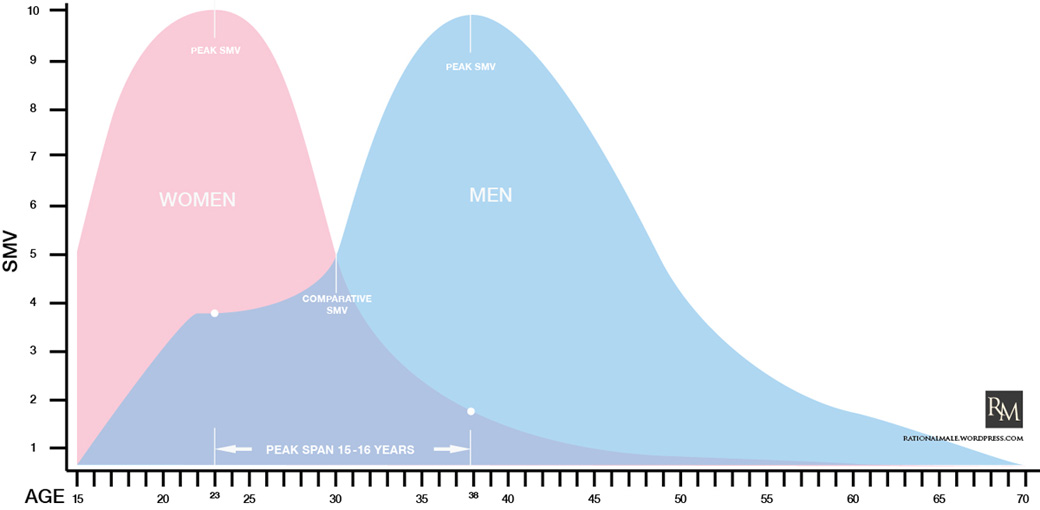
All that said, I can’t help but recognize the nerve that my SMV chart has struck throughout the internet. I’m not just talking about the manosphere proper here; from recognized psychology sites (generally for comparison) to BodyBuilding.com, this chart is easily the most linked-to picture from Rational Male. Whether it’s about refuting its accuracy or comparing how my instinctual understanding of SMP valuations gel with more scientific studies, that graph has become a benchmark, or at least the starting point, for a better understanding of comparative SMV over the course of a subjective lifetime.

A lot of that original post’s intent gets misconstrued, usually as the result of bruised egos still invested in blue pill social conditioning, but also women who are understandably threatened by the prospect of having their long-term sexual strategy chronologically laid bare for men to prepare themselves for. I’ve restated this repeatedly, but this graph was never the result of some scientific analysis, rather it was the result of observation and correlation. And I daresay (even to my surprise) that my graph lines up scarily close to most ‘statistical’ studies.

Nonetheless, Aunt Sue’s plea for site traffic prostitution made me aware that I should address some of the most common criticisms of the Tomassi SMV graph. So lets start with ‘Doctor’ Kelly’s assertions:

Those graphs are wrong because, with a fixed number of people in the world, equal between the sexes, you have to scale the curves so that the area under each one is the same. E.g. the top valued man is not a “10,” ever. He’s some relatively lower value scaled by the fact that men’s sexual prime lasts longer. Why is this, for the non math geniuses out there? Because if there are 50 men who are 7.5′s, and there are only 30 women, then men’s actual score and actual value on the dating market is downgraded because he can’t just choose a 7.5 and take her. He is downgraded by competition in the market.

You can read Kelly’s entire comment at Dalrock’s, but her analysis is fundamentally flawed for the same reason the 3 year old OK Cupid graphs are flawed (or statistically limited). This flaw is the assumption is that SMV evaluation is in anyway relatable to whom a person is actually pairing off with in the short or long term. As I’ve stated many times before, “wants” got nothing to do with it. Desirability, and peak sexual market value (and capitalizing upon that peak) have nothing to do with monogamy – however this is exactly the context I would expect from solipsistic women relating any and every detail of the SMP to how it fits into a feminine narrative. Though it might be a tall order I’d love to see a study done of how women’s menstrual cycle influences their short term breeding with who they pair off with in long term monogamy.

This was from a couple of comments he made on the Curse of Potential:

…with regards to the SMV graph–are you saying a 40 year old guy is gonna have an easier time picking up a 22 year old girl (at her SMV peak) at a bar than, say, a 27 year old? I dunno if I’m reading it correctly, but it appears to show a man of 40 as having almost twice the SMV as a man of 27, which doesn’t sound right to me. Almost all the hot young chicks I know are with other, young (maybe couple years older) douchebags, not forty year olds (or even 38 or 35 year olds). I mean, unless you’re Leonardo DiCaprio or something…obviously there are exceptions, but–even outside my circle friends, when I go to the beach, the movies, bars, etc. I don’t see a lot of young girls with way older guys, as your graph would suggest. Advising us to wait till we’re in our late thirties to settle down, and promising we’ll land 22 year olds if we keep up our Game, seems like bad advice–not to mention, you’re giving a lot of single dudes in their 20s false hope–like, hey, can’t pick up a girl at 29? Just wait till you’re 40! They’re gonna be all over that. Girls definitely hit the wall harder, and sooner, than guys, but if men really peaked at the age you say, then–again–most, or at least a sizable minority, of the hottest, youngest chicks would be with them, and they’re not.

SaladDays misunderstands the premise of men’s potential here. One of the most common criticisms I get, especially from disgruntled women, is Salad’s observation; “as a mid-20’s girl, there’s no way I’d ever be attracted to some older guy.” Once again, pairing and mutual attraction has nothing to do with SMV, and especially so when a woman is experiencing her peak sexual market value. The feminized-thinking presumption here is that like should attract like. The 22 year old SMV peaked hottie should be attracted to and interested in settling down with the 37 year old, in-shape, potential maximized, Game-aware man.

SaladDays continues:

If SMV is indicative of one’s ability to attract the most desirable members of the opposite sex, then presumably those in the upper echelons of SMV would want to pair with other, equally sexy mates–and, according to the graph, we infer that the hottest 23-year old girls will generally hook up with 38-year old men.

And, as much as I would like that to be true, 27 years of experience tells me otherwise. Girls that age don’t tend to date men that old (there are exceptions– they have father issues, or the guy is really wealthy & some girls dig that, though they’re certainly not my type).

I believe it was Aristotle who said the best years to marry were 18 for women and 38 for men. In a vacuum, this might be an idealized situation, but the mistake is comparing female peak SMV with male peak SMV. A woman of 22-23 has nothing like the benefit of life experience a potential-optimized man of 38 will have. The comparison shouldn’t be made between peaks, but rather within the peak SMV span between the sexes. Even Aunt Giggles concedes that when polled, most women will say they want to marry between 27 and 30 years of age. Conveniently this is exactly the point at which men’s SMV is (should be) on its ascendancy and women’s SMV drops to an equitable level.

What’s ironic is that for all the handwringing about how a female 23 year olds should or shouldn’t be attracted to older men, no one has anything to say about 28 year old women being attracted to or wanting to settle down with men of 36-38 years old. They titter and giggle about the Half Plus Seven rule while it’s advantageous to their sexual strategy in their phase of life, but only insofar as it benefits women’s sexual pluralism:

When the age ratios of the ½+7 formula are strategically favorable to the feminine sexual strategy, the response by the feminine is one of enthusiastic embracement. Once that ratio progresses to the point it becomes a sexually strategic liability, or even the source of anxiety, the response is one of scorn and shame for men.

When a 28 year old woman declares she’d like to marry an older man, her intellectual and financial status equal, we applaud her for her prudence, but when a 38 year old man declares he’d like to marry even a 27 year old woman to have children with he’s accused of ‘trophy-bride’ hunting and is scared of the Strong Independent Woman® of his own age.

The point is that SMV, in as rough a form as I illustrate with the graph, is that monogamy or even desire has little to do with actualized SMV. Hot, 22 year old coeds with big boobs will always sell more beer than comparably hot 32 or 42 year old women. What gets lost in the translation is that SMV for each sex is determined by the opposite sex, not what that sex would like it to be for themselves. An SMV peaked 22 year old has so much opportunity to capitalize on that peak it becomes distraction. She’s not (as) interested in monogamy with a 37 year old SMV peaked Man, because she has very little motivation to pair off with anyone during this phase of life, much less having the life experience to know a great long term catch when she sees one.

However, when a woman is properly motivated by a more pronounced need for long-term provisioning (be it emotional, financial, etc.) and begins to acknowledge her decaying SMV and lessened capacity to compete in the SMP (i.e. the impending Wall) we conveniently see 27-30 year old women preferring and pairing with men who are, or are just, experiencing their SMV beginning to appreciate. This is a pretty remedial lesson when you consider women of this age’s popular frustration in finding and pairing off with men they deem “their equal”. This is really just a euphemism for ‘man who can provide long term security’, but I’m focusing on the mechanics of the SMP here.

While it might be a popular concept to think of cougars as women looking for idealized, younger, lovers, the reality is one of women seeking men of equitable maturity, and certainly the same, or preferably more, means and status than herself to support her idealized lifestyle. At 27 and older women are motivated to seek the Man who’s realized his potential most fully, while men of 37 who’ve become Game-aware and have in some way capitalized on their slower burning SMV are still attracted to the youth and physicality that they were in their 20’s. The question isn’t about who’s SMV is making them more acceptable for pair-bonding, it’s about which sex’s motivation takes priority when their SMV is peaked and the phase of life the other sex finds themselves in.


Appeals to Reason

thinker

“A woman in love can’t be reasonable, otherwise she wouldn’t be in love”
— Mae West

Last week The Chateau posted an article about a Beta male asking girls for reasons why they rejected him. In the typical deductive logic that most Betas are prone to use, he runs down a checklist of questions regarding what he thinks killed his chances with the girls he thought he could get with. He petitions four women with questions about themselves, which, being women, all are more than eager to answer.

Do you usually figure out if you wanna do more than make out with someone pretty instantly? Or, is it a slow burn?

Was there anything I did wrong that turned you off?

If you had advice for any guy looking to meet a girl, what would it be?

What makes someone attractive to you? Do you have any types?

Do you feel that you could never date someone shorter than you?

Am I an unattractive person to you?

These are some of the more common questions John Brown puts to the girls, and true to form the girls answer with the standard feminine boilerplate responses that absolve themselves of their part in his rejection, while trying not to hurt the feelings of a guy they knew would never see them naked. With the exception of maybe Vanessa, it’s pretty clear that John’s punching well above his blue-pill weight with these girls even though I’d only rate Victoria as the only HB8 in the bunch.

The questioning is what I’ve come to expect from most chumps mired in their blue pill bubble of applying logic to their sexlessness, but it’s not John’s overt grilling of these women that’s keeping him trapped in the Matrix – it’s his buildups and followups to those questions. John isn’t just interviewing them to ‘get to the bottom of things’ so he can solve his sex problem, he’s leading these women with ‘if then’ logic in an effort to convince them that, by their own words, they should be attracted to him.

John is make the most fundamental error every plugged in chump makes — he’s appealing to women’s reason.

Why Women Can’t ‘Just Get It

Appealing to women’s logic and relying on deductive reasoning to sort it out is the calling card of a Beta mind. There is nothing more anti-seductive for women than appealing to her reason. Arousal, attraction, sexual tension, subcommunication of desire, all happen indirectly and below the social surface for women. It’s not that women are incapable of reasoning (hypergamy is one logical bitch) or are crippled by their emotion-based hindbrains, it’s that if you’re asking her how to be more attractive you don’t Get It. It’s in the doing, not the asking.

If you read through the responses these women give John from a red pill perspective, you’ll see a pattern emerge. On an intrinsic, subliminal level,  women understand that their genuine desire, their genuine arousal and attraction, has to be an organic process. When a guy like John makes attempts to convince a woman that by her own reasoning (and led by his) she should be with him intimately, it offends and then cancels that process for her.

For women, one of the qualities of the Alpha her Hypergamy demands is a guy who Just Gets It. An Alpha would intrinsically know what women’s arousal and attraction cues are without being told and without even the inclination to ask about them. John’s issue of overtly confirming for himself ‘what women want’ is really an abdication of a Beta who doesn’t get it. And true to form, John’s, and Betas like him, next logical resort is to rationally convince a woman (preferably using her own words) to be attracted to him by attempting to re-impress her of his status.

Betas like this generally end up as the infamous emotional tampon, or the Surrogate Boyfriend to a woman who’s banging the most Alpha Man her looks can attract. However, this appeal-to-reason rationale filters into other aspects of men’s lives. The logical progression for John would be to better identify with the women (really the feminine imperative) he hopes to bang in the future – embody the feminine prerequisites, get the intimate approval. For married or monogamous men this appeal-to-reason may come as a mistaken belief that doing more chores around the house will lead to more (or any) sex for him.

The fallacy of Relational Equity is essentially founded on men’s dependency on appeals to women’s reason. Your doing homework with your children to better their lives (while very ennobling) doesn’t make your wife any hotter for you in bed, nor will it be any bargaining tool should she decide to leave you. Just as John is learning here, women don’t fall in love with who you are, they fall in love with what you are, and no appeal to their reason will convince them otherwise.

Red Pill Women

There’s a lot being made in the manosphere about the emergence of red pill or Game aware women. I’m on record for stating that every woman is a red pill woman, it’s just getting them to drop the feminine-primary, psychological pretense and cop to red pill truths that’s the trick. While I do share the generally wariness of self-identifying “Red Pill Women” and their potential for sanitizing or repurposing Game-awareness to a better feminine liking, I think most women are already aware of the truth of Game. There’s a very real danger in Men accepting “red pill women’s” conversion and acceptance of those truths for exactly the appeal-to-reason dynamic I’ve described here.

Red pill women’s acceptance of what the manosphere forces them to acknowledge about themselves is essentially a convincing appeal to their reason, and this will always make their “conversion” suspect. Regardless of their reported red pill self-awareness, red pill women still want a guy to Just Get It, their desire still can’t be negotiated, and as illogical as it may seem to a manosphere Man, hoping to appeal to the same reason that made her “red pill” still wont get you laid.

Red pill or not, women are still women, and basing any relationship you have with them on appealing to their reason, rather than solid Game awareness and truths, is building you house on a foundation of sand.

The Script

script

There is a certain formula most romantic comedies rely on to convey how relations between men and women ought to go. It’s an old formula, as in Shakespeare and Greek antiquity old. It goes something like this:

An avowed Alpha bachelor for life questions the existence and nature of love, the sincerity of women, the illogic of not living just for his own self-importance, certainly the institution of marriage and lives, according to his rules, a satisfying life. He rationally observes the “madness” of his friends and fellow men when they fall in love, and out of it. He either mocks their foolishness or is analytical to the core in understanding their madnesses. He is an elemental force of one – a captain controlling the course of his own ship. He’s not wrong in his estimations; they all add up, they all make deductive, provable sense.

That is until he meets her. The ONE special woman who miraculously, alone amongst billions, has the unique power to bring the facade of all that he thinks he is into stark, insightful self-realization. He’s bit by the bug, smitten by the only woman who could fatefully tame the arrogance of his otherwise cruel rationalism. It’s akin to a religious conversion; he’s seen the light, he’s in love and all of his former concerns are proven to be falsehoods – it’s the triumph of true love! The one thing he was missing (the one thing only a woman can possess of course), the last piece to a puzzle he didn’t know he was  putting together, has been added and now he is complete. And they live happily ever after,…

Every writer from Shakespeare to Bronte, to modern writers, use some variation of this outline. The locations, time periods and actors change, but the basic story doesn’t. If you need a contemporary example watch Gerard Butler (King Leonidas, 300) in The Ugly Truth. The reason this formula is so successful and timeless is because it is essentially the fantasy of love and emotionalism trumping logic and reason. Women naturally love this because it puts them into the position of being the ‘cure’ to a man’s illness while making him look like a brooding, sulking, bitter child for clinging so tenaciously to his rationalism, when all he was really pouting about was feeling unloved.

All his intense powers of rationality, all of his implicitly provable facts, all of his monuments and achievements of deduction mean nothing without the only irrational thing a woman can uniquely supply – unknowable, fantastical love. It’s part and parcel of the Myth of the Feminine Mystique which makes women the gatekeepers of the knowledge of love; don’t try to understand it with your silly boy-logic, just leave well enough alone and be eternally grateful to whichever god you worship that a woman has favored you with the love you need to be perfected.

In this story, the build-up to men realizing this is what stokes the feminine indignation that sustains women’s interest, but the real satisfaction is summed up at the end when he finally concedes to the feminine imperative and drops all his pretense and submits to love.

The satisfaction doesn’t last long though, because it was the build-up, the tension, the anxiety, the want of a woman to scream at the TV, “SHE LOVES YOU!! JUST GET IT YOU STUPID MAN!!” that was making it at all interesting. Once he’s submitted and seen her light, all of that fades away to predictable, boring comfort. She’s done with that romance novel, puts it in the pile of them at the garage sale, and moves on to the next. And he’s left with all the echoes of his past rationalism, and explaining to all those he’s influenced and built his reputation upon, how love conquers all and how wrong he was all along.

For that man, it’s the last chapter in the vindication of feminine primacy.

And they lived happily ever after,..

For women, the only thing better than experiencing this script vicariously through movies and stories is to see it happen live. David D’Angelo, Tucker Max are a few manosphere notable who’ve played the come-full-circle surrender to the script. There are far more guys who play it in a more visual sense (the repentant ‘Womanizer’ episodes on the Tyra Banks show comes to mind), but no one really remembers them, and certainly not in the ‘sphere. While there’s a sense of vindication for women to have a guy surrender his anti-social (i.e. anti-feminine primary) lifestyle and beliefs in favor of a feminine paradigm, and “settle down” into a feminine framed, normalized monogamy, surrender is still surrender. Essentially the strong vibrant man who posed such a challenge to her, the one who’s steadfast determination and conviction made him a man she was hot for as well as one she could respect, loses his status.

He’ll say, hey, you don’t know where I’m at in life, you don’t know the experiences I’ve had, life has taught me the value of compromise. Women fundamentally lack the capacity to appreciate the sacrifices a man must make to facilitate a feminine reality, but if there’s one thing women outright despise, one thing men foolishly believe women should be able to appreciate, it’s a man willing to compromise the beliefs he’s established his reputation and integrity upon in order to facilitate her feminine reality. That’s the definition of a sell-out.

After the happily ever after comes the living. He can console himself in his new paradigm, he can hole up in a cocoon of domestication and simply not answer the phone calls of all his old friends who are also playing into the script, who are really only waiting to commiserate with him, but his new domesticity compromise wont allow him to. His old life is gone right? Love conquered him, made him a new man, ready to live up to the new, correct, feminine expectations he formerly railed against, but has been enlightened to and now calls his new masculine purpose. He’s been converted.

He looks into that girl’s eyes, the one who changed him for the better, but the memory of the urgency, the desire to tame him, the adrenaline he inspired all seem like an old song that reminds her of that thrill.


I would never wish ill on my fellow man, no matter his crimes, no matter his station, so I wont do so now. I sincerely hope nothing but the best for any man making this surrender, he will need every good fortune that comes along in the face of compromising his reputation and purpose in order to facilitate a woman’s primacy.

However, I’ll add that I also make it my policy never to speak ill of the dead.

Remove the Man

remove

A little over two weeks ago Washington state Governor Jay Inslee signed off on the final installment of a six-year effort to make language in the state’s copious laws gender-neutral. The sponsor of the bill, Senator Jeannie Kohl-Welles’ (hyphenated surname noted) reasoning for initiating the six-year endeavor was,

“It brings us to modern times, to contemporary times, why should we have in statute anything that could be viewed as biased or stereotypical or reflecting any discrimination?”

Thus words such as ‘freshmen’, ‘fireman’, ‘fisherman’ and even ‘penmanship’ are neutralized to ‘first year student’, ‘fireperson’, ‘fisher’ and ‘writing skill’. Perhaps the easiest way to grasp the process the committee used in their six-year effort is to presume that any noun or verb with the successive letters of ‘m-a-n’ in its syntax was replaced with ‘person’ or a substitution for a term that excluded the offending ‘m-a-n’ letters.

This hasn’t been the only effort to geld the English language under the guise of a want for avoiding legal repercussions. The University of North Carolina has initiated a similar effort in their school’s by-laws. Kent Law, Marquette and virtually every state college in the union, while not mandating the ‘manless’ language, has made efforts to encourage linguistic androgyny.

The Washington state initiative is really just the next predictable progression in this gelding, however the six-year effort represents something more endemically hostile; the Feminine Imperative, in its unconsolable insecurity, would reengineer the very language society uses in order to feel more secure.

Now granted, this is English, the second most commonly spoken language in the world, but in order to fully appreciate the scope of the Feminine Imperative and the lengths to which it will go unhindered to assuage the need for feminine-security, a red-pill man has to recognize the importance language represents to the human race as well as the removal of male, not masculine, influence from that language.

In all Latin-based languages there are gender associations with definitive articles. Nouns (and many adjectives) are specifically feminine or masculine as part of their intrinsic qualities. In Spanish ‘La Casa’, the home, is a feminine association. ‘El Toro’, the bull, is a masculine association. Anyone with even a rudimentary grasp of a Latin-based language understands that millennia ago the Latin culture found gender differentiation so important that it attached gender associations to the words, written and spoken, that represented the ideas and articles each word meant.

This might seem like a remedial review of language and society, but it’s important to understand what it is the Feminine Imperative hopes to undo, and the magnitude of its insecurities. The six-year effort of gender-abridgment in the Washington state law is really an illustration of the lengths to which the Feminine Imperative would reengineer society; from the very foundations of human communication, language, by eliminating masculine associations with any article or quality. The Feminine Imperative, that is dependent upon men being Men when convenient, simultaneously makes herculean efforts to remove men from its idealized environment and society.

Be a Man

There used to be a time when some cultures had a rite of passage into manhood or a passing into adult responsibility and masculine respect. In Latin cultures a young woman becomes a woman on here quinceñera – her fifteenth birthday. Jewish boys have a Bar Mitzvah, certain Native American tribes had similar traditions, etc. I think that if there’s a modern social complaint about men remaining perpetually juvenile this is the root of it – we don’t respect Manhood enough to define what’s expected and when that adult, masculine respect is due.

A lot has been written on this blog and many others about the ceaseless efforts of the feminine to marginalize and ridicule anything masculine. It’s easy to find consistent examples of this in the past 50 years of popular media, movies, TV sit-coms, music, etc. While masculinity is ridiculed, there’s more to it than this. It’s not simple masculine ridicule, because the same masculine attributes and qualities that make women ‘strong’ are the same that make men strong. The difference is in the application – it wasn’t enough to implant the seeds of masculine self-doubt into men, the Feminine Imperative had to make men, not necessarily masculinity, the problem to be solved.

In all of the examples of masculine gender reversal in popular culture, men are the unique problem, to which only women have the resources, wisdom and intuition to correct. The men of today are characterized as the Lucy Ricardos of the 50’s, requiring women’s guidance to avoid, often mutually destructive, disasters. However, the key to solving those problems, characterized as uniquely male, still require masculine-associated, mindsets, skills and applications.

Guys vs. Men

I was participating in a conversation just recently with a young woman of 26 and a young man of 18. The conversation itself wasn’t important, but at one point the young man referred to himself as a ‘Man’. He said something to the effect of, “Well I’m a man, and men do,..” At the word ‘man’ she cut him off with the unconscious snigger that’s resulted from years of feminine ridicule conditioning. Just the mention of a man self-referencing as a “man” is enough to inspire feminine ridicule. It’s laughable for a man to consider himself a man.

This exchange got me to wondering about the turning point at which I began to self-reference as a “Man”. In the face of a constant conditioned ridicule, it’s almost an uncomfortable recognition to distinguish yourself as a Man. It’s too easy to just think of yourself as a ‘guy’ and never be so presumptuous as to insist upon your manhood. In girl-world, to claim to be a Man is to admit to arrogance – it’s to embrace a flawed nature.

It’s important to note here that in embracing your status as a Man, instead of ‘just a guy’, you are passing a meta-shit test. By embracing self-referenced manhood, you are rejecting what a world aligned against you would like you to believe about yourself. You’re endorsing yourself as a Man with self-assurance despite the self-doubt the Feminine Imperative relies upon men believing about themselves, masculinity and the dubious state of manhood as a whole. By flagrantly referring to yourself as a Man you are passing the meta-shit test – you’re overtly stating you’re a Man, but you you’re covertly stating “I Just Get It.”

Remove the Man

As I addressed earlier, the Feminine Imperative perceives your Manhood as a Threat. By endorsing yourself as a Man, on some level, whether you’re cognizant of it or not, you’re alluding that you have an inkling of your own personal value as a Man. You’re expressing  a self-awareness that is both attractive and terrorizing for women, but due to the constant influence of feminine primacy you’re perceived as arrogant, self-serving and prideful. Even in the most innocuous context, insisting upon your status as a Man is inherently sexist to a world defined by the Feminine Imperative.

But the imperative needs masculinity. To insure its (temporary) satisfaction of security a masculine element is required. Strength, confidence, determination, a capacity for risk taking, dominance and the comfort that women naturally derive from those masculine attributes are necessities of a healthy, secure, existence for women and the feminine.

However, brutish, ridiculous and stupid men can’t be trusted to universally provide this masculine security that every woman deserves irrespective of attractiveness or merit according to the Feminine Imperative. So Men must be removed from masculinity.

No longer are Men allowed a monopoly on masculinity. Domineering women as a default status in heterosexual relationships pushes masculinity into her domain. Dominant masculine partners in sexually fluid relationships are similarly, unironically, re-characterized.

These are the easy examples. Volumes have been written in the manopshere about how feminine-primary government assumes the masculine providership role in modern relationships, thus freeing an already unhindered hypergamy even more so, but the effort to remove the Man goes far beyond this obvious institution. The fundamental restructuring of gender reference in our very language – as illustrated by the Washington state legislature – attempts to, literally, remove the Man from the equation.

Masculine Security

I can remember an instance at a former workplace where some coworkers were organizing a team to run in a Breast Cancer awareness walk/run. At one point a particularly mangina coworker suggested we all wear the prerequisite pink color at the event, and needless to say I arrived in a black T-Shirt amongst a sea of pink. The predictable accusation of my sexual security came up: “What, aren’t you secure enough in your manhood to wear pink?…herp..derp!” to which I answered “I’m secure enough in my Manhood not to wear pink.”

What the mangina was obliviously parroting back is the same social tool that’s been used by the Feminine Imperative for the past 60 years; inspire self-doubt in male-specific masculinity. By making compliance with the Feminine Imperative a qualification of masculinity, men assign the power to define masculinity to the Feminine Imperative. My answer to him was simply taking that power of definition back into a male-controlled frame – “I’ll tell you what manhood is, your grasp of manhood doesn’t qualify you to tell me.”

This power of defining the masculine isn’t limited just to snarky, subconscious referencing; it’s simply one aspect of a greater effort to remove men from masculinity. While the efforts of certain women bloggers and psychologists (both within and without the manosphere) to build better betas seems ennobling to white knights, the unifying purpose behind their efforts is really one of portioning or rationing masculine authority to men in as convenient a way as would satisfy their immediate needs for those masculine aspects. Be Alpha as needed, but beta for the greater part so as to allow for fem-masculine dominance and primacy.

I’ve explained this previously as the Male Catch 22, but it’s important to understand that this Catch isn’t some unfortunate byproduct of male inheritance; it’s a careful, calculated feminine social dynamic with the latent purpose of making men accountable for masculine responsibilities while simultaneously making them shamed and guilty of ‘male privilege’ when that masculinity conflicts with the dictates of the Feminine Imperative. That’s the crux of the dynamic, but the mechanics of it are still rooted in specifically male masculine self-doubt.

For the Feminine Imperative to sustain itself men can never be trusted with masculinity, solution: remove men from being the definers of masculinity and apportion them only enough authority of it that would benefit the Feminine Imperative as necessary.

The Evolution of Game

evolution

If you ever need a reminder as to how you came to a particular belief or set of beliefs, the best way to consider (or reconsider) that process is to write a book about it. As most of my readers are aware I’m in the process of publishing my first book based on the writing of the past ten years of my involvement in the manosphere. It wasn’t even known as the ‘manosphere’ back then.

For the men (and women) who’ve read my ideas since the inception of the SoSuave forum almost 12 years ago, I expect they’ll find the book kind of remedial – like going back over old classics they’d internalized and take for granted now. If I make a reference to Hypergamy or the Feminine Imperative, for most, there’s a standard level of pre-understanding about the elements associated to each of these and many other concepts. However, a problem of familiarity arises when I, or anyone else familiar with red-pill awareness makes an attempt to educate the unfamiliar. The Red Pill reddit community makes a good effort of this, but after going through 2 revisions of my book it’s become evident to myself and my editor that familiarizing the uninitiated is a major obstacle to reaching the men who’ll benefit most from unplugging (yet another manosphere term).

Familiarity

The majority of the requests I’ve received over the years for a comprehensive book of Rational Male ideology has come from readers expressing the desire for a condensed version in book form which they can give to family and friends (mostly male) in the hopes that they’ll better understand their need for emancipation from their fem-centric mental models. Of course that’s always been my goal from day one, but it presumes that a large part of those reading will be unfamiliar with common terms and concepts I, or familiar readers, will already have a grasp of.

Another issue I often run into is the presumption that readers new to my blog or commenters on other blogs have a familiarity with my work. I often find myself having to link back to articles where I covered a specific topic that a critic or an inquisitive reader might want to take me to task about. For the most part I make a conscious effort not to repeat something I’ve addressed, sometimes years, before, but that’s simply a part of this medium. For convenience I’ve recently added a new page to the top of the blog with all the relevant links I think cover most of my basics from the Year One post.

It’s a difficult enough proposal to unplug men from their blue pill conditioning, but leading them to an understanding of principles they mentally have a resistance or aversion to is a particular challenge. My editor is only peripherally familiar with these principles which is kind of a blessing and a curse. In one sense it requires me to revise old posts and concepts to be more ‘noob friendly’, but it also challenges me to review how those concepts evolved over the years to be what I and other red pillers now consider common foundations. For instance, while I might rigorously debate the Feminine Imperative with those familiar with it on Dalrock’s blog, I had to spend over an hour defining it further with my editor after he’d read my seminal posts about it.

Game

Of these concepts the one I return to the most frequently is that of Game. My editor asks, “Just what is Game?” Throughout the upcoming book, this blog, and virtually every major manosphere writer’s blog there’s a constant presumption that readers will know exactly what Game is when it’s referred to. Game has been lifted up to an almost mythical state; like some panacea for the common guy struggling with achieving women’s attentions and intimacy. It’s gotten to the point where familiarity with Game has become a flippant aside for manosphere bloggers – we have varieties of Game, we have internalized Game, we have ‘natural’ Game, direct Game, Beta Game etc., but defining the term ‘Game’ for someone unfamiliar with the very involved intricacies, behaviors and the underlying psychological principles on which Game is founded is really tough for the uninitiated to wrap their heads around in the beginning.

For the unfamiliar, just the word ‘Game’ seems to infer deception or manipulation. You’re not being real if you’re playing a Game, so from the outset we’re starting off from a disadvantage of perception. This is further compounded when attempting to explain Game concepts to a guy who’s only ever been conditioned to ‘just be himself‘ with women and how women allegedly hate guys “who play games” with them. As bad as that sounds, it’s really in the explanation of how Game is more than the common perception that prompts the discussion for the new reader to have it explained for them.

At its root level Game is a series of behavioral modifications to life skills based on psychological and sociological principles to facilitate intersexual relations between genders.

Early Game

In its humble beginnings, Game was a set of behaviors, learned, adapted and modified with the express purpose of bettering a guy’s prospective sexual ‘success’ with the women he had only limited (if any) access to. Game was defined as a series of behavioral skills and techniques observationally experimented with, and developed by the burgeoning PUA culture of the early 2000’s. While there was a peripheral acknowledgement given to the psychology that made these behavior sets effective, the purpose was more about the result and less about the head-mechanics that made the result possible.

This introduction was many of the current manosphere’s first contact with ‘formalized’ Game. The quality of the Art in pick up artistry was (and still is) really left up to the practitioner’s capacity to understand the basics of behavioral psychology (with regards to women) and refining a deft ability to adapt and react to his target’s changing behavioral cues on a given environment and/or context..

If this were the only extent of Game it would understandably be very short sighted and limited in scope. In the beginning Game had a utility in that it helped a majority of men lacking the social intelligence to approach and develop a real, intimate rapport with women they fundamentally lacked. The problem was that beyond Game’s “in-field” uses it wasn’t really developed past the point of ‘getting the girl’, and left even the most socially adept PUAs unprepared to deal with the real psychology motivating women on a greater whole. It was just this feminine meta-psychology that drove men, unaccustomed to enjoying and then losing the affections of women formerly “out of their league”, to depression and suicide.

Game was a wondrous tool set of skills, but without the insight and foresight to deal with what these tools could build, it was potentially like giving children dynamite.

Evolving Game

From the earliest inception Game was more or less viewed as a solution to a problem. Game has been described as a logical social reaction to the women that the past 60+ years of feminism, social feminization and feminine primacy has created for the men of today. Courtesy of modern connectivity, the internet and collectivized social media, evolving Game or some variation of it was inevitable for men.  Despite the public social stigma and ridicule attached to men attempting to understand the psychologies of women, privately the internet facilitated a global consortium of men comparing experiences, relating observations and testing theories.

The behavioral psychology that led to Game which prompted the desired reactions in women began to take on more import for men. Sure, the now classic Game techniques like being Cocky & Funny, Amused Mastery, Agree & Amplify, Neg Hits, Peacocking, etc. were effective in their own artfully used contexts, but the latent psychology that made those behavior sets work prompted the questions of why they worked.

The psychological aspects of effective (and ineffective) Game began to take on a new importance. Through this broader exploration of the role biological, psychological and sociological factors affected Game sprang new ideas, theories and experimentative models leading to new behavioral sets and the abandonment of less effective ones.

As connectivity grew, so did the knowledge base of the Game community. No longer was Game exclusive to the PUA pioneers; Game was expanding to accommodate the interests and influences of men who’d never heard of the earlier version of Game, or would’ve rejected it outright just years before due to their feminine conditioning. Married men wondered if aspects of Game could reignite the sexual interests of their frigid or overbearing wives. Divorced men embraced the Game ridiculed when married to improve their potential for new sexual interests, but also to relate their experiences and contribute to that Game knowledge base. Men, not just in western culture, but from a globalizing interest began to awaken with each new contribution not only about how women were,  but why women were. Game was making the unknowable woman knowable. The enigmatic feminine mystique began unraveling with each new contribution to the Game knowledge base.

Game was becoming something more. Men could now see the code in the Matrix: we knew the medium was the message, we began to see the  feminine social conventions used to control us, we began to see the overarching reach of the feminine imperative and fem-centrism, and we came to realize the insidious, but naturalistic, influence feminine hypergamy had wrought in both men and women. Game was prompting Men to push back the iron veil of feminine primacy and see what made her tick.

Predictably, fem-centric society sought to cast the rise, and expansion of Game as a modern version of the ridiculous macho archetypes of the 50’s-70’s. The threat of an evolving, more intellectually valid form of Game had to be ridiculed and shamed like anything else masculine, so the association with its infamous PUA forerunners was the obvious choice for the feminine imperative. The feminine standard appeal to the Masculine Catch 22 was the first recourse: any man who desired to learn Game was less than a man for that desire, but also less of a man for not already knowing Game (as approved by the feminine imperative). Any guy actually paying for, or personally invested in, Game was associated with the PUA culture that was characterized as a throw back to the ‘Leisure Suit Larrys’ of the 70’s.

Contemporary Game

For all its marginal efforts to shame Game back into obscurity, the feminine imperative found that the Game movement wasn’t being cowed as easily as it might have been in the mid 1990’s. The Imperative was falling back on the reliable tropes and social conventions that had always pushed the masculine back into compliance. At the apex of fem-centrism in the 90’s these social constructs worked well on an isolated, shamed and ignorant masculine imperative, but with the evolution of the internet, by the late 2000’s Game was snowballing into a threat that required new feminine operative conventions.

Game evolved beyond the behavioral sets, and beyond the psychological and sociological mechanics that underlined women’s psyches and larger socializations. While still encompassing all that prior evolution, Game was becoming aware of the larger social meta-scale of the feminine imperative. Game began to move beyond the questions of why women are the way they are, and into piecing together how the intergender acculturations we experience today are what they are. Game asked how did we come to this?

Game branched into specific areas of interest in its scope to answer these broader questions and solve more expansive problems. While we still have all of the prior iterations of Game, we have expanded into christianized Game, married Game, divorced Game, socialized Game, high school Game, etc.

However, underpinning all of these areas of specialization was still the need to internalize and personalize Game in a Man’s life. Game was the path to male re-empowerment; an empowerment that even women today still feel men should Man-back-Up to. Game required a reinterpretation of masculinity towards something positive, beneficial and competent – something entirely apart from the negative, shameful and ridiculous archetypes 60 years of feminization had convinced women and men of. Call it Alpha, call it Positive Masculinity, but Game necessitates the reimagining of the importance of the masculine imperative. Game needs Men to change their minds about themselves.

Needless to say, even in its most positive of contexts, the male re-empowerment that Game led to was a Threat too great for the feminine imperative to allow. Controlling the intrinsic insecurities that the feminine imperative is founded upon has alway depended on men’s ignorance of their true value, and true necessity to women. Men have to remain necessitous to women in order for their insecurity to be insured against, and the feminine imperatives control to be insured of.

The well of knowledge and awareness that Game represented had to be poisoned. The social conventions the feminine imperative had relied on for decades was no longer effective. The continued expansion of Game into the social, psychological, evolutionary and biological realms was evidence that Game was something those old convention couldn’t contain, so the imperative evolved new tacts while reinventing old ones.

Shaming and ridicule were (and still are) the rudimentary tactics that the less intellectual of the feminine imperative would resort to, but the expansiveness of Game needed something more distorting. Proponents of the feminine imperative began to concede certain universal points that Game had long asserted about feminine nature (and the FI had long rejected) in an effort to co-opt the social momentum Game had taken over a decade to develop.

The Feminine Imperative couldn’t argue with the extensive validity of the tenets of Game, so it sought to reengineer Game from within and modify it to its own purpose. The Feminne Imperative wants just enough male empowerment to return men to an improved (really an older) state of usefulness to its ends, but not so much that true male emancipation from the imperative would threaten its dominance. In co-opting Game and conceding to the truths it finds less threatening the imperative hopes to build better betas – men who believe they are empowered by Game, but are still beholden to the Feminine Imperative.

True emancipation from the imperative threatens its dominance, so Men with the vision to see past this are labeled Dark, Sociopathic and Deviant by the imperative. It wasn’t enough just to infiltrate Game and sanitize it fot its benefit, the Feminine Imperative had to categorize Game for itself – Evil vs. Good Game. The good of course being characterized with whatever aspects benefitted the imperative and the bad being whatever ‘selfishly’ benefited the masculine. The Feminine Imperative doesn’t care about the various branchings of Game – natural, internalized, marriage, etc. – it only concerns itself with what aspects can be distorted to its advantage and what aspects cannot.

This brings us to Game as we know it today. Game is still evolving, and had I the prescience to see where it will go next, I would veture that it will come to a real emancipation with the FI. Not an emancipation from women, but an emancipation from their imperative. Not a ‘men going their own way’ negligence of women in the hope that they’ll come around to behaving as men would like being given no other choice, but a true Game driven emancipation from the control that fem-centrism has maintained for so long.

Make no mistake, the Feminine Imperative needs men to be necessitous of it, and it will always be hostile to the Men attempting to free other men from that necessity. In this respect, any Game, even the co-opted Game the imperative will use itself, is by definition sexist. Anything that may benefit Men, even when it associatively benefits women, is sexist. Freeing men from the Matrix, breaking their conditioning and encouraging them to reimagine themselves and their personalities for their own betterment is sexist.

Encouraging men to be better Men is sexist.

Master & Servant

master-servant

Evan12 on the SoSuave forum has an interesting observation:

I’ve noticed in many lesbian couples the submissive woman in the relationship is not embarrassed from that , and she showed her love and submissiveness to her partner without shame. For example they write on their facebook “I want to worship you” or “you are my goddess ” etc.

Also in real life they took some clear orders from their dominant partner, that if a man would’ve ordered a woman in-front of others they would consider it degrading to them .

In the workplace, I find women submit to other female managers very easily and sometimes even voluntarily, but when a man is manager they play a lot of power games to challenge/question his authority.

Is this because of public shaming from the figure of woman following a man, so women feel more free to show her submissive side when it is toward a woman and not a man ?

The inimitable Burroughs (who is cordially invited to comment more on this blog) then picks up the next salient point:

The next time you switch on the television, count how many programs have the token ‘stupid boyfriend’ or ‘abusive husband’ or ‘paedophilic father’ figure.

Switch over to a children’s channel / time window and watch how many cartoons or programs reflect ‘silly daddy’ characters or ‘bullying big brother’.

Don’t forget, of course, nearly all the women in these same programs will be smart, sexy, sassy and full of beans, capable of juggling a career lifestyle with children, a husband and a social circle

– let’s not forget that she’s undoubtedly a wonderful cook and always remembers everybody’s birthdays.

If these images are being constantly spread out over our airwaves, what does that tell our children who are growing up watching & learning daily, hourly, that men are just so stupid, abusive and … well, useless?

I addressed a good portion of Evan’s observation in Sexual Fluidity:

Ironically—or not, as some might argue—it is certain “masculine” qualities that draw many straight-labeled women to female partners; that, in combination with emotional connection, intimacy, and intensity.

“Men can’t understand why I want to be with Jack, a lesbian, when I could be with a biological man,” says Gomez-Barris. “And at first I thought it would be threatening, but I have a rebellious spirit. He’s powerful, accomplished, and appealing. And in some ways, the experience is better than in heterosexual sex.

So what are we seeing here? Heterosexual women, still crave the masculine dominance that men cannot or will not provide her. Thus, we see condition dictate response.

Burroughs accurately notes the social symptoms of the dynamic. It’s not difficult to outline how the institutionalized social feminization (via mass media ridicule and shaming of masculinity) of men over the past 60 years has greatly contributed to men uncomfortable in their innate masculine predispositions. However, by the same means, the other side of the story is women’s fem-centric conditioning predisposes them not to expect masculinity to be anything other than negative when coming from a human being born with a penis. Masculinity paired with a vagina however is the only legitimate form of masculinity acknowledged.

It takes a feminized society of millions and half a lifetime of institutionalized feminization conditioning to repress the male definition of masculinity in a man. As I’ve noted before, feminization seeks to redefine masculinity to better fit with an egalitarian equalist doctrine, but what thwarts the effort is men’s biological, and in-born psychological, bent to manifest a uniquely male defined masculinity.

Hypergamy’s Doms & Subs

This is only one half of the dynamic though. The other half being women’s innate desire, through natural hypergamy, to be submissive to that male-defined masculinity; but only to the man who is dominant enough to satisfy a woman’s hypergamy.

In an era when Hypergamy has been given free reign, it is no longer men’s provisioning that dictates her predisposition to want to be a submissive partner in their relationships. To an increasingly larger degree women no longer depend upon men for the provisioning, security and emotional support that used to insure against their innate Hypergamous impulses. What’s left is a society of women using the satisfaction of Hypergamy as their only benchmark for relational gratification.

Men with the (Alpha) capacity to meet the raw, feral, demands of women’s Hypergamy are increasingly rare, and thanks to the incessant progress of feminization are being further pushed to marginalization. The demand for Men who meet women’s increasingly over-estimated sense of Hypergamic worth makes the men women could submit to a precious commodity, and increases further stress the modern sexual market place.

But women want to be submissive –preferably to the dominant Man qualified to quell her Hypergamy, but in his absence (thanks to mass feminization) substitutes needed to be created. One of the most important points doubters of the Feminine Imperative need to understand is that every social dynamic must work to the benefit of the feminine. When we observe modern social variances on traditional themes, understand that these are modification intended to ‘re-provide’ women with a previous benefit lost due to the distortion of feminine primacy. No men around to provide that masculine dominance? Turn women into men.

Enter the Hyenas

One thing you’ll notice amongst the majority of homosexual couples is an inherent hierarchy of dominance. With all the debate about gay marriage and civil rights these days, I find it fascinating that a subculture founded on non-traditional values, to the point of  subverting them, would demand with such fervor to participate in one of “traditional society’s” most traditional institutions – marriage. Even homosexuals want that heterosexual, interpersonal social structure.

For all of the sermonizing about the want for egalitarian equality, the observable establishing dynamic is still one of a dominant and a submissive partner in a monogamous framework. As our collective gender identities become more homogenized, the role of whom will play the part of dom and sub becomes based upon who better has the stronger personality to live that role out.

Combine this with a collective social consciousness that, by default, puts men into a position of masculine ridicule, and you get the now stereotypical ‘whipped’ husband seeking his dominant wife’s permission as part of his internalized sense of identity. You also see the homosexual woman ‘worshiping’ her dominant partner – a partner more hypergamy-satisfyingly masculine than any man she’s ever encountered, or ever had the capacity to attract. We see the ‘tough bitch’ fearlessly making demands of her female (and male) subordinates that would be grounds for harassment were a man to issue them.

The Meta-Shit Test

We have a society based on presupposed male incompetence, but women still want the hypergamic satisfaction of submissiveness that men should provide for them. It’s in their fantasies. Women’s literature from classical antiquity to modernity is characterized by a want for masculine dominance.

This is the great social shit test of our time. In spite of a world arrayed against him, a Man needs the fearlessness of purpose to pass what has become a meta-scale test of hypergamy. The provisioning, support, emotional investment, and security a man could establish that used to buffer Hypergamy are all ancillary to satisfying Hypergamy now. Feminization has seen to it that in defying its purpose you are identified as being less than a man, but still challenges men to be Men by defying it.

It’s Their Game

george-3

http://live.huffingtonpost.com/r/segment/why-do-girls-date/5154ae1878c90a511200016b

As glad as I am to see George from 3rd Millenium Man grab the manopshere colors and go to the front lines, I’ll admit I’m a little disappointed with this. Roosh has predicted 2013 will be the year the manosphere goes mainstream, but my concern is less about the exposure and more about the representation. The MSM is the feminine imperative.

I understand the host here is contracted to the Huff-Po so the context begins in terms of what entertains women’s need for indignation. No indignation, no audience. George is hamstrung from the outset: we have the ubiquitous 50+, “I’m ok with the beta provider I married after fucking my spell of bad boys and learned my lesson so you gals should learn from my mistakes” woman (aka the Aunt Giggles, Kay Hymowitz archetype). Next we have the prerequisite “clinical psychologist” who looks like one of the mothers on Dance Moms, and rattles off the feel good humanist psychology truisms clichéd in the 1990’s. After that we have Nathan the self-identified White Knight who’s only purpose is to bolster both women’s feeble positions to better identify with any woman in the hopes that she might be watching and, God willing, anonymously seek him out to potentially hook up with him for being such a team player.

That’s a tough cast to work with so I will commend George on his effort, however, his dropping the ball here is less about his grasp of red-pill wisdom (I know and read his blog regularly), and more about the context that the MSM will allow the manosphere to be represented in. Learn this now red-pill literati before you venture into the MSM – the feminine imperative will gladly make you the red meat for the indignation that sells their advertising to women.

As I said, Roosh predicts that the manosphere will surface in the MSM this year, and I will concur, the manosphere will come to the attention of the greater whole of western society, but don’t think for minute it will be for the positive. With any luck it will reach out to a few blue pill men ready to realize the truth, but my trepidation is about the overall image the manosphere will be molded to by the Feminine Imperative. Men are simply not allowed to have any legitimate insight into intergender dynamics – as I’m sure George is realizing now. In girl-world, women are the sole arbiters of relationship wisdoms – men are simply foils for their legitimacy, even in the best of pretenses.

I don’t write too much specifically about the manosphere with good reason – the ‘enlightenment’ is still evolving. As I’ve been quoted many times before, unplugging guys from the Matrix is dirty work. It’s triage, and the greater majority of men aren’t ready or even in a mental position to be unplugged when you’re in a personal, one-on-one context. So when you extrapolate that to a larger context it’s easy to see how the feminine imperative will readily use men’s default lack of legitimacy for its own purpose. The greatest Threat to the Feminine Imperative is men becoming self-aware of their own sexual market value and the dissemination of information about how the imperative uses this lack of awareness to perpetuate itself.

The first recourse to prevent this is male-specific ridicule and derision for even attempting to explain the social constructs of the feminine imperative.

In a large public forum like this Huff-Po video we don’t see the underlying feminine social urgency and anxiety about men becoming aware of the mechanisms of the feminine imperative because for decades women’s unknowability has become synonymous with the feminine mystique. So it’s made laughable by default that any man would have a legitimate understanding of women – they are just unknowable, so men’s perspectives and insight about the psychology of women starts from a position of ridicule, even when it patronizingly agrees with women’s perspectives.

But underneath the Dance Mom psychological snark, underneath the accusatory tones 50+ woman uses to burn interview time, underneath the attempts at hopeful beta white knight feminine identification, even in the overall context the host uses to broach the topic, red pill men can see the nervous tension of the possibility of the rational exposure of the underpinnings of the feminine imperative.

When you’re in an isolated social setting, it’s a dangerous topic to venture into – like religion or politics – but you can make an effort without too much social repercussion. You can speak red pill truth and endure the wrath of women (who’ll likely fuck you after the fact) and white knights, but you’ll make a point. You may even open the eyes of a few men. However, the larger, meta-scale feminine narrative will use and distort your red pill awareness to make advertisers rich.

Women sustain themselves on indignation and nothing stimulates that better than a man who publicly declares he knows how women think. The Atlantic has made a very profitable business model for a dying form of media based solely upon this feminine-satisfying indignation. This host, the Huff-Po, are simply following the model. So yes, Roosh is right, the manosphere will go mainstream this year, to the overwhelming adulation of the media that’s discovered this type of feminine imperative indignation is extremely profitable.

Half Plus Seven

Half+7

Last week Dalrock plumbed the dangerous waters of the Eat, Pray, Love feminine social convention for the geriatric crowd in Grannies Gone Wild! It’s an entertaining piece to be sure. If you believe(ed) in the Soul Mate Myth as some article of your personal faith or your internalized  blue pill conditioning, you’re in for a cold bucket of reality when you read the dating escapades of these Golden Girls once their lifetime soulmates husbands die and the Buffers of online dating and social networking are introduced to them by women of the Pepsi generation.

You see gentlemen, hypergamy trumps the soulmate myth, even for the 68 year old sweetheart you met in high school all those years ago. Sort of puts the Myth of the Lonely Old Man into perspective too.

Anyone with some red pill awareness isn’t shocked by this. The Feminine Imperative and the rigors of hypergamy are always a reality men will have to deal with, and even old age wont diminish the drive for optimization. What does change however is the means by which the Feminine Imperative will fluidly adapt the social conventions it embeds into our  social awareness in order to perpetuate itself. Collectively convincing 70+ year old widows and divorcées that ‘they still got it’ is just a new inroad for an old feminine social convention meant to reach the elderly demographic. It’s almost a future reassurance for the 40+ demographic unable or unwilling to live out the ‘Stella Got Her Groove Back’ script. The message is “Don’t worry, if you can’t get your groove back re-optimize hypergamy at 40, 70 looks pretty good too.

With the exception of ‘mature’ porn (not to be confused with MILF porn), the idea of women aged well past their post-Wall expiration date “exploring their options” might seem dubious,..until you read about the rise in sexually transmitted diseases amongst seniors.

Social Convention Fluidity

I’ve written more than a few articles outlining Feminine Social Conventions, but Dalrock’s piece highlighted the adaptability with which the Feminine Imperative will change those conventions to suit its specific purpose. There are many examples of this, but in this particular instance what we’re seeing here is a reinvention of a similarly useful feminine social convention – that is the Half Plus Seven trope made popular by teenage girls and aging spinsters concerned with their competitive edge in the SMP with the younger women men naturally find more sexually arousing. The Urban Dictionary spells this convention out for us:

“Half, plus seven” is the age-old dating rule for dudes. It justifies the dating of younger women, within reason. The formula begins with each dude’s age (for example, 22). That age is halved (22/2 =11), and 7 is tacked on to the divided result. Therefore, a 22 year old male may legitimately date an 18 year old female, a 25 male may date a female of 19.5, and a 30 male may date a female of 22. While there is no technical ceiling on this social anthropological formula, there is a point at which common sense takes over, and it just becomes disgusting. For instance, this formula should not be used to justify a 60 year old man dating a 37 year old female.
Half plus seven examples:

Guy’s age: 20. Formula: (20/2)+7 = Minimum acceptable age of female: 17.

Guy’s age: 25. Formula: (25/2)+7 = Minimum acceptable age of female: 19.5

As with the most useful of feminine social conventions, the feminine imperative assimilates the ‘insensitive brinksmanship’ of men’s sexual strategies and repurposes them to serve feminine sexual strategies. You see while a man is 25 and his ½+7 acceptability is 19.5 this ratio adjust radically when he’s 40 and his ½+7 acceptability is 27. Forty year old never-married or divorced spinsters looking for a second shot at monogamy with their socio-economic rivals equals shriek in unison at the ½+7 rule they embraced when they were in their mid to late 20’s. Not so coincidentally this age ratio aligns almost perfectly with the optimization of male monogamy on the SMP evaluation scale.

I’ve locked horns with Aunt Giggles about the Half +7 theory on a few occasions and generally the debate ends when she agrees to the Roissy maxim that the most solid LTRs are the result of the Man being 1-2 points higher than the woman’s SMV rating, or perceptually so to her.

As an aside, it’s important to remember the Cardinal Rule of Relationships here:

In any relationship, the person with the most power is the one who needs the other the least.

When a woman perceives (legitimately or not) that your SMV is above her own, the power dynamic in the relationship is one of secure attachment. However, boost that SMV beyond 3 or 4 points and the relationship becomes one based on insecurities and fear of loss (for men and women). While dread is an important underlying element in maintaining a healthy relationship, push it too far and too overtly and you lean over into unhealthy insecurity.

As I addressed in The Mature Man, look at this from the half +7 rule, the older a man the greater the impression that he should have matured into a higher SMV than the younger woman, and thereby is perceptually of 1-2 points above her own by virtue of his experience and hopefully affluence. Principles like Amused Mastery are at their most effective when a woman perceives a man’s SMV is higher than her own.

That said, if there is any merit to Half +7 it’s more about SMV imbalance and the Cardinal Rule of Relationships than any feminine social doctrine. So when you look at my SMV graph you can also see the age differential between the points where men’s SMV would generally be 1-2 points above a woman’s (35+) and where a woman’s SMV begins to decline (27+).

Repurposing The Convention

When the age ratios of the ½+7 formula are strategically favorable to the feminine sexual strategy, the response by the feminine is one of enthusiastic embracement. Once that ratio progresses to the point it becomes a sexually strategic liability, or even the source of anxiety, the response is one of scorn and shame for men. In light of this you might think the feminine response would be complete abandonment of the ½+7 canard, but as we see, reinventing the formula from a fem-centric perspective becomes not only a source false empowerment (i.e. the Cougar fallacy), but also the motivation for the Eat, Pray, Love schema Dalrock so ably details in his writing. Thus we have 68 year old women ‘amazed’ by their sunset years desirability, inflated courtesy of technology age buffers, and a built in social convention ready to help them abstract and rationalize away any vestige of guilt they may feel about indulging themselves with (comparatively) younger men.

Hypergamy doesn’t care what age a woman is.

I should add here that any social convention that is a sexually strategic benefit for a woman, which later becomes a strategic liability, will be retrofitted to a man’s shame and repurposed to her strategic benefit under her new circumstances. Another illustration of this is the shifting acceptability of inter-gender friendships with women. Prior to locking down a suitably optimal hypergamous monogamy with a man, women will enthusiastically embrace the idea of men and women being platonic ‘friends’. Once she’s monogamous this acceptability shifts to unacceptability in favor of a cautious, measured jealousy, and again reverts back to acceptability while unengaged with a monogamous prospect. Women having male orbiters, women involved in multiple ‘friendships’ with men, is sexually advantageous to her hypergamous assessment of prospective men – however once that assessment is settled upon, inter-gender friendships (for her man) becomes a strategic liability for her.