SMV in Girl-World

If you haven’t been to the Badger Hut, why not? As reluctant as I am to thread-jack Badger I am compeled to repost his YouTube find because it, and his post, were instrumental in opening my eyes to a fresh take on an old (see, previously hashed-out) social dynamic convention. The manosphere has been awash in articles detailing the sexual marketplace and the impact women’s short-term vs. long-term sexual strategies have for them for as long I’ve been writing about gender issues (10+ years). These analyses range from the biological consequences to the insidious, life-damaging punishment a socialized feminine primacy (feminism) inflicts upon unassuming members of both sexes. The most recent manifestations of this have been the social ‘shaming’ efforts of the Man Up! 2.0 popularizations in mainstream media.

You can read Badger’s breakdown of the history of women lamenting their ignorance (willful or by design) of the true nature of the SMP and the inevitability of the impact with the Wall, which I cosign, however I recently had a somewhat inspired post about exactly the nature of the modern SMP about a week ago. So, yes, I’m guilty of cracking this topic more than once, but it took this video to really bring home the association of how feminism, equalism and the feminine imperative conspire to reinvent sexual market value for women.

SMV

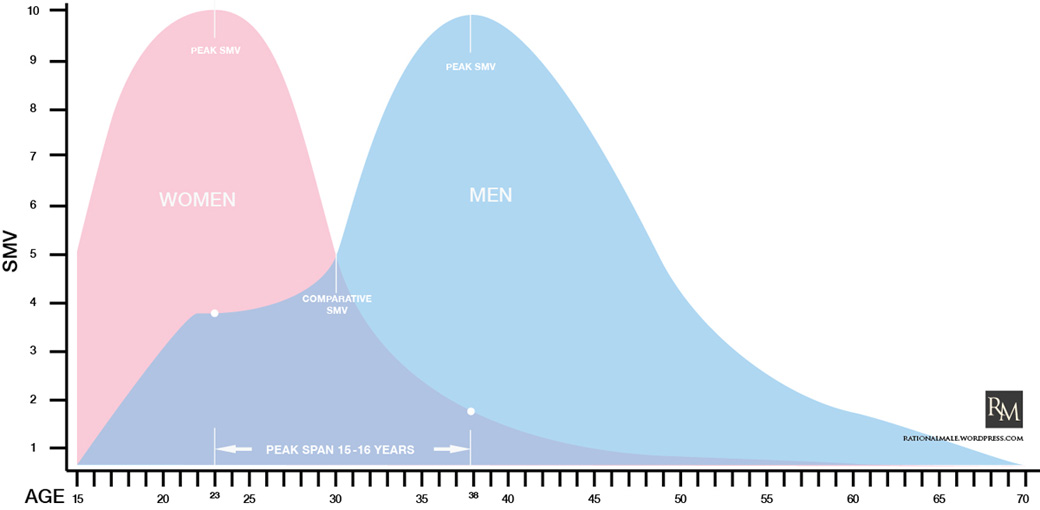
Just last week I graphed out my own rudimentary overview of how the SMP lays out, as well as sexual market values relative to each sex. Although I began a bit tongue in cheek, in all earnestness I attempted to visually plot out what a persons’ life time-line might look like were he or she to have a ‘God’s Eye’ perspective of when their SMV will be at it’s apogee, when it builds and when it wanes. As with everything I put to keyboard, my effort was to get to the honest nuts & bolts of the SMP and how our live’s events coincide with that valuation. Here’s the breakdown from last week:

This was an effort in defining a contemporary, realistic view of how sexual market value fluctuates for each sex. I think it’s comparatively reflective, if a bit rough, however I approached this graph from a male perspective in that its intent was to educate Men of their SMV potential later in life, and to plan accordingly.

What I failed to account for is feminization’s influence on women’s (and by association men’s) gestalt understanding of their own SMV. Given the plentitude of manosphere articles devoted to women’s distorted and deluded interpretations of their sexual market value I figured this had been done to death, but it took Badger’s post and video to shake a new thought into my head.

Women like men

As if on cue, Team Red vents his frustration from yesterday’s comment thread:

“Why should money even matter anymore to these women in the long-term when it seems like the majority of them have put their careers first and put marriage/kids off until later on in life? It seems like the dating world is polluted with 30+ year old career women that have been riding the carousel 10-15 years and are now ready to “settle down” and pop out 2-3 kids by ripe old age of 40. What these women seem to have forgotten is the greater risks involved having children so late in life.”

I found this comment apropo since it sums up my epiphany: Women want to be men. This is the legacy that a since-decayed feminist social impetus has imparted to the generations of both men and women who’ve come after the Gloria Steinem’s got married themselves and blew away. Women need to be the men of tomorrow. I suppose I should’ve seen this messaging long before reading Badger’s blog, and in honesty I think the greater part of Matrix thinking revolves around role reversal, but this is more than reversal. Women want to be men.

If a man can wait until his maturation develops, his achievements are more actualized and his SMV peaks at 38-40, equalism says “why shouldn’t you Man-Girl?”

Whether it’s in terms of Dom vs. Sub in sexually fluid relationships, or in terms of respect or social entitlement, Women want to be men. This is what 60+ years of feminization has taught women is valuable, and taught men to accommodate for. In fact men are ‘lesser men’ for not offering women a ‘hand up’ to manhood. Feminization in this respect is the ultimate form of penis envy; acculturate consecutive generations of both sexes willing to masculinize women into prominence. This is the heart of the feminine imperative and feminine primacy.

Hypergamy and women’s innate psychologies naturally conflict with this socialization effort. Thus we have women expecting masculine equitability while simultaneously feeling entitled to traditionally feminine courtesies. In the interests of feminine primacy, if it works, use it.

So it should come as no shock that in a desire to be like men, a popularized parallel had to be socialized into women’s collective understanding of SMV expectations. In the most literal sense, if men could enjoy a more progressive and maturing SMV then, by the doctrines of equalism, a ‘new’ woman should also be able to mirror that masculine SMV.

Feminized SMV

By a combined effort of feminism, feminine primacy and its imperatives women have been socialized and acculturated to believe that their SMV profile encompasses and is synchronous with that of men. Since women are essentially men, Equalism (the religion of feminism) convinces women that their SMV schedule should at least be identical to that of men.

I could have simply recolored the MEN bell curve from my previous SMV graph to illustrate the feminized redefinition of SMV, but that would be inaccurate. It wouldn’t account for the obvious benefits women expect to enjoy in their true sexual peak years (22-24) in addition to the masculinized SMV feminization has convinced the modern woman of.

One thing I did find a need to account for was the Myth of Sexual peak. As Team Red laments, and in my post Myth of the Biological Clock, this feminine defined delusion is deceptively close to women’s post-Wall valuation. Since men’s SMV generally peaks around 38, women needed a social convention that would also make their sexual peak coincide with men’s. Thus we read the endless articles about sexual peak inflating older women’s sexual prowess above that of the 22 year old ‘girl-children’ men manifestly prefer for sexual partners. Equalism enforces the delusion that if men are at their most desirable at later stages of life, then so too must be wo-MEN.

Cracks in the Wall

For all its efforts to convince women of a feminized redefining of SMV, there are obvious cracks beginning to show in the social constructs designed to ensure a lasting feminine primacy. Badger’s video find is an excellent illustration of these cracks. Since the last wave of significant feminism was carried along by the Baby Boom generation, women of the consecutive generations are only now beginning to realize the gravity of the “have-it-all” lie.

The institution of gender primacy (masquerading as ‘equalism’) is largely, and grossly apparent, at odds with women’s true sexual market valuation and its progression. Try as it may the feminine imperative has never had an effective counter for the biological motivations that drive SMV – as women age, feminine primacy becomes a victim of its own hypergamy. Thus the imperative must continually redefine its mission, create new social conventions and rely on blaming the men it subjugates for its own inadequacies.

The reason this video is humorous is because all too many women in this demographic are realizing their true SMV isn’t what feminization has convinced them of too late – one crack in the Wall. Another other tact is to shame men for their unwillingness to participate in the SMP the feminine imperative defines for, and expect them to participate in. “Man Up you infantile boys!” – and another crack appears in the Wall.

That a writer like Kate Bolick can form a prosperous career and celebrity around her inability to come to terms with the conflict between her true SMV and the SMV model the feminine imperative has conditioned into her ego is an indictment of the scope to which the distorted, feminized SMV model has been ensaturated into our women and our culture.

Case Study – Creative Intelligence

Below I have posted descriptions of 4 men from a case study I was involved with as part of a graduate study for personality psychology. Before you ask, no, this wasn’t an original study, however it was a measures experiment we performed to see how the results matched with our own university.These descriptions are excerpts from that case study comparing female mate selection. They were presented individually to 101 university women between the ages of 18 and 36. All were single/unmarried and none were aware of the intent of the experiment. I’ll present more details of the experiment after you have chance to respond so as not to spoil your genuine responses. Here are the descriptions:

––––––––––
M is an art student. M has always had a passion for painting and plans to pursue a career in art. He creates paintings of people and complex landscapes. His paintings are so lifelike that they are often mistaken for photographs. The consensus amongst his art professors is that he is, by far, the most talented student they have seen. One professor, an expert on lifelike paintings, says he believes M is one of the most talented artists ever to produce these paintings. To make extra money to support his schooling, M has sold a few of his best paintings. They have sold for between 100 and 200 dollars. One professor lamented that M’s paintings are worth far more, but like so many other artists, he will probably never make very much money selling them.

L is an art student. He paints abstract paintings. L came into art by chance. He took an art class as an elective because it fit well in his schedule. For his midterm project, he produced an abstract painting after an hour of “fooling around” with the paint and canvas. The majority of the painting actually consisted of paint he accidentally spilled onto the canvas. A very wealthy man who was looking for art for his home discovered L’s painting in the student art studio. He paid L $5,000 dollars for the painting. Some of the man’s other wealthy friends liked L’s painting and commissioned a total of $100,000 in paintings from him. L and his art professors were shocked at the success of L’s paintings, because, in the words of one professor, “he has no real talent, just some good luck.” L continues to capitalize on his success by selling his abstract art.

L and M are considered highly desirable by other women on campus and very attractive. Friends of L and M say that they are dependable, kind, and generous friends.

J is an entrepreneur who had great success in his first business venture. He started a small software business in a friend’s garage. His product was a new kind of software for improving factory designs to radically increase the profitability of manufacturing. Within his first year, J secured contracts with Ford, General Electric, and Boeing. In the next three years, J sold his software to most of the top manufacturing companies in the United States and several of the top companies in Asia. After 5 years in business, J’s company was valued at 120 million dollars and had 250 employees. The Wall Street Journal credited the success of J’s company to the “brilliance and novelty” of J’s product and to J’s “sheer genius as a businessman.” However, J’s company fell victim to misfortune the next year. After J rejected a take-over bid from Microsoft, Microsoft filed a lawsuit claiming that J’s software infringed on some of their patents. Although most experts agreed that the suit had no merit, the cost of defending himself against the lawsuit created huge cash flow problems for J, which drove the company into bankruptcy. Although J has very little money left, he has recently begun a new business venture to sell another of the software products he has invented.

R recently inherited 20 million dollars from the couple who had adopted him when he was a year old. They died in a car crash, having made their fortune in commercial real estate. Before they died, R worked as a sales person at a computer company. Although R worked at the company for several years, he had not advanced past his starting salary or rank within the company. He went to a community college, but after graduation he didn’t feel sure what to do with his life. A friend who was working at the computer company suggested that R join him and work there. In R’s words, “I guess I’m just not very good at this job. At least now I won’t have to worry about money any more.” R and his adoptive parents were very close, and he was deeply saddened by their deaths.

J and R are both attractive and in their mid-twenties. They were recently nominated as two of the most eligible bachelors in Los Angeles.
–––––––––––

Bear in mind, these guys a theoretical archetypes, how they relate to women is irrelevant. How the subject women percieved them is what’s being assessed. Of these 4 men, which do you suppose was rated the highest in desirability with which to have a short-term sexual affair with by these women? And which man was rated the highest in desirability to enter into a long-term relationship with?

This study was done to determine comparative priorities in women with regards to male ‘creative intelligence’ vs.‘provisioning ability’ in female mate selection. I would’ve titled this thread as such, but I wanted to get some unbiased and impulse responses from readers here to see what the perceptions of these archetypes were from men and the reactions guys expected from women to these archetypes.

You’ll notice that care was taken in these archetype descriptions to balance out the physical attractiveness of each man (i.e. both artists were considered equally attractive by peers and both businessmen were ‘eligible’ bachelors). What was at issue wasn’t their extrinsic characteristics – comparative physiques or obvious Alpha presence – but what women chose in regards to these men’s intrinsic characteristics. The theory being that Creative Intelligence is of a higher mating value in the short term while a better Provisioning ability is more desirable in the long term. Bear in mind that hypergamy influences the decision making process for both of these sexual strategies. Also added was the caveat that legitimacy of provisioning ability, and the potential for future provisioning in it’s absence (i.e. the down on their luck men), played a factor in this mate selection.

Creative Intelligence

So what exactly is “Creative Intelligence”? Although there is no firm consensus on how to define it, we often know it when we see it. We also know a bit about it from a century of creativity research. Within humans, creative intelligence is closely associated with the highly heritable general intelligence, and creative intelligence seems to rely on the generation, selective elaboration, and skillful implementation of ideas and strategies. In other words, creativity represents a strong capacity for successful improvisation, thus it became a desirable, selected-for species survival trait.

The problem is that creativity sounds desirable, as does intelligence, so “creative intelligence” can become a vague term that seems useful for solving any behavioral problem, whether technological, ecological, social, sexual, or cultural. Many plausible adaptive functions explain the origins of human creative intelligence. These include: tool-making and tool-using, hunting, foraging, and food preparation methods, social strategizing within and between groups and sexual courtship dynamics (i.e. hunter-gatherer proto-Game).

Sorry for the psych lesson, but we had to be specific.

Trade Offs

As I elaborated in Schedules of Mating, most women face trade-offs in mating. In selecting a long-term mate, it makes hypergamic sense for women to put greater weight on traits that advertise ability and willingness to invest in protection, provisioning, and care of the woman and her offspring. This will favor the evolution of ‘good dad’ indicators – reliable cues of paternal investment ability and willingness to participate in those responsibilities. In our past, women of very high mate value (HB 8 and above) had the luxury of attracting a long-term mate who has both good dad potential and good genes. Fast forward through the ages and women have progressively had to settle for a committed partner who is not ideal either paternally or genetically. Then add to this the increasing complexity of men adapting to mimic these cues in order to facilitate their own breeding strategy. Consequently women are, by order of degree, incentivized to secure better genes or better paternal care from short-term or extra-pair partners, while simultaneously seeking long term provider males. Either would help at any time.

In this study, the idea was that, issues of relative attraction and arousal being satisfied, women will prefer a male possessing a higher capacity for Creative Intelligence in short-term sexual encounters to ensure the best possible future options for her offspring, while choosing a mate with better Provisioning ability for long term parental investment.

Art and business were chosen as two contrasting domains of work. Each requires distinct styles of creative intelligence, but both demand combinations of practical and theoretical skills, individual effort and social interaction. Hence, merit-based success in either domain may function as a mental fitness indicator. In each domain (art or business), one vignette described a man who showed high creative intelligence in his work, but who was poor due to bad luck and adverse circumstances. The other vignette in each set described a man who was average on creative intelligence, but who was wealthy due to good luck and beneficial circumstances. All vignettes made clear that each man’s creativity level was largely endogenous, reflecting natural (and presumably heritable) talent, but that his wealth level was largely accidental, gained through no merit or fault of his own.

Results

Each woman completed two forced-choice questions: (1) “Based on these descriptions, who do you think you might find more desirable for a short-term sexual affair?”; (2) “Based on these descriptions, who do you think you might find more desirable for a long-term committed relationship?” (L or M in the artist vignettes, and R or J in the entrepreneur vignettes). Next, participants rated the desirability of each man as a short-term mate and as a long-term mate on two 9-point scales (where ‘1’ = not at all desirable, ‘5’ = average; ‘9’ = extremely desirable). The rating questions were as follows: “Overall, how desirable would you find L [M, R, or J] as a long-term partner?” “Overall, how desirable would you find L [M, R, or J] as a short-term partner?

In this study M was overwhelmingly chosen as the short term partner. 89% of the participants chose the naturally talented, but out of luck artist for a short term sexual encounter. 7% chose L the rich artist, 3% chose J the poor/talented businessman and 1% opted for R the wealthy/untalented businessman.

J was rated highest for a long-term relationship, but not as significantly as M in the short term. 67% of our subjects chose J, and surprisingly 17% chose L (rich artist). R was rated at 12% and M took 4% for the long term choice.

Tickle Me Emo

A Rational reader asks:

I realized some (not many, but some hot) chicks tend to fall for the sensitive sissy – the one labelled as “Wimpster” or “Emo” (I guess you know what I mean).

I think, these “men” are as pathetic as it gets. How do they manage to get hot chicks? I really saw some couples HB+Emo-Kid during the last months.

What do they have in order to attract hot women?
What sort of secret “quality” is it, that makes (some of) these poor, pathetic losers so successful?

Any idea?

You’re pigeon-holing the ‘Emo’ thing as a specific type, when it’s really just a manifestation of an archetype. Emo Game is really a variation of the Dandy. Playing the Dandy has been a time-tested seduction schema for centuries. In the late 70s and into the 80s you could make comparisons to David Bowie or even Jim Morisson (before they were famous) or the Glam Rock phase. You can even compare them to the pensive, Kurt Cobain style Grunge Rock ‘artists’. Emo guys are just the next check on the bill, and in fact I’d say their time is just about up as the herbilicious Indie-Rocker has pushed them to the side these days. Splitting hairs, I know.

But to answer your question, just break it down into understandable dynamics. Why does this type of guy attract women?

Exceptional Emos

First of all, only exceptional guys of this archetype really attract women with any regularity. The sissy-boy, sensitive, Emo guy is only going to get so far if he is exceptional in some way and even then, only with women who have the capacity to appreciate his characteristics. While most arousal cues are universal, women tend to base their learned attraction ‘preferences’ on what they think, at least subconsciously, is within the realm of attainability proportional to their capacity to attract that ‘type’ of guy with some degree of predictable success.

However, the notable Emo (dandy) guy must be exceptional in some respect to pull off his schema. By exceptional I mean they must posess some real demonstrable talents in order to play the stoically tragic, socially misunderstood, artist character. You don’t have to be an artist to play the Emo card, but this is the natural association women apply to the archetype. Remember, women are like casting agents for their own fantasies; the fat kid with nothing to back up his ’emotional nature’ (such as demonstrable artistic merit) is simply an even bigger, whining, ‘Baby Huey’ dressed in drag, mascara and painted nails, and has little success in pulling off the sensitive thing when no one is paying attention to him in the first place.

For the guys that can back up the character (such as Mystery); I can see why this would confuse the average guy wondering WTF is going on. These guys can pull tail and it seems to contradict (again) what women say they’re “looking for” in a guy. Remember that it is a woman’s behavior that is the benchmark of her intent, not her words. So why then do they opt for guys like this?

Emology

First of all, guys with this schema tend to place themselves and their passion (or at least the perception of it) above anything else – and this includes women. This is fundamental to the personality type as well as the legitimacy of the fantasy that women want to cast him in. Their passions are literally the ‘other woman’ to the women that are attracted to them. This establishes him in a position of power in that he presents the appearance of being so consumed with himself and his art that he becomes a challenge to her and this is what locks her into his intrigue. He sets the frame for her and she has no other choice but to follow. In so doing this, he places her in a position of him needing her less than she does and she therefore chases and qualifies herself to him.

Secondly, guys of this type have a demonstrated value of creative intelligence with at least the potential for long term successes. From the Evo-Psych perspective, behavioral cues of creative intelligence is sexy for women – it represents a capacity for innovation and survival skills – this is why the starving artist gets laid, often with more variety than does the typical ‘good provider’ male. In respect to women’s pluralistic breeding strategies, Emo Guy makes for a wonderful short-term breeding prospect (good genes), but usually a lousy choice for a long-term provisioning or parental investment prospect. This is the same reason why women will fuck the pool boy, but marry the lawyer. Many an Alpha Widow pines away her late adulthood for the artist boyfriend she left behind for the stable provider.

Lastly, it seems ‘right’ for certain women to want to nurture this ‘artist’ because it plays into the whole romantic, chick crack predestination idealism that so many women want to believe can happen for them. They’re making the world a better place by sponsoring one more male to explore his sensitivity and helping him to fully realize his feminine potential by mothering him and letting him fuck her in appreciation.

At this point I should add a caveat here in that my intent isn’t to vilify the nature of truly artistic men (I count myself among them, and I have played the dandy in my youth to great success). Rather my purpose is to explain the appeal this type of guy has for women. The average salt-of-the-earth guy will (most times accurately) associate a man ‘not playing by the masculine script’ as wishy-washy, effete and indecisive (i.e. effeminate), but the more exceptional characters of this type, the legitimate ones, are some of the most determined and persistent Men you will ever know. Jim Morrison was a tortured, addicted poet, but he was Alpha as fuck.

My advice is to watch by patiently and stick to your masculine guns in this respect. The women that would pass you up for this type of guy are few, very particular, and rarely worth the effort in encouraging them see this dynamic at work in themselves. Hold out for the much more plentiful women that do respond to pronounced masculinity. It’s really only a matter of time until this type of woman tires of the ‘sensitive guy’ after coming to terms with the inherent emasculation and the associated irresponsibility of this kind of male. Very few men can play the dandy indefinitely.

[Now I’ll go sit on pins and needles to await Emma the Emo’s inevitable response.]

Final Exam – Navigating the SMP

You know, there’s really no substitute for graphs, and charts, and data plot maps. Human beings, being essentially a visually oriented species, see a graphic heads-up display, a God’s eye view as it were, as essential to seeing the forest for the trees. You may not like being on a budget at home, but show a guy a graph of where all his money goes in a month and he’ll feel better about not pissing it away for a peck on the cheek over the course of a couple weekends.

So it was with this in mind that I took it upon myself to plot out a chronology of the little known and far too under-appreciated sexual marketplace (SMP) we presently find ourselves experiencing (at least since the sexual revolution). Bloggers in the manosphere (as well as other self-impressed pseudo-feminist gender pundits) often use the SMP in a context which presumes that readers are already familiar with their mental model of it, and understand the dynamics of the modern SMP. Personally I think this presumption is fraught with individual bias, both intended and unintended. And make no mistake, I’m about to define the SMP and sexual market values (SMV) from my own perception, but I fully recognize the want for defining these dynamics in a clear, understandable format, so I’ll beg forgiveness for this indulgence.

Can I Graduate?

As some of you know it’s about graduation time for many high school seniors, and with that comes a lot of pontification from ‘adults’ who want to impart some grand words of wisdom to the next genration as they launch headlong into a future of student debt and/or dismal employment prospects. This is a special time for parents and childless adults alike to reflect upon their own lives and ask themselves “what would I tell my younger self to do differently?” and hope against hope that the 18 year old they feel compelled to cast in the role of their younger selves will tear themselves away from texting their friends about who’s going to get whom to buy their prom night liquor long enough for it to sink in. So you’ll have to forgive me for playing the professor here for a moment while I make the same vain attempt.

Not long ago I had a commenter tell me,..

“Rollo, I just wanted to say that your stuff has been truly groundbreaking for me. This material should be a graduation requirement for all high school seniors.”

Well, far be it from Dr. Rollo J. Tomassi, Professor Emeritus, to be so remiss in his sacred charge of educating the next generation about the perils of the sexual marketplace they would otherwise so blindly stagger into. Challenge accepted. So please gather round the podium, turn off all your cellular devices (prom night liquor’s easy to come by), take a sheet of notebook paper from your Pee Chee folder and prepare to take notes on,..

Navigating the SMP

Now class, if you’ll direct your attention to the display above (click on it for the larger version) I’ll explain the parameters of this graph. In the vertical column we have Sexual Market Value (SMV) based on the ubiquitous ten scale. Professor Roissy emeritus at The Chateau did us all the good service of elaborating upon individuated sexual market valuations for both men and women long ago, however for our purposes today it is important to note that these valuations are meant to encompass an overal sexual value based on both long and short term breeding prospects, relational desirability, male provisioning capacity, female fertility, sexual desirability and availability, etc. et. al.. Your milage may vary, but suffice it to say the ten scale is meant to reflect an overall value as individuated for one sex by the other. Outliers will always be an element of any study, but the intent is to represent general averages here.

On the horizontal metric we have a timeline based on the age of the respective sex. I’ve broken this down into stages of five year increments, but with notable ages represented for significant life-to-valuation phase for each sex to be detailed later in our lecture. As an aside here you may notice I began the SMV age range at 15. This is intentional as it is the baseline starting point for the average girl’s midrange desirability value as evaluated by the average high school boy of the same age. Also of note will be the age range between 23 and 36 which represents the peak span years between the sexes, also to be detailed later.

Lastly, I’ve color delineated each gender’s respective SMV range bell curve and indicated their crossover phases accordingly.

Women’s SMV

In various contexts, women’s SMV is without doubt the most discussed topic in the manosphere. Try as we may, convincing a woman that her sexual peak lay actually between 18 and 25 is always an effort in debating denial. For all the self-convincing attempts to redefine sexual valuation to the contrary, SMV for women is ultimately decided by Men. Thus this bell curve is intended to represent the sexual value of women based on men’s metrics, not as women (by way of ceaseless social engineering) would like to define desirability. Please see the Myth of Sexual Peak and Sexy for cross references.

As we continue along you can see that the peak years for women’s SMV tops out at around 23 years. Fertility, desirability, sexual availability  and really overall potential for male arousal and attention reach an apex between 22 to 24 year of age. Remember this approximation isn’t an estimate of personal worth or character, or any metric beyond a baseline of desirability invoked in men. Ladies, on average, this is your best year. I don’t think I’m relating anything the cold truth of your hindbrain hasn’t woke you up at night over.

At no other phase in your life will you enjoy more affirmation or legitimate male attention more zealously applied for your sexual approval than this brief stretch. Once past the apex, every effort you spend on generating male arousal cues will be in trying to recapture the experiences of this phase. Every post-apex, pre-Wall (24 to 30) calorie you burn will be motivated by the memories of your SMV peak.

By the age of 27 women’s SMV decline has begun in earnest. That isn’t to say that women can’t remain stunningly attractive and vivacious in their post-peak years, but comparative to the next crop of 22-23 year olds, the decline progressively becomes more evident. Competition for hypergamously suitable mates becomes more intense with each passing year. The age’s between 27 and 30 are subliminally the most stressful for women as the realization sinks in that they must trade their ‘party years’ short term mating protocol for a long term provisioning strategy.

It’s at this point that rationalizations of ‘living a new life’ or ‘getting right with herself’ begin to formulate; not as a result of guilt per se, but rather as a function of relieving the anxieties associated with the new reality that she will eventually no longer be able to compete effectively in the SMP. The writing’s on the Wall; either she must establish her own security and provisioning, or settle for as acceptable a provider as her present looks will permit to secure his long term provisioning.

Men

It may seem dismally pessimistic to begin boys SMV at so low a starting point at 15, but recall that we’re looking at overall averages. A 15 year old girl will look at an 18-20 year old man’s sexual approval as more valuable than that of her same age peers. It’s not that notable boys’ attentions are worthless, but they are far more mundane to a mid teens girl, thus the evaluation starts much lower.

As men age you can see that their SMV tends to level off during their 20’s with a gradual rise up to age 30. This represents men’s slow build SMV as they become more valuable by metrics of physical prowess, social gravity, status, maturity, affluence, influence, and hopefully dominance. It’s a slow process and unfortunately, of a man’s significant maturing to his SMV, most of it occurs while women are reaching their own SMV peak. At age 23, while a girl is enjoying her prime SMP value, a man is just beginning to make his own gradual ascent.

By age 36 the average man has reached his own relative SMV apex. It’s at this phase that his sexual / social / professional appeal has reached maturity. Assuming he’s maximized as much of his potential as possible, it’s at this stage that women’s hypergamous directives will find him the most acceptable for her long-term investment. He’s young enough to retain his physique in better part, but old enough to have attained social and professional maturity.

Comparative SMV and the Peak Span Years

One important note here is to compare men and women’s SMV decline. Women’s SMV being primarily based on the physical, has a much more precipitous decline than that of men’s. who’s decline is graduated upon a declining capacity to maintain his status as well as his health / looks. Since a man’s SMV is rooted in his personal accomplishments, his SMV degradation has much more potential for preservation. Women’s SMV burns hot and short, but men’s burns slow and long.

Now class, please address your attention to the critical 15-16 year span between a woman’s peak SMV and that of men’s. It should come as no surprise that this span is generally the most socially tumultuous between the sexes. The majority of first marriages take place here, single-motherhood takes place here, advanced degrees, career establishments, hitting the Wall, and many other significant life events occur in this life stage. So it is with a profound sense of importance that we understand the SMV context, and the SMP’s influence as prescribed to each sexes experience during this period.

At age 30 men are just beginning to manifest some proto-awareness of their sexual value, while simultaneously women are becoming painfully aware of their marked inability to compete with their sexual competitors indefinitely. This is the point of comparative SMV: when both sexes are situationally at about the same level of valuation (5). The conflict in this is that men are just beginning to realize their potential while women must struggle with the declination of their own.

This is the primary phase during which women must cash in their biological chips in the hope that the best men they can invest their hypergamy with will not be so aware of their innate SMV potential that they would choose a younger woman (22-24) during her peak phase over her. I wrote about this in The Threat:

Nothing is more threatening yet simultaneously attractive to a woman than a man who is aware of his own value to women.

The confluence between both sexes’ comparative SMV is perhaps the most critical stage of life for feminine hypergamy. She must be able to keep him ignorant of his SMV potential long enough to optimize her hypergamy. In men’s case, his imperative is to awaken to his SMV (or his potential of it) before he has made life-altering decisions based on a lack understanding his potential.

Every man who I’ve ever known to tell me how he wished he’d known of the manosphere or read my writing before getting married or ‘accidentally’ knocking up his BPD girlfriend has his regret rooted in not making this SMV awareness connection. They tended to value women more greatly than their own potential for a later realized SMV peak – or they never realized that peak due to not making this awareness connection.

Well, I’m afraid that’s all I have space for today class. I hope this brief intensive has given you some food for thought as you enter a feminized world legally and socially dedicated to the benefit of optimizing hypergamy. Just remember, as you see your illustrious manosphere instructors gazing proudly from the gallery in our professorial caps and gowns, an ounce of prevention is worth a pound of cure.

Class dismissed.

––––––––––––

[Update] Star student White Raven at Elephants and Trees has posted his most excellent term paper regarding the SMP. A+, highly recommended.

The Abdication Imperative

Rationalmale regular and all-around red pill evangelist MikeC had an interesting Matrix experience recently. This comment was drawn from yesterday’s Respect post:

“This is another socialized manifestation of hypergamy: the man must always perform for her, ***always qualify to her.***“

Yup….I actually got engaged over the weekend, and when we got back in town we visited her parents. Me and her on one couch, her parents on the other, and I have a friendly relationship with them (her Mom loves me).

Anyways, we were talking some plans and stuff, and her Dad chimed in about getting used to just saying “Yes, dear”….”Yes, honey”, etc. First thing that popped into my head was the femcentric thinking involved. I didn’t think it was the time or place to call that out for the crap that it is…but I didn’t need to as both myself and my fiancee chimed in at the same time that our relationship isn’t one where she calls the shots and I just go along with it.

It truly is mind-boggling. It almost seems like at some point, a mass brainwashing took place that instilled in men that to “RESPECT” women you simply had to go along with whatever they wanted to say or do in that moment.

[Congrats Mike, and I mean that sincerely since I know you have your roots planted firmly in positive masculinity and Game-awareness. RT]

I was listening to a local talk radio show on my commute home last Friday and a caller tells the hosts that he’s getting married for the first time over the Memorial Day weekend. After all the ubiquitous congratulation, he petitions for advice from the show’s hosts as well as any listeners who call or text or IM into the show.

I can’t say as I was surprised, but predictably, every guy who dropped some words of wisdom couched it in exactly this “just say ‘Yes Dear’ to anything she asks, she’s always right” mass groupthink. “Happy wife equals happy life” was literally what at least 5 of these guys called in or texted to say. Everything after this was autonomously, automatically implying that a husband’s primary duty in a marriage was to ‘keep her happy’. “Make sure you get to all the things on her Honey – Do list and you’ll be alright” was another caller’s advice intoned in a voice that sounded as if he were telling a new arrival at Auschwitz of how best to survive in the camp.

Last week I wrote about how the Unplugged become progressively more sensitive to the group-speak of the Matrix, and MikeC’s experience is a a textbook example of this. However, it’s one thing to identify the code in the Matrix, but it’s quite another to see the latent purposes behind the memes, the clichés and the idioms that the PluggedIn take for common sense.

Hypergamy and Cognitive Function

As MikeC astutely highlighted from Respect, Men’s preoccupation with performance is a direct psychologically, sociologically evolved response to qualifying for women’s hypergamy. Perhaps the most important reason women’s primary drive revolves around security-seeking is due to hypergamy, by definition, being an inherently insecure proposition. In fact so insecure is feminine hypergamy in principle that it was necessary for women to evolve psychological fail-safe schemas on the subconscious level (i.e. involuntary shit tests).

In general, when a psychological dynamic is pressed into the limbic, involuntary, subconscious level of our psyche’s, it’s primarily due to that dynamic requiring too much mental attention for our conscious minds to process effectively and maintain a cognitive awareness of other dynamics, stimulus, etc. in our environment that require our more immediate attention. Mother Nature has evolved humans with a wonderful ability to muti-task our awarenesses, but there are limits to how much information a person can process efficiently before that psyche becomes overwhelmed. Taken to the extreme this processing overload has potentially life threatening and species survival implications. Thus these processes that would overwhelm our conscious cognitive abilities are relegated to our peripheral awareness and/or pressed down to a subconscious / preconscious level.

This then is the mental realm of feminine hypergamy. When Roissy writes about women’s hindbrains or imagination/rationalization hamsters, this is the conceptual, psychological region from whence they issue. It’s easier to think of hypergamy – and its manifestations such as shit tests – in terms of breathing. We can control our breathing when we think of it, but when our mental attention is required elsewhere our autonomous nervous system takes over and we breath on autopilot until such time as we become aware of that breathing. Whether we are under stress or running a marathon, that autonomous system kicks in to allow us to focus on more important stimuli. So too is it with hypergamy – women are aware of it, and may adress it consciously, but more often hypergamy is pushed into women’s peripheral consciousness to allow them to focus on other stimuli.

The Abdication Imperative

Hypergamy is rooted in doubt. Hypergamy is an inherently insecure system that constantly tests, assesses, retests and reassesses for optimal reproductive options, long-term provisioning, parental investment, and offspring and personal protection viability in a potential mate. Even under the most secure of prospects hypergamy still doubts. The evolutionary function of this incessant doubt would be a selected-for survival instinct, but the process of hypergamy’s assessment requires too much mental effort to be entirely relegated to women’s subconscious. Social imperatives had to be instituted not only to better facilitate the hypergamous process, but also to reassure the feminine that men were already socially pre-programmed to align with that process.

In an era when women’s sexual selection has been given exclusive control to the feminine, in an age when hypergamy has been loosed upon the world en force, social conventions had to be established to better silence the doubt that hypergamy makes women even more acutely aware of. And nowhere is this doubt more pronounced than in the confines of a monogamous commitment intended to last a lifetime. Thus we have the preconception “Happy Wife equals Happy Life” pre-programmed into both gender’s collective social consciousness. It’s as if to say “It’s OK Hypergamy, everything’s gonna be alright because we all believe that women should be the default authority in any relationship.”

When you disassemble any operative feminine social convention, on its most base, instinctive level the convention’s latent purpose is to facilitate and pacify hypergamy.

As I covered in Hypergamy doesn’t care,.. it isn’t enough to profess love, promise support, exemplify dedication, etc., no, in a social context hypergamy demands a total pre-abdication of authority. Hypergamy wants social assurances before it makes a decision it has to live with. And even under the condition of total contrition hypergamy will not be pacified, but feminization, since the sexual revolution, has defined society in hypergamic terms, and that imperative will insist that the general populace internalize that “Happy Wife equals Happy Life.”

Respect

I can remember a period in my 20s when I heard countless times “Rollo, you need to / you don’t respect women” from both women and (who I thought at the time were) men as if by saying this to me I would stop wanting to hook up with the strippers, groupies and club girls I was getting with then. In hindsight it’s interesting to see how my dalliances with less than ‘pristine’ women elicited such a shaming tactic. The 2012 Rollo knows the ‘respect’ ploy for what it is now; a social convention which attempts to disqualify a guy’s personal/sexual experiences as being less than ‘quality’ in comparison to the personally identified ‘quality’ they hope to embody.

It’s comedy of course to conflate genuine respect with a person’s character – that may sound odd at first, but I personally know (and you probably do too) some truly despicable people who I nonetheless have a respect for, if not an admiration of. Respecting one’s enemy is a hallmark of a learned Man.

R-E-S-P-E-C-T

From the late 80’s into the mid-90’s I didn’t give much thought to it, but I do remember thinking how odd it was that women were entitled to my respect by default. I never heard anyone, male or female, ever tell a woman that they “needed to respect men”. There was never an onus on women to respect men by default.

Now, of course I think we’d agree that men must earn respect from each other and from women. However, from a very young age boys, at least by and large, are taught never to hit a girl, watch your language, carry her books, respect HER, but there is no opposite dynamic for women. This is another socialized manifestation of hypergamy: the man must always perform for her, always qualify to her. For her, everything is fair game; kick him in the nuts if he cross the line. Obviously I’m referencing things from a traditional standpoint, but now extrapolate this into modern culture where single mothers and emasculated men cover the cultural landscape. Even in traditional Latin cultures where women tend to prefer masculine men, it’s not formally taught to them to respect men. Their respect is reserved for the men who qualify for it.

Masculine Respect

So this is my point, women don’t respect men, or rather, they don’t respect the masculine – and most certainly don’t have a default respect for it. They’re taught to be adversarial, not cooperative. Women are taught to relinquish respect, and then only begrudgingly when a man has proven his quality beyond the reach of most men. Masculinity is popularly ridiculed in western culture as it is, but to respect a man is to compete with him, to out-masculine him. Cooperation or even recognizing that the genders could be complimentary is viewed at best as antiquated, at worst, sublimation to the male imperative.

I should also add that I don’t think this dynamic is limited to the Daddy-Issues strippers or coed sluts. I’ve personally known very well standing, church going puritanical women, who’d cringe to be called a feminist, parroting back the very ideologies, practicing the behaviors and subscribing to the mindset (albeit in different context) of disrespecting the masculine. They were just as loud and just as obnoxious about it as any girl in Panama Beach, Florida on spring break.

Over There

Part of my job is to travel. I’m in Europe (Netherlands, Germany, Belgium and France) generally twice a year. I can say I’ve noticed pronounced differences in demeanor among women there in contrast to American women. I live in the U.S. so I’m not going to pretend I know everything about women in different countries. Neither have I banged any woman in a foreign country, but I am a keen observer of behavior. I’m not sure it’s necessarily an ethnic issue per se, but certainly a cultural one. I’ve been to Aruba, Guatemala and Panama, and from a Latin perspective I don’t see these women as any more reserved than American women, however they have a definite masculine expectation for their Men. A Man has to live up to being a Man in Panamanian culture, that’s a baseline expectation, but respect is something different.

I think that the double standard guys will run into in pointing out “how American women are” with regard to respect is that they’ll be accused of not being Man enough to handle respect them. You’ll get the standard “powerful women are a threat to men’s egos” line implying that women in other countries are ‘less powerful’ due to weak men preferring them. So the Catch 22 becomes a guy being dominant enough to master her as being the abuser, and the one pointing out her flaws being the whiney bitch who needs to man-up. Then we come full circle and see default respect for what it is – an element of the male Catch 22. To be considered a Man he must respect women (boys don’t respect women), but to be a Man he mustn’t be afraid to disrespect women.

And as with all no-win social conventions, it’s always best to err on the side of appearing too dominant than to accommodating.

Mr. Mom

Fatherhood 2.0

This article was written in 2007, before the “economic downturn”, before the End of Men. It basically outlines the travails of house husbands and how “fulfilled” they felt they were in just “being there” for their kids.

What I find interesting in this article, and the many more just like it, is the fact that, once again, masculinity is always perceived in the negative. As if there is not a single beneficial quality of masculinity. “Masculinity is bad for you” you’re poisoned by your testosterone. Never is it mentioned that traditional, positive masculinity emphasizes rationality, persevereance, duty, and yes, risk taking behaviors that are necessary elements in daring to be something, or someone more than what your limited expectation might have you believe if all you had taught to you was feminine empathy, security-seeking and self-preservation instincts.

Imagine a world where men are taught not to rush into a burning building to save innocent lives because it’s just too dangerous. A feminine aspect is necessary for empathy, caring and nurturing to be complete, but you cut a person in half when you fail to teach them risk taking, perseverance, rationality, a desire to dominate and win, a positive competitive drive, and yes, a calculated ability to reserve and control one’s emotional reactions – all of these traits serve to make a more complete human being be they male or female.

99% of men in a house-husband capacity are there by economic or personal necessity, not by design. Notice that in every instance the guy is cast in his role due to his wife making more money than he – that was the reality of his situation. Of the guy’s interviewed in this article, you’d be hard pressed to find one who’s life’s ambition was to be a stay-at-home Dad. Most are so because of personal decisions they made and didn’t pan out. Is it any wonder that unemployed or underemployed men would need to find some rationale to give them a sense of pride? They make their necessity a virtue and then pass their failings along to another generation.

How many of these couples would’ve decided to have the father stay home if they both made the same money? How many opt to keep their children in daycare while both work due to economic realities? How many of these men will remain in their role once their children reach a self-sufficient adolscence? How many of these house husbands would still opt for this role (or reverse the role with their spouse) if offered a job that paid half again what their wives were making? You can fluff up the touchy-feely emotionality of it all, but at the end of the day it’s the bottom line that makes the decision, not some self-righteous sense of masculine or feminine purpose.

Paul Haley, 38, a father of two, says women look at him when he walks down the street with his kids. “I think it’s admiration,” he says.

Well I’d guess he’d better hope it is, otherwise it’s just him standing out like an anomally. Something tells me that a 38 y.o., married with 2 kids house husband would necessarily HAVE to interpret it as admiration, even though I’d doubt he has the social skills to recognize admiration from pity considering he’s been socially cut off dealing with diapers, runny noses, cartoons and early childhood development. Once again, necessity is a rationalized virtue.

I think there’s a derivative of Beta Game that men fulfilling a matronly role for their kids like to convince themselves of. They fashion for their egos the idea that since they are more directly involved in their kids upbringing, they share this commonality with women that other men don’t or wont. It’s a more pronounced form of Identification (beta) Game; “The ladies love me (but can’t have me) because I’m already the husbandly ideal they crave – a man who changes diapers, washes dishes, and gets the kids off to school.” As with most identification schemas, Mr. Mom thinks he sets himself apart from “other guys” by being better able to relate with experiences unique to women. By becoming a woman he believes he’s more desirable.

“Masculinity has traditionally been associated with work and work-related success, with competition, power, prestige, dominance over women, restrictive emotionality.”

Oddly enough, this is exactly the world into which women choose to put themselves. By this article’s definition, they are assuming the masculine role, but notice that for women, emmulating masculinity is a positve. If we’re going to go to the absolute and say “masculinity = bad” then professional mothers are the worst offenders of masculinity, because it is also their role to be the examples of feminine virture and nurturing. At the very least, by this logic, we’re expecting women to play both the masculine and feminine equally well. However in this model, we have a woman give birth and then pass off her responsibility of engendering her children with this exclusively positive femininity on her mate (which admittedly he’s unprepared for) while she goes off to engage in the masculine.

My daughter is not at want for anything either positively masculine or positively feminine. When she was younger I combed my daughters hair for her, not because I was “exploring my feminine side”, but because her hair needed combing so she was presentable and we could get out the door and be on time to whatever it was we were doing. I also personally taught my girl to ride a bicycle, even after she’d gone and fell off it numerous times and was scared crazy about it. But she got back on that damn bike, tears and all, and learned how to risk injury for a greater reward. I taught her to swim as well using the same principle. Mrs. Tomassi has a primal fear of deep water and about pees herself when I take my daughter into the waves (and they’re pretty small in Florida) at the beach. But once my girl got over that fear, she learned how fun it is to play in the surf. Both of us do homework with her and teach her along with her schooling, is this a masculine or feminine trait? On occassion, I’ll make her re-do an assignment, even though correct, if she’s done a sloppy job of it. She predictably complains and kvetchs all over, but the “big, mean, evil masculine” Father sticks to this so as to instill a sense of pride in ones work. I’m sure the authors of this article would call me a callous tyrant for being masculine and insensitve, but often enough it takes a masculine man to kick a kids ass because sometimes ‘good enough’ isn’t – not because masculinity is bad, but because I love her and it’s necessary.

Perceptions


I attended a conference about a year ago where one of the presenters was this feminista chick talking about how to make your business appealing to women. Some of the stuff she was saying was really out there in that she painted most businesses as ‘inferior’ because they did not go out of their way to become female friendly. Despite the fact that her strong feminist slant was semi-obnoxious to the audience (primarily men), there were some nuggets of wisdom in there.

One of those was that for women, intuitive perceptions are by-and-large women’s primary basis for making judgments about everything, whereas men will use information to make judgments. If the public bathroom in your office is anything less than sanitary & comfortable, a woman will use that as a gauge for the success of your entire business over actual financial data. In that same regard, she’ll use testimonials (social proof) from other women over any proof-based demonstrations of success you have. Obviously these are generalizations, but they underscore the point that there are fundamental differences in the way the two sexes perceive the world around them.

Bear in mind that the ability for the everyman to create the illusion of success has only been around for the last 100 years or so. The advent of protracted consumer debt has created the ability for people to acquire material possessions which allow them to feign success and status. For a 21st century example, look no further than social networking – the ultimate way to craft a perception of status which may not be at all aligned with reality. Yet, facts are trumped by facades in female psychology, and it’s nothing to fault women for. It’s simply how they’re wired.

I think what we can learn from awareness of this reality is that part of our role as men, in the role of leader in relations with women, is to control the facade. Keeping her interest level peaked is a function of her consistently being able to see and bask in your success as a man. It costs money and it costs time to deliberately focus on one’s image, especially if you are content with a low-complexity lifestyle, which I think describes most men’s inclination were it not for the mating game (i.e. society’s expectations, driven by the feminine).

It’s a scary thought to consider how easy it is to sway the hearts and minds of most women simply with imagery over substance. It’s manipulation of the image which makes even flat broke women work themselves into a rabid frenzy over $200 purses. Successful politicians and marketers have become masters of working this psychology. If there was any wonder left as to why women are the primary consumers in western culture, look no further than the power that perception plays in women’s decision making processes.

The Strata of Perception

In past posts I’ve emphasized the idea that women may claim to want truthfulness, but they absolutely do not want full disclosure.

Right about now I’m sure there are readers thinking “This is some really stupid shit, what you’re saying is I have to manage my ‘facade’ indefinitely and never let the fantasy perception drop? I can’t possibly be expected to ‘play a role’ all the time! When can I Just Be Myself and be comfortable in knowing she’s into me for me?”

The short answer to this is yes, you must never let your guard down; her emotionally associative perceptual interpretations will ALWAYS be an influencing factor in assessing your hypergamous worth for her. However, the practical answer is maintaining that perception becomes increasingly easier to do as you build upon prior perceptions, and legitimately owning those perceptions as part of your personality.

Whether you’re Game-aware or not, every girl you engage with, whether a plate to spin or a monogamous potential mate, your role, your character, has all been crafted by the gestalt sum of the perceptions she’s built around you. Even from before the moment you approached her with romantic interest you’ve been progressively layered with her emotionally associative perceptions. Perhaps by friends, maybe social proof, or even pre-conditioned expectations (for better or worse) that she cast you into, your personality to her is the sum total of a strata of emotional perception. Later into an LTR (or even a fuck buddy situation) this perception becomes more solidified.

The difficulty most men have with using this perception dynamic to their benefit is based upon their failure to grasp how women cognitively differ from men. It seems patently disingenuous for a man to manipulate a woman’s perception of him to his advantage when he’s been socially convinced that women are rational agents needing factual information upon which to base their personal decisions, and are aware of their emotional impulsivity and therefor controlling of it. This is the equalist tripping stone, men’s acculturation has taught the average guy that women are cognitive equals to men.

The tragic part of this situation is that men are, passively or actively, always making attempts to influence that feminine emotional perception to better facilitate some kind of harmony between themselves and women. When a married guy tells me his wife has no respect for him the root of that condition lies in an inconsistency of perception on his part.

“Man, everything was so good in the beginning, but then I went Beta on her, got needy, got ONEitis and she left me for the stud at the custom motorcycles chop shop.” Again, perceptional inconguencies with priorly established perceptions, and then modified by external novel emotionally associative perceptions.