Choreplay

Gardening

One of the more entertaining debates I’ve had in my post-red pill awareness has been discussing the issue of men doing more “chores around the house” so as to more equitably distribute domestic duties amongst couples. The operative beneath this canard is that a more idealized state of gender neutralized bliss can be attained in a couple if only the male partner would feel it incumbent upon himself to assume chores that the female partner feels she’s entirely overburdened with.

Hmmm,..this presents a quandary for the Feminine Imperative; how would a Strong Independent Woman® motivate her live-in lover (sometimes known as ‘husbands’) to pick up the domestic job slack? Why of course, resort to the strategy that worked so well in convincing him to monogamous commitment – bait him with the obligation promise of unrestricted less restricted sex! It’s so simple in its form, so elegant in its function,..enter Diane Mapes’ Choreplay.

Gals make passes at guys who wash glasses.

I had a party not too long ago where a funny thing happened. One of the guests — a 30-something, single straight guy — came out to the kitchen and volunteered to do my dishes. “That way you won’t be stuck with a huge mess after everyone leaves,” he said, filling the sink with hot, soapy water.

As he started scrubbing wine glasses, I glanced over at my guests. Every woman in the room was staring at him with what can only be described as pure, unadulterated lust.

Behold the appeal of the dishy man.

Yes, that’s right gentlemen, Roissy had it all wrong, in girl-world washing the dishes is the undiscovered catalyst for ‘gina tingles. Athol Kay and his MAP? Get the fuck outta here, it’s vacuuming and dusting that inspire “what can only be described as pure, unadulterated lust.”

Side Note: Have a look at the date this article was published (2/13/2008, just before Valentines day) it’ll be important when we get to today’s bonus round.

Are there any benefits, aside from soulful glances and the satisfaction of a sparkling clean floor, that exist for men who share the load (laundry and otherwise)?

That’s hard to say, although there are some interesting indicators. A recent survey by Parenting Magazine found that “choreplay,” i.e., husbands pitching in around the house, was what put 15 percent of moms in the mood.

Ooh, a whole 15%?! Would this mean the other 85% were turned off?

You know, I’ve been married for over 16 years now and in that time, on occasion, I’ve performed many domestic duties for no other reason than it was a necessity. I have changed my daughter’s diaper, I have cleaned toilets, I’ve done laundry, I’ve vacuumed, etc. However, in 16 years never have I had my wife be consumed with an uncontrollable lust to give me a spontaneous blow job or pin me down on the kitchen floor, tear my pants off and ride me to glory after my having put away the dishes. Neither have I ever heard the words, “damn, you looked so hot ironing my blouse yesterday, fuck me you stud, fuuuuhhck MEEE!!” proceed from her lips while in the throes of passion.

And in the interest of being fair, I’ve never been turned on, nor do I consider it foreplay with my wife, when she’s the one doing the chores. I have been greatly turned on by the sight of her in lingerie; sweat pants, a t-shirt and a toilet bowl brush in hand? Not so much.

However some of the most memorable sexual experiences I’ve had with her (and other women in my sexual past) have come after I’ve done something particularly masculine or I performed well doing something that benefitted me with a lot of social proof. For instance, my wife seems to like sex after I’ve had a good heavy lifting day at the gym. She also seems very amorous after social engagements I bring her along to for my work.

So the moral of this story is, as always, base your assessments on a woman’s behavior – NEVER on her words. Any woman telling you you look hot in an apron or she loves how you pee sitting down is selling you something. It’s up to you to determine what she’s selling.

Ah, but what is she selling?

Research conducted by Laurie A. Rudman, a psychologist at Rutgers University, also seems to point to a hot soapy love connection. Her study, recently published in the journal Sex Roles, looked at feminism’s impact on romantic relationships. Among other things, she found that men with feminist partners reported both more stable relationships and greater sexual satisfaction.

“We didn’t ask who was doing the dishes or taking care of the kids,” says Rudman. “We asked broadly about the quality of the relationship and about the agreement of gender roles in the relationship. But we did find that if men were with a feminist woman, they had more sexual satisfaction and their relationship was more stable. Men benefit from having a feminist partner.”

Oh ho ho, that’s it! Feminist women get hot seeing their men in an apron, and boy dothey ever benefit. So you see guys, you’re going about this all wrong; you benefit from locking down a feminist woman and embracing the gender neutral sexiness of traditionally feminine household chores.

Back to the Future!

Ah, 2008 what heady time it was, but unfortunately I need to step back into my phone booth DeLorean time machine and fast-forward to January 30th, 2013 where, not to be outdone by her 2008 assertions of Choreplay, the exact same media has a new take on intergender chore assignments. Take it away 2013 feminine imperative Diane Mapes:

Hey, fellas, put down those vacuum cleaners and pull out the lawn mowers.

Married men may think helping around the house may up their hotness quotient in the bedroom, but what really matters is the type of chore. Heterosexual married men who spend their time doing yard work, paying bills and changing the oil have more sex than husbands who spend their time cooking, cleaning and shopping, according to a new study on the subject of housework and sex.

“Households with a more traditional gender division of labor report higher sexual frequency than households with less traditional gender divisions of labor,” says Sabino Kornrich, lead author of a study that appears in the February issue of the American Sociological Review. “Housework is something that people use as a very important way to express gender, masculinity and femininity. We weren’t surprised to think that sex might be more tied to this type of gender expression.”

So, let me get this straight, the yard work, manual labor, auto maintenance, home remodeling and pressure washing hotness that I replaced with soapy dish washing, ironing boards and laundry detergent was actually what inspired “what can only be described as pure, unadulterated lust?” Whoda thunk?

You mean to tell me all that shit I ate in 2008 about being a neanderthal 50’s throwback for expressing that Men’s work is what women really find sexy was all just horse shit slung from the feminine imperative?

I realize I’m goofing on this, but I remember reading Mapes’ first article in 2008 and started thinking about why a man doing “woman’s work” would be in any way sexy or at all arousing for a woman. As usual it’s always a good start to reverse gender roles in order to get a better understanding of any social contrivance or perceived “double standard”. The equalist mindset can never logically stand up against this reversal.

Would a guy get sexually excited to see a woman doing traditionally masculine housework? In 16 years of marriage I’ve never had my wife do, much less offer to do, things around the house (on a regular basis) that I assumed as a husband from day one. I get the dirty jobs. I mow the lawn, clean up the dog shit in the back yard, I have trash duty, clean the pool/spa, install the nice new acrylic sinks and marble countertops she picks out, plunge the toilets when they back up, install the garbage disposal, fix what I can on her car, wash the cars,…you get the idea. And of all those (with the exception of maybe seeing her wash my car in a thong bikini) I can’t say as I’d get turned on by seeing my wife do any of that. So what is the intrinsic appeal of seeing a guy doing the dishes Mr. & Mrs. Gender Equalist?

The role reversal of putting a man into a traditionally feminine role doesn’t have real arousal value. It has a power value for sure, in that it temporarily casts a man in a submissive role, but after the novelty of having a guy perform those behaviors repeatedly wears off, does it still have that arousal value? My wife doesn’t wear lingerie for me every night, but she does so often enough that the arousal value of it still turns me on. However doing the dishes is something so mundane and so monotonous that any thrill that might be associated with it wears thin in a month.

The Mapes Effect

I can’t end this article without drawing attention to what I’m sure most of my readers are getting about the 5 year shift in attitude with regards to these articles. It’s easy to pass these off as some flighty progression in feminine self-understanding, but remember Diane Mapes draws a paycheck for writing these articles in well read media sources. She’s a media arm of the feminine imperative.

What we’re graphically witnessing is the fluidity with which the feminine imperative can realign itself socially to better affect its propagation. You see in 2008 the message to men (that resonated with women) was Fem-Up; stop being so insecure in your masculinity and do the dishes and laundry – the payoff will be more sexual access. In 2013 the message to men (again resonating with women) is Man-Up; stop being such a house frau and get out int the yard and mow – the payoff will be more sexual access.

Don’t be fooled into thinking that this is just another example of women’s fickle duplicity. A lot has happened socially in the five years between these articles; the End of Men, Kate Bolick, feminine triumphalism, men “checking out”, kidults, ‘late term’ spinsters unable to find “acceptable” men, etc. and a whole slew of other gender shifts occurred between both these articles. What Mapes’ most recent article represents is the feminine imperative reworking an outdated feminine social convention to accommodate women’s Man-Up needs in 2013 that it actively extinguished itself in the Fem-Up years leading up to 2008.


The Choice of Attraction

choice

This has always been an interesting debate. I think it was  David D’Angelo who coined the phrase, “Attraction is not a choice.” This notion is so popular even red pill carpet baggers like Aunt Sue had to give it wings.

Pandora from SoSuave broke it down thusly:

What is the true nature of attraction? I am often ambivalent about this myself. This is ultimately the root the contention between the so called “AFC”s and the so called “cynical” red pill guys.

Camp 1:
Attraction is a deeply psychological phenomenon that is largely unpredictable. This camp implies that there is no deliberate decision that a woman makes to become attracted to a man. Her decision is made largely within the first few seconds of meeting or noticing you. They claim that whether a girl is into you or not is largely out of your control ( D’ Angelo). This philosophy gives credibility to the people who say money and looks really don’t matter too much. They are just icing on the cake. In all honestly I have seen example of this play out many times in real life. I mean we all know the common phenomenon of a hot girl with a loser boyfriend who sits on the couch all day and plays video games. We all had a girl that just was “attracted to us” no for no apparent reason. There are plenty of examples of successful women going after losers (not marrying, but screwing regularly). These guys are pretty average looking to tell you the truth. These guys are not really even that “alpha”. Kinda like Casino, I know its a movie, but when DeNiro’s wife who had everything was still deeply in love with the scumbag loser pimp who had nada. Many of these guys have self destructive tendencies really, aka bad boys types, emo losers, broke artsy dudes to plain ol average joes. If you ask the female why do you like this guy so much when you could get just abut any other guy… 9 outa 10 times they say ” i dont know, i just do, i wish i didnt”. They have no rational explanation for it. Many times the girl will admit that the guy isnt even attractive or her type thus supporting the view attraction is not a choice and deeply psychological.

Camp 2:
Money, looks, power, and overall dominance will get u women more reliably than anything else. This is the red pill crew. There are a TON of examples of this also. Go to any rock concert, football game or club and you will see this in action. There’s a reason why women want to marry the rocker,doctor, lawyer, CEO, athlete. The catch is by agreeing with this viewpoint you have to agree that the nature of attraction in women is largely logical and deliberate. That women turn off or on their attraction based on status and resources. If you are this camp then how do u explain the examples of hot women going out with loser to average boy friends. Are these truly exceptions to the rule? How do you also explain chicks that dig you for no apparent reason at all (rare but it happens) and we have all had these types of girls once or twice.

This is an important question to answer because i think its the cause of many of the conflicts in the manosphere. Its also a fundamental question for any man. I think the truth is in the middle. I think that both camps are making something that is very complex into a cut and dry matter. For every instance of a chick being attracted to a high status male there is an instance of a chick just being attracted to a regular guys. Im starting to believe attraction is just one of those things that is largely unpredictable and mysterious. This is the whole basis of when women say they just felt or didnt feel any “chemistry”. Its largely mysterious. Like Rollo eludes to, attraction is a chemical thing.

There’s a very clichéd truism from the 80’s that states “a woman knows if she’ll fuck you in the first 5 minutes of meeting you.” I disagree somewhat, I would say a woman knows if she wont fuck you within the first 5 minutes of meeting you.

Attraction is instinctual and predictable, but is it a choice? It really depends upon the conditions of the persons involved. Honestly I think it’s kind of a loaded question because the answer tends to validate the beliefs and ego-investments (also prompted by personal conditions) of the one promoting it.

For the unemployed, chubby guy, believing that attraction is some nebulous, random occurrence gives him hope that, with a bit of Game, he can enjoy sex with the HB 9s that his douchebag “natural” friends are. Similarly, the good looking, affluent guy with a bit of Game is rewarded with sex so often that he attributes his success to his own capacity for ‘creating attraction’ that he presumes a woman is making a choice to be attracted to him.

Choosing Attraction

Like pretty much everything else, attraction is conditional. I wont go so far as to say it’s a choice, but I will say there exist many prompts that can spur attraction when they are congruent with the conditions a woman consciously or subconsciously requires at a given time.

For example, in high school, teenage girls tend to focus their attraction (which is prompted by sexual arousal) on the teenage boys who best display an ideal physicality. Cute face, good body, maybe a slight bit of status with regards to exceptional performance (sports or drama for instance), but generally affluence and personal status aren’t an issue since none of them can expect a high school junior to be the CEO of his own company. Remove money & status from the sexual environment and physical arousal will tend to dominate. Personality and game, play in of course, but to a far lesser (adolescent) degree than when a woman is 19 and in a college environment where potential status, affluence, game and personality begin to take on more importance. Physicality still dominates arousal, but compatibility and future emotional and parental investment potential begins to factor into attraction. As a woman approaches 30-35 her preconditions for attraction and the priority she places on them shifts towards long term security. Physicality, while still important, is compromised in favor of long term security potential.

Now, is she choosing to be attracted to specific characteristics or types of individuals at different phases of her maturity? No, not consciously, but on some level of consciousness we are all aware of our own conditions and what (we believe) is necessary to meet satisfaction of particular deficits we lack. For the 32 year old AFC who’s never done anything different and has waited the better part of his 20’s for the, now 30, HB 8, he thinks his ship’s finally come in and that attraction is indeed some random act of divine kindness – rather than the fact that he now makes the kind of money his dream girl subconsciously realizes is necessary for her (and her offspring’s) long term provisioning.

Predicting Attraction

Human nature being what it is, it’s important for Game aspirants (and those applying Game for other reasons) to understand that Game, inter-gender dynamism and the physical elements of arousal / attraction are Probablistic not Deterministic.

I don’t believe attraction is a conscious choice – no girl says to herself “hmmm,..I think I’ll be attracted to him” – but there are definite, predictable determinants, based upon the personal conditions of the woman, that influence a subconscious state of arousal and attraction. I know those are big $10 words, but try to think of it in terms that a woman doesn’t make a rational choice to be attracted to a guy, but rather is influenced by motivators she’s not fully aware of and makes an emotional association with them and the guy she is attracted to. Accurately determining what those motivators are and manipulating them (within any one Man’s capacity) is the heart of Game. Attraction may not be a choice, but what you do to stimulate the motivators of attraction is a choice – your choice.

I rarely engage in the “american chicks suck / foreign chicks rule” debates, but one of my best friends is Filipino who’s recently been making frequent trips back to the Philippines to visit family and (still) help out with the recovery effort after the last hurricane. He comes back with stories about how eager all the hottest Filipinas are to do anything sexual with him. He’s not an ugly guy, but by American standards he’s not all that desirable – short, stocky, about 15lbs overweight, well off but not wealthy. But because he’s American and Filipino he’s got status that few guys in P.I. can match. He has what we joke is the ‘Golden Ticket’ (ala Willy Wonka) to Amercia since he’s single. He’s got decent game and he does hook up in the U.S., but he says he doesn’t even have to make an effort in P.I. Women catch wind that he’s American and their legs spread involuntarily.

This is an excellent illustration of how status can influence attraction based upon personal conditions / deficits that prompt it. However, sustaining that attraction after that personal deficit has been satisfied is another post altogether.

The Choice

So in layman’s terms you are saying Attraction is not a conscious choice made by women but one that can be unconsciously evoked by a guy with good game?

Yes, if that particular guy’s Game is what she’s subconsciously lacking. However, it’s all in the ‘read‘ of any given woman. If you read the Art of Seduction by Robert Greene, the first foundation of seduction is to have as full an understanding of your target as possible – this is called ‘reading’ your mark. To the best of your abilities, it’s important to evaluate where she is in her stage of life and pick out areas where she’s in a deficit. You may think this is impossible to do in the short space of sarging a girl at a bar for instance, but once you have a general understanding of the cues to look for it actually becomes second nature. I’ll give you an example.

There’s a woman I know named Julie who I bump into on occasion at promos I do. On first sight I see: she’s attractive, mature (late 30’s early 40’s perhaps), dresses to get attention, she’s thin, bleach blonde, and married (I know from the big diamond ring). After speaking with her for less than 10 minutes I know she’s attracted to me; there are ‘tells’ in her conversation with me, verbal cues that she’s hoping I will pick up on and deliver back covert confirmation of. 10 minutes in and I know she’s in a marriage of convenience with an affluent man, who can take care of her financially, but who’s incapable of meeting her physical deficit, her excitement deficit, her covert communications deficit, etc. If I wanted to seduce her, these would be the areas I would adjust my sarge to emphasize. She’s attracted to me because she sees my potential for satisfying her deficits, and then probes me for confirmation of her suspicions. I tell her I’m married in code-speak, and she chooses not to be attracted to me any longer, or at least not to such a degree that she wants to pursue any more.

Some people would call this being a good judge of character, but essentially the ability to ‘read’ a person (of either gender) is the beginning of good ‘natural game’.

The New Thin

new_thin

My Reddit Q&A on Monday generated a lot of good questions:

Ever notice on Facebook, when ever an average/fugly/fat chick post’s her picture you have like ten women (only women) chime in with their comments under the picture saying stuff like “HOT!” “you’re so pretty!” “damn you look good” when in fact she isn’t?!

Are women trying to make their not so attractive friend feel better about herself?! Or is there another scheme involved here of setting the bar low in order to boast their own attractive scale up.

I see, hear and read this constantly. What we’re observing however is a carefully constructed feminine social convention, and a feminine-combative one at that. By tacitly reinforcing the “good looks” of an obviously overweight woman with positive compliments, the latent message is that she doesn’t need to improve her looks to attract men. The truth of course is that she could be semi-fuckable after dropping another 15 pounds, but in telling her she’s hot ‘as-is’ the idea, in the form of an encouraging compliment, is to get her to relax and stay fat. Thus the complimenter(s) simultaneously feel relaxed in their fat.

It’s really a socialization attempt by less physically appealing women to regulate the sexual market in favor of themselves.

I can remember experiencing this firsthand long before the advent of social media. In the days I worked in the resort casino industry, I was in the lunchroom with the largely (heh) female advertising department and the conversation came up about how some woman in accounting was “too thin” or she need to gain some weight. I emphatically disagreed; I knew the woman they were going on about and she could’ve lost 10 pounds and still been overweight. The ladies lost their shit when I said she could stand to lose a few pounds and hit the gym more often. The hens practically pounded the table with their fists and the accusations of misogyny, and the old chestnuts about men’s “shallow” desires for the physical all flew wild and furious.

You see all the women at the table were as heavy if not heavier than the woman in question. I had insulted the herd by association.

The funny thing about body image is that most people tend to judge obesity based on their own physique. If you’re overweight and your regular peer group is fatter than you, you tend to think you’re “normal”. It’s similar to eating a donut from a box someone’s brought to work for all to enjoy. If one person is eating a donut it tacitly gives others “permission” to enjoy one too.

I was once at a distillery in Panama with a group of Dutch people I work with and a stunningly attractive Panamanian secretary asked me if I was Dutch. I told her, no, I was American and she said “oh, you don’t ‘look’ American. I laughed at this for a minute and asked her what an American ‘looks’ like and she said, “well, they’re all fat.” I took it as a compliment, but I had to agree with her.

Books and Covers

You can’t judge a book by it’s cover, but more often than not, it’s a good indicator of what the story’s about. An attractive cover should make the reader want to read it.

Women have far more rigid prerequisites for what makes an acceptable man for an LTR than men do for women. Women base their estimate of a man on his confidence, status, affluence, looks, humor, intellect, creativity, ambition, determination, decisiveness,..and the list goes on. Men’s requisites for intimacy? Looks and sexual availability, that’s it. Beyond that, you can make a case for any ephemeral quality that convinces you the girl’s worth your long term investment, but if she’s not hot enough to keep your physical interest, you’re going to look elsewhere to make up for it.

Yet what is the single most common shaming tactic women use for men? Painting them as ‘shallow‘ for requiring her to maintain a good shape and be sexually available. Men have far too much on the line in the long term NOT to be concerned with demanding the highest standard from a woman for an investment that goes beyond anything she could hope to genuinely appreciate or match by other means. For all of the personal investment a man must make in himself to meet women’s ‘attraction prerequisites’, it only makes pragmatic sense that his (physical) standards for women be strict and exact.

It’s really up to you to make the judgement call, but by no means should you allow accusations of superficiality influence your decision in that. As a Man, you are well within your rights to expect a maintained physique from a woman, considering the far greater sacrifices she expects from you. Would you leave her if she got fat? Damn right you would. Would she leave you if you went beta-listless-unemployed-alcoholic? Damn right she would.

All that said, what it really comes down to is the reason why this girl lost the weight. There are plenty of fresh divorcees frenetically working out at Planet Fitness in the hopes of reconditioning themselves enough to attract another husband – only to fatten up again once she finds the guy who “loves her for who she is”. Women who once were fat, who slim down are prone to this. That’s not to say there aren’t women who make a definitive lifestyle change and go from being a walrus to a Fitness America Pageant contestant and parley that into modeling or  personal training career, but these are the most rare and notable exceptions.

I should also point out that it’s a uniquely White Knight habit to publicly defend a woman’s body image insecurities in order to get the identification / affirmation strokes they believe endears them to women. I hear these guys parrot back the same lines women self-affirm when talking about their body shape or trying to disqualify a sexual competitor, in an effort to be more ‘like’ the women they hope to get with. The idea is that they believe they’ll be rewarded for taking the “fat acceptance, love-who-you-are” tact and be perceived as more modern or up with the right conventions, and that guy’s who actually have the temerity to say they prefer a tight body are the neanderthals – again, to disqualify their own sexual competitors.

The Mechanics of Sexual Selection

Whenever the ‘fat is OK’ debate pops up all it does is serve to further illustrate yet another feminine social convention. All of these conventions are sociological and psychological methodologies with the latent purpose of securing breeding opportunities for less than physically optimal women.

  • Point 1: Women know on an instinctual, biological level that, overall, men generally base their breeding selection on the physical conditions of a female. Hips to waist ratio, breast size, facial symmetry, fullness of lips, youthful appearance, etc.

  • Point 2: In order to compete with similar women in meeting the physical standards of a given demographic of men, women must create physical methods in order to compensate for this deficit. Thus they have make up, cosmetic surgery, high-heels, hair dye, etc.

  • Point 3: Failing this, sociological and psychological constructs are necessary to ‘level the playing field’ in the sexual marketplace. Thus, fat, out of shape women attempt to convince men to feel ashamed for wanting a physically superior female by converting that desire into shame. It becomes superficiality. Likewise, older women who’s sexual marketability wanes with every passing year, must create social constructs that praises the sexual prowess of older women.

Women have been trying to convince themselves for centuries that there ought to be more to sexual attraction for men than physical appeal, and for centuries this method has been thwarted by simple male biology. Rather than play the game better, they attempt to change the rules of the game to better fit their own limitations in a variety of ways.

The problem with the idea that “it’s what’s inside that counts” is that it’s what’s outside that arouses. All the “feeling good about your body” that a fat woman can muster is NEVER going to be an aphrodisiac or a substitute for having a great body that men are aroused by.

Soldiers

marines

It never fails. Whenever I think I have a good post developing in my drafts folder, along comes a reader’s comment that abruptly halts that process and demands my full attention. Rational Reader, Eric had one such comment today:

Rollo,

Military men ought to be a targeted audience for your red-pill teachings.

As an Army veteran, I can attest that being socialized as a soldier is to learn positive masculinity in terms of a man among men. While not immune from political correctness, there is a stand-off distance from civilian society that preserves within the military perhaps our last best repository of traditional masculine values and culture.

Before I joined the Army, the military seemed alien and threatening. What I found, instead, is the nature of soldiering just made sense to me on a basic level as a man that I had not experienced before the Army. Soldiering opened my eyes to the intrinsic higher value of manhood. I have not found the same masculine fit since returning to civilian society. (Granted, I didn’t become a cop.)

However, the Army does not cure Beta. The military – as you imply – does not teach soldiers how to handle women and deal with feminism. When soldiers apply the 7 Army values (loyalty, duty, respect, selfless service, honor, integrity, personal courage) to women, they simply don’t receive the same positive feedback they get from applying the Army values on the job among soldiers. If anything, their heightened engagement with masculinity in male terms obscures their understanding of women. Editorially, I believe the disjunction between the masculine culture of the military and the feminized culture of civilian society is an unacknowledged reason why many seemingly capable veterans are tripped up in their transition from military life to the civilian world.

The masculine values that soldiers learn are invaluable, and our society would be made healthier and stronger if veterans could spread those values upon their return to civilian society. However, in their current condition, military-sourced masculine values are fragile in the context of feminized civilian society.

I believe the solution is adding formative red-pill teachings to the traditional masculine lessons received by impressionable young soldiers. Doing so will empower and protect the soldiers in their immediate personal lives, especially important for the soldiers who are anxiously distant (Dear John, Jody) from their love objects. And, by the time they are mature veterans returning to civilian society, their traditional masculine values hybridized with red-pill awareness should be robust enough to thrive in feminized civilian society. From their success, the combination of red pill and traditional masculine values can spread.

I attempted to address this in Casualties.

For whatever reason I seem to be held in high respect with military guys. It’s kind of strange thinking about this post-red pill, but a majority of my male friends have been soldiers and marines, and the common theme with every one of them has been their ‘get it done’ attitude and the conflicts it has with a beta relationship they all had with women.

I’ve got a guy in another dept. who was a former Marine who served 3 tours in Iraq and is an amazingly organized and responsible guy. Alpha as fuck in all respects but one; he too is saddled with an overweight fianceé (soon to be his 2nd wife I might add) who barks at him via cell phone while he takes his smoke breaks. I hear them bickering occasionally and all the guy does is attempt to appease her – this former Marine, who had live ammunition fired at him, is crushed mentally and emotionally by a woman who should never have a position to question him. Why? because he subscribes to the societal fem-centric default mentality when entreating with women.

At the risk of encouraging some ecumenical debate in the comment thread, the great failing of most military guys is the expectation of relational equity with regards to their commitment to the 7 Army values. In a military sense, in a sportsmanship sense, in a business sense men believe that the personal investments of sacrifice, loyalty, duty, respect, selfless service, honor, integrity, personal courage, etc. will be appreciated, considered and rewarded with respect, value and/or status. Whether or not this is the actual case on an individual basis, the expectation from amongst a man’s peers is one of an appreciable equity he can build upon and have his eminence increase upon.

The rude awakening for most soliders is that Hypergamy doesn’t care about relational equity. All of the social value he should be able to accrue through his steadfast commitment (actual or imagined) to principle isn’t recognized by feminine hypergamy. Hypergamy doesn’t care about his belief in the 7 Army values, it only cares about its own imperative. It’s not that women can’t learn to appreciate these virtues in a man, it’s that her natural state of hypergamy (and solipsism) doesn’t facilitate it.

I have no doubt I’ll get female commenters explaining to me how they in fact do recognize and appreciate men’s commitment to duty, but I’d argue that this appreciation came from learned necessity, not a natural appeal to her hypergamy. When hypergamy is satisfied for a woman, mitigated by her capacity to attract better male prospects, only then is a woman in a position to consider men’s integrity and character.

This is naturally frustrating for a young soldier wondering why his sacrifice and commitment to duty doesn’t make him any more attractive, more arousing, more deserving of his girlfriend or wife’s monogamous commitment. He’s done everything ‘right’ yet there is no advancement, no appreciation, and in fact sometimes outright abandonment of him and his ‘principles’. The reflex of course is to amplify that sacrifice to levels above and beyond what he’s previously committed himself to, or to rationalize disqualifying a woman lacking the capacity to appreciate that sacrifice.

The real tragedy is that young soldiers (and sometimes old) are easy marks for the feminine imperative looking to consolidate on a security derived from those sacrifices without ever appreciating them. I have a friend back in Reno who after 16 years, and 4 children, had his wife leave him after a military marriage. In her unhaaaaapiness she decided to go to back to school (funded by him) to be a dental assistant and promptly divorced him just 3 months prior to his discharge. They share custody now, but she ended up getting with a dental surgeon soon after the divorce. His disappointment and depression didn’t come from her abandoning him and the kids as much as it came from his bewilderment that she’d leave everything he’d built for them as a family, and himself personally. He couldn’t imagine that his investments had been less valuable to her than a life with a more resource rich man.

Parting Shot: Military Suicides exceeded combat deaths this year. While this is sobering, what most media covering the story fail to illuminate is the overwhelmingly disproportionate number of men who take their lives in comparison to women.

Tom says the military’s suicide problem is a complex one. “Most of those committing suicide are young men, 18-24,” he says, who are worried that asking for help will undermine their career.

While some of the deaths can be linked to the stresses of being deployed in a war zone, a third or more of those who killed themselves were never deployed, Tom says. They seem to have been made desperate by financial or personal problems.

Personal problems, yeah, personal problems.

Mister Softee

mr_softee

I have friend named Floyd. Floyd is in his early 50’s and spent the better part of his life in the military. He’s in fairly good shape for his age and has the rough, but stoic attitude of a soldier who’s seen actual combat. He doesn’t talk too much about those years, but he is an interesting guy and has a wealth of world-learned experiences that he’s more than ready to let you know about.

Floyd is not what I’d call a Type A personality, but he does have the pragmatic ‘get it done’ personality taught in the military, and he’s prone to being opinionated. At the risk of splitting hairs again, I’d definitely say he’s Alpha, but in a subdued, matter-of-fact, self-evident sense rather than the stereotypical in-your-face douchey Alpha caricature most beta chumps like to associate it with. Being a Man comes natural to him, and his expressions (or non-expressions) of such irritates the betas we know – but in a passive sense rather than an aggressive one. Just being who he is, often enough, gets eye rolls from our more plugged in friends.

Unfortunately Floyd’s Game-ignorant. After his discharge, he followed the ex-military formula for marriage by getting involved with a very domineering woMAN who promptly got ‘accidentally’ pregnant 12 years ago. They have a son whom they share custody of, the divorce not being final until last year. For all his Alpha cred, he followed the ‘do the right thing’ script right up until the finalization of his divorce. In the military, he was ostensibly a badass; with his ex he was always trying to find a solution to her problems with a rational ‘get the job done’ approach. He didn’t see the method behind her madness then, he does now.

Since the finalization Floyd has gotten together with a new girlfriend, Ann, who is the polar opposite of his ex. Against my advice he’s moved her into his home, but the bright side of this arrangement is that Floyd has learned the importance of maintaining Frame with her. Maintaining Frame with Ann isn’t too difficult for him as she’s about a point below Floyd in SMV. She’s not unattractive, but Ann loves Floyd because he takes care of business like the Alpha  her ex never was.

I was hanging out with Floyd last weekend and the conversation got around to how unlikely it was that Ann would get with a hard ass like Floyd. She say, “Oh that’s just his schtick, he’s really a big softee. Underneath all that he’s really a sweet guy.”

The Scripting

Now I realize these are the words of a 48 year old woman who’s vested interest and second chance at long term security are in my tough-guy friend, but it struck me that no matter how genuine a Man can be in his personality, no woman wants to accept a personality that is incongruent with her own imperative.

The main reason for this is rooted in women’s innate solipsism. If the reality doesn’t fit with her interpretation, rationalize the reality to force fit it to that interpretation. The nuts and bolts of it is that Floyd represents a valuable prospect at a second chance for provisioning. Floyd is not an overly emotional or emotionally available guy, but to reconcile the wish that he would be, Ann must tacitly endorse that he is; “you just don’t know him like I know him.”

A lot of freshly unplugged guys have trouble accepting Game as being anything more than an act – a series of behaviors meant to elicit a response in a woman, and once she’s been attracted they can go back to their regularly scheduled personality. They rely on rote memorization instead of learning and internalizing Game. What a lot more don’t understand is that even in their blue pill Beta Game days they also followed a similar ‘acting’.

This acting is encouraged in much the same way as Ann was attempting to distort her own reality. As with most women, they fall in love with a dichotomy; they want a sweet guy, who’s tough and gets shit done. If one of these aspects is out of balance her rationalization engine (i.e. Hamster) will make subconscious attempts to compensate for it in her words and beliefs. “I want a sweet guy with a good heart” is boilerplate for the feminine imperative because it ‘sounds right’. Men hear this and ‘act’ on it in the deductive belief that it will endear him to women in general.

The greater truth is that, for all the conflicting messages about men needing to get in touch with their feminine sides, and then men need to Man-Up, your personality is still going to be rationalized to fit a woman’s psychological ideal.

Upping the Alpha Doesn’t Mean Offing the Empathy

I think too many critics in the manosphere believe that the underlying message is about men needing to kill off the emotional, sentimental or impassioned aspects of their personalities. I would never advocate this. Firstly because I don’t think it’s entirely possible, but more importantly, you shouldn’t have to. No man should lessen himself or his human experience to accommodate the feminine imperative.

When I wrote Kill the Beta people assumed I meant that doing so would also include killing of the better parts of their  personalities. Beta is a mindset in the same way Alpha is. You can be an emotional Alpha, and women will swoon, but be an emotional Beta and you’re doomed to feminine pity. Emotions and passions only reinforce a self-defeating loop for a Beta mindset, but in careful, self-controlled measure they strengthen an Alpha mindset.

The problem is in the measure. Most Betas, raised from birth to believe that women want a “sweet man with a good heart”, build a personality around that message. Thus we have several generations of men trying to out “sweet” one another. In the end of The Game Neil Strauss worried that PUA practitioners would turn into “emotional robots”; men only aping the behaviors that have value in their getting laid and not genuinely emotional. I think his worries are unfounded, because most men of the last generations have such a foundation of ‘being in touch with their emotions’ the issue is more about the self-control necessary to maintain that emotionalism.

Upping the Alpha doesn’t mean offing the empathy. Game doesn’t mean learning sociopathy – it means learning control of one’s psychology. Most Betas find themselves miserable because they’ve been raised to believe that self-expression and open communication of emotions are the keys to successful living with women. It’s interesting that for all the understanding about how women are wired for emotion and men are wired for reason that it should be the men of the last generations who are more emotionally expressive than any preceding generation.

Guys like Floyd aren’t any less emotional or compassionate or sentimental, they simply know the value in controlling their more ephemeral aspects. They know when to apply it and when to withhold it. They know the reward value a rare display of emotion means to women who want to write their own script for the Man they’re in love with.

House of Cards

house-of-cards

Rational Reader Martel (who’s blog I’ve only recently become aware of) trapes into the shark infested waters of the manosphere with another attempt at defining the elusively subjective definition of Alpha. It’s almost a red pill right of passage now; become Game-aware – offer self affirming definition of what makes himself a Man an Alpha.

Before I begin here, let me state emphatically that this is not a take-down piece. Martel’s observations here made me consider a few things I’me not sure I developed adequately when I wrote the Desire Dynamic.

Martel does make a good stab at the beast. Most anyone familiar with my reductionist approach to Alpha mojo knows I don’t mince semantics into the debate. Alpha is as Alpha does – as popular as Vox Day’s delineations of degrees of Alpha, beta, sigma, delta, omega, etc. are I’ve always held that Alpha is a mindset and not a demographic.

I do agree with Martel’s observations, I’m not sure he’s considered a few things in forming his Alpha perspective. I think one of the primary stumbling blocks Game-aware men have with regard to Alpha-ness is the disparity of defining it in male terms. When Martel uses Michael Jordan’s example as a male definition of Alpha, he’s disappointed that women don’t share that estimation. Rationally, logically, and certainly perceptively, men see and appreciate the accomplishment, status, talent and stature of Jordan. Why wouldn’t women see and appreciate the same?

Martel figures that it’s women’s innate solipsism and irrationality that makes them count Alberto Tomba as an athlete to be reckoned with (actually I was surprised it wasn’t David Beckham, but that Spice Girl in the picture ruins the fantasy I guess). However, it’s not solipsism or illogic that brings women to this, it’s that men have a different criteria amongst themselves for what makes a man an Alpha. It seems illogical, and yes I’m sure Tomba inspired tingles of imagined self-role fantasies, but the fundamental disconnect is the disparity in men’s ideal of Alpha and women’s perception of Alpha.

Relational Equity

One of the more rage inspiring posts I’ve ever published here was Hypergamy Doesn’t Care. It’s become a manosphere meme now. It was simplistic in its measure, and it struck a nerve. I got so much enthusiastic follow up on that post (thanks red pill reddit) I had to elaborate and explain the dynamic in greater detail with Relational Equity.

It is from the male concept of relational equity that much of what men determine as Alpha characteristics for men comes into conflict with what women perceive as Alpha. Martel’s male expectation was that Michael Jordan, or even one of his peers, would be the obvious athlete that either sex would agree upon as being an elite example. As men, we understand the dedication, determination and personal investment necessary to achieve this level of accomplishment.

Jordan’s is one extreme example, but in other arenas, and by order of degrees, men have an appreciation of  the achievements of other men – even if only because they have a common frame of reference. Those positive character attributes – determination, confidence, fidelity, humility, sacrifice, dedication, commitment, etc. – even in marginal degree, men believe should have Relational Equity. These virtues should be factors in attraction for a woman.

It seems logical and entirely rational that women would have the same appreciation for this equity, but time and again men’s expectations are trumped by women’s hypergamous response. From Relational Equity:

As if all of the investment, emotional, physical, financial, familial, etc. would be rationally appreciated as a buffer against hypergamy. The reason for their shock and disbelief is that their mental state originates in the assumption that women are perfectly rational agents and should take all of their efforts, all of their personal strengths, all of the involvement in their women’s lives into account before trading up to a better prospective male. There is a prevailing belief that all of their merits, if sufficient, should be proof against her hypergamous considerations.

For men, this is a logically sound idea. All of that investment adds up to their concept of relationship equity. So it’s particularly jarring for men to consider that all of that equity becomes effectively worthless to a woman presented with a sufficiently better prospect as per the dictates of her hypergamy.

That isn’t to say that women don’t take that equity into account when determining whether to trade up or in their choice of men if they’re single, but their operative point of origin is ALWAYS hypergamy. Women obviously can control their hypergamic impulses in favor of fidelity, just as men can and do keep their sexual appetites in check, but always know that it isn’t relationship equity she’s rationally considering in that moment of decision.

Women love opportunistically, men love idealistically. Much of men’s idealism is rooted in the mistaken notion that women have the capacity to appreciate their sacrifices and they’ll be loved for who they are rather than what they represent to women. As I’ve argued in the past, attraction and arousal are two separate elements for women. As Martel elucidates, a couch surfing Alpha will be arousing enough to pull tail despite his impoverished condition. He has no relational equity, and so frustrates the efforts of men who believe that the definition of Alpha ought to be based on the equity they hope women will appreciate.

Women will return (even if just mentally) to the callous or cavalier Alpha because he arouses her, but she will stay faithful to her husband because what he offers is attractive to her. This is why I say, by and large, women love most men for what they represent – once they cease to represent that, once they stumble in maintaining that, hypergamy is free to run. On a personal level this may be you losing a job or how you failed a shit test, on a meta scale it may be women’s social capacity to provide for themselves.

House of Cards

From Martie Hasslton on Sexual Pluralism and Mating Strategies:

According to strategic pluralism theory (Gangestad & Simpson, 2000), men have evolved to pursue reproductive strategies that are contingent on their value on the mating market. More attractive men accrue reproductive benefits from spending more time seeking multiple mating partners and relatively less time investing in offspring. In contrast, the reproductive effort of less attractive men, who do not have the same mating opportunities, is better allocated to investing heavily in their mates and offspring and spending relatively less time seeking additional mates.

The vast majority of men (i.e. betas) fall into this latter category. One of the reasons the scattershot sexual strategy of more Alpha men is considered a social deviance (Playa’s) is because it’s in direct conflict with the socially normalized, investive mating efforts of beta men – as well as the maternalistic, security side of women’s sexual pluralism. Betas are invested in relational equity as a sexual strategy.

The problem inherent in this mental model is that it is entirely dependent upon maintaining that singular, personalized investment in their mate. The root of male providership, the personal sacrifices men endlessly expect themselves to make, are all contingencies against feminine hypergamy. Once those provisions and sacrifices falter, the house of cards risks collapse.

In the words of Chris Rock, “Men, if you lose your job, your woman will leave you. It might not be right then, she might tell you, ‘It’s OK baby we’re gonna get through this’, but just know, the clock is ticking.” This is the time you will hear “I love you, but I’m not in love with you” or “You’ve changed, you’re not the man I fell in love with.”

Men’s idealistic love expectations being to conflict with women’s opportunistic love expectations. His idealism predisposes him to believe the strength of his relationship is dependent upon his intrinsic qualities – fidelity, compassion, empathy, sacrifice, humor, determination, etc. – qualities he’s convinced make him Alpha and up to this point his wife or girlfriend claimed were appreciated. It’s only under conditions where he’s unable or less able to provide extrinsic resources, or conditions in which she (or women in general) can provide for themselves that feminine hypergamy takes mental precedence.

It’s at this point of disillusionment that these men realize that his self-perceived Alpha status, based on what he believed women, his woman, would appreciate, has no equity for her.

Genuine Desire

Martel continues:

Even if reliable beta-boy wasn’t as exciting as the greaser, there was a chance the reliable guy could get the girl. The tingle had to compete with her reputation, the chance of unwanted pregnancy, advice from her elders, her own moral code, and curfews.

She might want to bang the butler, but there was a chance she’d be faithful to her husband instead. There’s more at stake than women deciding who they want to boink, there’s also who they actually boink.

Genuine desire is a very difficult trail for most guys to follow. I emphasize the want part of Martel’s quote here because while hypergamy is often mitigated by personal and social elements, the underlying, ambient desire for a hypergamously optimal mate (or mating) is always the operative for women.

The problem with Martel’s assessment here is that it’s founded on a definition of Alpha rooted in an expectation of Relational Equity on a woman’s part. Intrinsic attributes, invested effort and extrinsic rewards will never be enough to make a woman desire to bang you. In various combinations they may be a sufficient buffer against her hypergamy, they may be endearing qualities she loves about you, but they aren’t sexy in and of themselves. She may not fuck the pool boy due to moral convictions, fear of loss, or simply because she lacks the capacity to attract him, but it wont stop her from wanting to.

There will come a point when a woman’s conditions will make her more dependent on a man’s intrinsic qualities. His empathy, love, loyalty and compassion makes a world of difference once she’s past the Wall.  As her ability to remain a sexual competitor diminishes, her dependency on her husband’s emotional and security provisioning takes precedence. This may even be a genuine appreciation for a woman, but it’s important to understand that this new appreciation is the result of her opportunistic understanding of love. At some point she will need to love these intrinsic qualities.

Nice Like Me

NGOKC

Lib Arts Major:

“Generation AFC” has done a great job of producing Brevik, Cho, Laughner, Sodini, Holmes, and now recently Lanza among scores of others who never got a bodycount high enough to make the news.

Here’s to a new generation of defects.

Or should I say products working as intended?

Furious Ferret:

This is just standard way of tearing down beta males. Most of the guys that are nice are geniuely nice guys but being guys they still want to fuck. They were taught by women that being nice and respectful lead to being attractive so they were brought up to behave this way. It’s no uniqueness or virtue for a woman to call ‘nice guys’ as really horrible digusting perverts while rewarding the bad boy.

Mumtaz elaborates in response to a female commenter:

‘ From my own personal experiences, I’ve found that being nice does not equate to attraction from men. ‘
Actually, it’s being nice man that doesn’t equate to attraction from women. Nice woman means sweet and pleasant , that is attractive.

‘ Nice is boring. ‘
That’s exactly what women think.

‘ And the average person appears to NEED drama or kaybe just more vivacity. ‘
No , it’s average WOMAN who seeks drama . For a man , coming home after day of hard work , drama is the LAST thing he wants…

‘ It seems that a lot of men look to women for something akin to entertainment ‘
Again, swap sexes and it rings true.
Also notice anecdotal evidence…

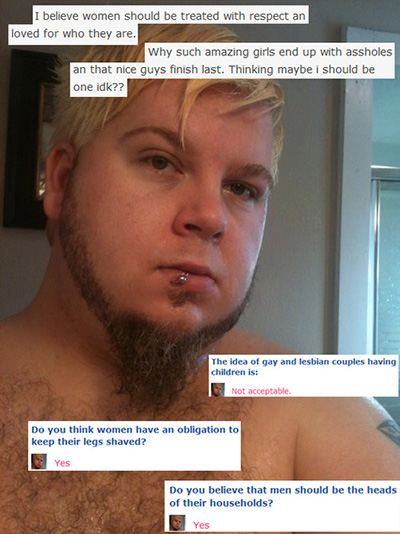
When I wrote Play Nice I elaborated upon the recent fem-centric trend of ridiculing self-professed Nice Guys. The notion of Nice Guys only using the monicker as a ruse for an assholish reality has been a staple response for Alpha-burned women for decades now. However, an interesting threshold is being crossed when a globalized internet society begins a campaign of mass ridicule of Nice Guys.

Nice Guys of OK Cupid is one such effort.

While I’ve come to expect women’s rationalizations about Nice Guys as foils for their attention needs, what NGOKC illustrates is an escalation in beta male in-fighting. Some have called this ridicule cyber-bullying on a global scale, but there’s more to this than that. The progression from rebuking forum white knight to online attack blogger is evidence of a new comfort level the femosphere has in sowing discord amongst the beta orbiters they rely on for fem-centric male affirmation.

NGOKC is really a clever new twist on Dalrock’s proposition of “lets you and him fight.” In viscerally exposing OKC Nice Guy profile pictures and pairing them up with subjectively contradicting statements about being ‘nice guys’, NGOKC is (perhaps unwittingly) attempting to define what makes a guy genuinely “nice” based on the terms that indicate feminine supremacy.

If you peruse the sampling of ‘nice guy’ case subjects on the blog you’ll begin to see a pattern form. A, most likely out of context, declaration of ‘Nice Guy-ness’ paired with some horribly incongruent statement about expectations of women’s legs being shaved or men being the head of the household. The social experiment that NGOKC is involved in starts with its efforts in qualifying ‘Nice’ as being compliant with what best serves the feminine imperative. Do you like the feel of a woman’s smooth legs that she painstakingly shaves 7 times a week? You’re not a Nice Guy. Do you believe that men should be confident, decisive, heads of the household? You’re not a Nice Guy either. In fact if you indicate on your profile any belief that is inconsistent with absolute, equalitarian gender neutrality, you’re not a nice guy.

For all the semantics debates the manosphere gets into over the proper usage of “Nice” for men, the binary nature of the femosphere is definitive; if a belief is contradictory to the feminine imperative, it is decidedly “not nice”.

Beta Fights

Being that beta men constitute the vast majority of men in modern society, one of the larger problems of being an abject beta is the sheer volume of sexual competition they experience from other betas. When a beta chumps is AMOG’d by an Alpha there’s an almost tacit understanding by the beta that the Alpha held an advantage over him. The Alpha had the physical, Game and status tools the beta does not. However, put two (or more) betas in contention with each other and they will resort to ever escalating feats of greater beta qualification amongst each other. When all you know is Beta Game, only more intense applications of that game is the natural response to competition within Beta Game.

NGOKC is one such escalation in the Beta Game arms race. From Enter White Knight:

Every random chump within earshot of your conversation about Game, about your ‘changed’ way of seeing inter-gender relations, about your most objective critical observations of how women ‘are’, etc. – understand, that chump waits everyday for an opportunity to “correct” you in as public a way as he’s able to muster. That AFC who’s been fed on a steady diet of noble intent, with ambitions of endearing a woman’s intimacy through his unique form of chivalry; that guy, he’s aching for an opportunity to prove his quality by publicly redressing a “villain” like you for your chauvinism.

By essentially doxxing the Nice Guys on OKC, NGOKC is a blog dedicated to beta white knights attempting AMOG other betas while the women of the femosphere egg them on. The social impetus behind the blog is one of beta men jockeying for feminine approval by ever increasing declarations of being more suitable, more feminine identifying betas, than the so-called fraudulent Nice Guys they hope to expose. They’ve made a game of qualifying for the approval of the femosphere by looking for chinks in their competitor’s beta armor:

“I’m a nice guy,..”

“Charlatan! You want to oppress women by expecting to be the head of the household! I’m the real nice guy,..”

“STFU rape apologist, says here you’re open to first date sex, and what type of guy has tats and piercings like that? Rapists, that’s who! I’m the real nice guy,..”

“Misogynist, looks like you expect women to shave their legs,…FOR YOU!,..only fucking patriarchs think women should make themselves ‘acceptable’ for men,..I’m the real nice guy,..”

The feminine influence naturally loves the beta dystopia between guys they’d never want to fuck otherwise because it primes their need for indignation while simultaneously satisfying a woman’s need for attention and affirmation of her own imperative.

Obligation

One of the things that solidified this beta in-fighting for me was reading Hugo Schwyzer’s Jezebel endorsement of NGOKC.

Hugo Schwyzer has a rightly earned reputation in the manosphere for being a manboobed captain amongst the vichy males feminization has made so common through its selective breeding efforts . The lengths to which he’s ego-invested his life, career and personality into a feminine identification schema is truly grandiose. Hugo’s gender self-loathing is a monument to the dictates of the feminine imperative – he is what feminized men would ultimately become in a society defined by the feminine imperative.

While I have patience for the likes of Manboobz and even the information deficient members of the PUA Hate forums, Hugo is a step beyond their simple mockery.

What’s on offer isn’t just an opportunity to snort derisively at the socially awkward; it’s a chance to talk about the very real problem of male sexual entitlement. The great unifying theme of the curated profiles is indignation. These are young men who were told that if they were nice, then, as Laurie Penny puts it, they feel that women “must be obliged to have sex with them.” The subtext of virtually all of their profiles, the mournful and the bilious alike, is that these young men feel cheated. Raised to believe in a perverse social/sexual contract that promised access to women’s bodies in exchange for rote expressions of kindness, these boys have at least begun to learn that there is no Magic Sex Fairy. And while they’re still hopeful enough to put up a dating profile in the first place, the Nice Guys sabotage their chances of ever getting laid with their inability to conceal their own aggrieved self-righteousness.

Nice Guys of OkCupid provides an excellent opportunity to reiterate a basic truth: there is no right to have sex.

This represents the basic disconnect that a feminine conditioned male like Schwyzer can’t grasp. He’s very concerned that self-avowed Nice Guys harbor this endemic, deep expectation of obligatory sex in lieu of ‘being nice’, yet remains willfully ignorant of the nature of exchange inherent in the sexual marketplace. Of the hundreds of self-professed nice guys I’ve known or counseled, not one of them expressed an expectation of reciprocal sex. In fact the genuine ‘nice guys’ are so self-sacrificing that the idea of a social contract of reciprocal sex is alien to them.

The new popularity of Nice Guy demonization that Hugo and the predictable, gender trend vultures piling on at The Atlantic isn’t about expectations or entitlements it’s about the underlying and unspoken reciprocal nature of the sexual marketplace being exposed. When a ‘nice guy’ does express some angst over his sexless and solitary life, or does bring his Savior Schema to the surface in a public fashion it becomes an ugly reminder for the feminine that the SMP is actually that, a marketplace. A fem-centric society doesn’t like the idea of a visceral resource exchange, because it ruins its humanist/equalist social pretense. Solution? Ridicule and marginalize the one doing the exposing.

Besides the near-universal sense that they’ve been unjustly defrauded, the great commonality among these Nice Guys is their contempt for women’s non-sexual friendship. They rage about being “friendzoned,” and complain about the hours spent listening to women without being given so much as a hand job in return for their investment.

Because Hugo has been so well conditioned by his feminization he lacks any frame of reference to understand the reflexive rage these “false-flag nice guys” experience. This rage response isn’t the disappointment of some societal masculine influence convincing these guys of a sex-debt obligation, it was the entirely feminized influence which convince them of myth of Relational Equity:

…I’ve repeatedly read men relate to me when they say how unbelievable their breakups were. As if all of the investment, emotional, physical, financial, familial, etc. would be rationally appreciated as a buffer against hypergamy. The reason for their shock and disbelief is that their mental state originates in the assumption that women are perfectly rational agents and should take all of their efforts, all of their personal strengths, all of the involvement in their women’s lives into account before trading up to a better prospective male. There is a prevailing belief that all of their merits, if sufficient, should be proof against her hypergamous considerations.

For men, this is a logically sound idea. All of that investment adds up to their concept of relationship equity. So it’s particularly jarring for men to consider that all of that equity becomes effectively worthless to a woman presented with a sufficiently better prospect as per the dictates of her hypergamy.

Hugo’s preoccupation with the sex-debt obligations for being ‘nice’ is a convenience for his inability to address the concept of relational equity. In a sense he’s correct, men should never presume that anything they do, any personal sacrifice, any emotional investment they make for a woman will EVER be appreciated, much less reciprocated, because hypergamy doesn’t care about any of it.

If these ‘nice guys’ are guilty of anything, it’s in their ego-investment in the lie that any woman might have the capacity to appreciate his investments in them. That rage isn’t about the disappointment of not getting an expected lay, it’s the self-rage associated with the disillusionment of a belief in a relational equity that women (often times the same women they want to become intimate with) continue to convince them of. It’s a rage that comes from the loss of investment and being ridiculed for ever having invested by the same women who convinced them to invest.

So thank you Hugo, you’ve unwittingly made the manosphere, Game and red pill wisdom all the more attractive for ‘nice guys’ with your exposé. The obvious moral to this story is to drop the pretense of being a ‘nice guy’ and embrace a self-concerned Game perspective. In other words, unplug. Drop any expectations of a mutual respect, shared purpose or infantile visions of an idealistic love – because you have no ‘right’ to something women fundamentally lack the capacity to reciprocate. Your idealized relationship doesn’t exist in a feminine frame, it only exists in a positive masculine frame of your making. The only thing ‘nice guys’ have to lament is not embracing these truths before they posted their profile pic on OK Cupid.

Queens, Workers & Drones

mount

As I’ve stated in many prior posts, it is Men, not women who are the True Romantics. It is actually Men who will more readily alter their lives in the most radical of ways to achieve what they think is an idyllic state of monogamy with their ‘Woman of Quality’. I understand how this statement may conflict with women’s (and mangina symp’s) characterizations of ‘typical guys’ just wanting to fuck anything that smiles at them, but this sentiment is only designed to maintain the feminine as the victimized gender.

It is in fact Men who are more prone to wanting commitment from a woman. The operative word here is “wanting” commitment.

Men are now also just as likely to want to get married as women and more likely to fall in love at first sight.

Experts said that the results were evidence of ‘gender blurring’ in which women have become more like men and men have taken on the characteristics usually associated with women.

I doubt that last quote from this article will shock my regular readers. Considering that the overwhelming majority of men are corn-fed betas, raised from birth to be devoted, “supportive”, wives to their masculinized fem-husbands, it’s really no surprise that men would be the ones seeking solace in a monogamy they’ve been conditioned to believe should be their goal-state for so long.

While betas are concerned with qualifying for an idyllic monogamy, Alphas tend to focus more on fidelity – their women’s fidelity, not necessarily their own.

Feminized Commitment

One very effective meme the feminine imperative has cunningly inserted into our social awareness is the feminine ownership of the term ‘commitment’. Calling a guy a ‘commitment-phobe’ is really a 90’s shaming cliché that’s been a retread for the Man Up! generation. There are different variation of this shaming – a guy can be ‘phobic’ because he lacks maturity, or because he’s become bitter and burned by a spurned woman, but underneath all that is the association that the concept of commitment uniquely applies to a man committing to monogamy with a woman.

From the Paradox of Commitment:

The idea is that commitment should only have meaning in a feminine defined reality. Ironically, it’s Men who commit far more readily to ideals, family, military, business ventures or partnerships, and servitude than women have the capacity to appreciate, because recognizing this doesn’t serve their imperative. In other words, a commitment to anything that doesn’t directly benefit the feminine isn’t commitment; answer? Redefine commitment to reflect feminine interests.

One thing that needs to be understood about women’s innate feminine solipsism is how it’s expressed on a meta-scale. It’s very easy to observe and consider individual examples of women’s subconscious sense of self-importance (read any comment from women on a manosphere blog) , but what most men aware of this phenomenon don’t consider is how this solipsism scales up to the larger social narrative.

I’ve written extensively about the Feminine Reality and Feminine Social Primacy, but these have been ‘top down’ assessments with regard to how society follows a feminine primary narrative as the correct premise of origin. Put simply, if it benefits women, it benefits society – society is better when benefiting women’s imperatives are its focus.

However, from a ‘bottom up’ perspective it is this proclivity for solipsism in women that collectively becomes the social narrative (or paradigm if you prefer). Millions of women solipsistically expressing the demands that would ensure a secure hypergamy for themselves makes for a fem-centric social narrative. And from this develops an expectation of, and entitlement to a default, secured commitment to satisfying women’s hypergamic impulses.

Selective Breeding

So powerful is this sense of entitlement, so consuming and convinced of the correctness of their purpose is the feminine that women will literally breed and raise generations of men to better satisfy it. Hypergamy is cruel, but nowhere more so than in the relationship between a mother overtly raising and conditioning a son to be a better servant of the feminine imperative.

But to breed a better worker, the feminine imperative’s queens can’t afford to have any corrupting, masculine, outside influence. On a societal scale this might mean removal (either by disincentives or forcibly) of a father from the family unit, but this is the easy, extreme illustration. There are far more subtle social and psychological means that the imperative uses to effect this filtering – via mass media, social doctrines, appeals to (feminized) morality, the feminine is placed as the correct imperative while the masculine is filtered out or apologetically tolerated as vestiges of an immature and crude reminder of masculinity’s incorrectness.

Yet for all of this social engineering Hypergamy still demands satisfaction of women’s most base imperative, Alpha seed. The queens need physically / psychologically dominant drones – if just for a season and at their ovulatory pleasure. While beta workers are endlessly vetted in sisyphean tasks of qualifying for the acceptance of the feminine imperative, the Alpha drones live outside this shell; their qualifications only based on how well they satisfy the feminine’s visceral side of  hypergamy.

The great irony of this social solution to hypergamy and long term parental investment is that the vast majority of the offspring of this arrangement would be raised to be better workers. Those betas-to-be boys must be insulated from the corrupting influence of the drones lest they devolve into the Alphas they crave yet cannot control. It may seem counterintuitive, to raise what should ostensibly be optimized genetic stock as a cowed, sometimes medically restrained, feminized beta males. However it is through this harsh conditioning that truly dominant Alphas must rise above. Essentially the genetic lottery isn’t won by women in such a social environment – it’s men, or the ones who rise above in spite of the conditioning efforts of the feminine imperative.

Generation AFC

We’re just now seeing the results of almost three generations of this selective breeding effort. While women bleat and bemoan, “Man Up!” over the lack of suitable men to meet both their hypergamy and their provisioning, they only grind their teeth at the results of a social momentum set in motion by women two or three generations before them. While more boys are raised to pee sitting down by women concerned that their sons’ testosterone poisoning will make him a potential rapist, the fewer and fewer “suitable” males present themselves 20 years later.

A lot has been made about men just checking out or giving up on themselves as they reach a projected notion of maturity. The feminine complains about them not living up to the standard set before them by the feminine imperative – women are owed reverence and tribute of an enduring security, why are men not sacrificing themselves on the altar of the goddess? In the face of all the so called social advancements in women’s independence over the past 50 years we still hear a deafening cry for ‘real men’ to measure up, to qualify themselves for acceptance, to be worthy of providing for her and (her) offspring. Despite the refutations of masculinity and claims of independence, women still want Men.

In the manosphere it’s been argued that the reason for this sexual disparity and men’s ambivalence is due to some new awareness among men of the way the Game has been rigged against them. It’s been argued that men are consciously opting out – going their own way – in some new social movement causing a de facto ‘marriage strike’. I think this estimation is greatly exaggerated.

The male crisis of this generation isn’t the result of men’s conscious decision to opt out, but rather due to being forced out by this selective breeding. As exampled in my first link, men want to get married. It’s part of their feminized conditioning to view long term monogamy as a goal state. No, the men that women want to “man up” are the ones they’re already married to, or the ones they’d consider worthy if only they acted (not actually became) more like drones and less like dutiful workers.

It’s not that the vast majority of men wouldn’t eagerly bind themselves to women in monogamy, it’s that they’ve been bred in grand proportions to be ‘less-than-men’ by the feminine imperative.