Timeline of the Professional Woman

Most ‘professional’ women are forced into an uncomfortable choice in life. Generally women in this demographic have decided to pursue a career at the sacrifice of caring for a family, and for some, initially, there is a learned disdain for the idea of being ‘trapped’ in a domestic life. Some are aware of this sacrifice and some are not. Most professional women swallowed the all too common ideology that “you can have it all”, a ‘rewarding’ career, a family and are deserving of an equally professional, equally intellectual husband that will respect her choosing the career path and equally share in what she perceives as his domestic duties. This of course is the new image of the American Dream for egalitarian equalists. And like most professional women, at some point they come to realize this dream is false because the sacrifices required to attain this fantasy defeat it’s own conditions.

Timeline of the Professional Woman

At age 18 she’s progressed through high school with a high GPA and her single mother or 2 parent equalist family (only rarely is it a single father) has raised her to believe she can go far, and through the financial aid available only for women and/or the college fund her parents planned for her to be ready to compete in “a man’s world”, she’s ready for college. Not a bad thing for a woman who understands the future sacrifices she’s about to make and is ready to actually meet the challenges of a University and a ‘promising’ professional career.

At age 24-26 she’s achieved a bachelor’s or master’s degree, perhaps a doctorate by 28. More often than not though it’s a bachelor’s degree, and an expectation of professional respect in the professional world. 90% of professional women graduate with education, psychology, journalism or communication degrees. That’s not to say some don’t seek out careers in law or medicine or business, they do, but in far fewer numbers. Regardless of her education, her expectations are the same as her peers – once in the workplace she will be rewarded and respected based on merit. Unfortunately, in the professional world, things don’t go as smoothly as her Women’s Studies teacher prepared her for. She discovers that to function as a professional she is also required to be responsible as a professional and more times than not, it’s not all that ‘rewarding’. In fact it entails a lot of rejection and a lot of hard work at the sacrifice of a personal life and personal relationships.

At 30 she sees the girlfriends she went to college with married and perhaps having their 2nd child. She still clings to the self-affirmation that her choice requires she have, but can’t understand why she hasn’t ‘gotten it all’ by now. She’s single or may even be divorced at this point, but looking for that ‘professional’ and intellectual equal of masculinity that the fantasy sold her, yet it hasn’t quite worked out that way. Most guys her age don’t have the intellect she expects they should or they lack the status in their careers. Men more successful and mature aren’t interested in her since she pales in comparison to the 22 y.o. women they seem to prefer.

At 35 she’s achieved quite a bit in her career, but has no prospect for a family at this point. She enjoys reading the articles in the women’s magazines that affirm what she thinks she experiences often enough – that men her age are juvenile with ‘fragile egos’ and only want to become involved with women in their 20’s because they feel ‘threatened’ by a woman who would dare to be their equal. The truth being that the men who she’d consider her peers are hardly juvenile at this age, but rather calculating, they generally have a better understanding of what they want and what is satisfying for them after more than a few failed attempts and have learned how the game is played to a greater or lesser degree. Particularly professional men of the same or higher status than she, since they have more access to being particular with the women they choose to become involved with. They are aware that the 35+ y.o. professional woman’s personality has been shaped by 12-15 years of expectations of ‘having it all’ and they are aware that she is generally not a good candidate to start a family with since he knows all too well the sacrifices and responsibilities necessary to achieve his own status. A career man rarely sees a career woman as a good choice for a wife or an LTR, not because he’s ‘threatened’ by her status, but because he’s known and worked with enough of them once he’s reached 35+ years of age to steer clear of them.

Men typically could care less what a woman earns or what she does to earn it – it’s simply not a factor in attraction for us – we don’t take a woman’s status or wealth into consideration; all she has to be is hot. That is a guy’s one condition for intimacy, physical attraction, sexual availability. She’s gotta be hot – whether she makes six figures or is in the pit of poverty is irrelevant in attraction. Oprah and Star Jone’s husbands still have to get aroused, and all the money in the world wont be any better an aphrodisiac.

Status, wealth and the other rewards that result from ‘professional’ life are conditions women have for MEN in attraction. That’s not to discount men being physically attractive or other conditions, but women have far more conditions for their intimacy than men, and these conditions are predicated on characteristics that prove a man as a good provider for her and any future offspring’s security. These male characteristics (or sometimes just the prospects of a man attaining them) are defined by women as having value and are therefore attractive. Attractive enough to make a man with these qualities one to be competed over with other women. Women define what is masculine, they define what male traits have value for their investment of intimacy. Men define what is feminine, they define what female traits have value for their investment of their provision of security and meeting the condition criteria women place on them for their intimacy.

The ‘Today’s Woman’ crowd loves to use this pseudo-fear that men are expected to have in response as to why guy’s ought to be ashamed of themselves for basing their attraction on the physical by blaming it on ‘men’s fragile egoes’ or how they ‘feel threatened by professional women’. It comes down to an expectation and entitlement from their ‘professionalism’ that men should redefine their own attraction based on what women find attractive in the masculine.

This is the overreach of the feminine imperative – to attempt to thwart men’s biological predispositions by convincing them what they should find attractive and arousing in women. This becomes all the more ironic when you consider that the women the imperative would have men be attracted to are masculinized versions of  women.

Women in the professional realm would like the conditions for attraction to be predicated upon their professional status (wealth), individual merit and/or aspects of their personal integrity, and a whole list of esoteric qualities, but they still fight against men’s basic impulses – she’s-go-to-be-hot! If a woman is attractive, a man is more than happy to have her foot the bill regardless of comparative incomes, it’s just icing on the cake for us, but this is analogous to a woman who marries a rich guy who also happens to be good looking and fun in bed.

As most women bemoan, men have a tendency to see women as sex objects in attraction. Women have a tendency to see men as success objects. The problem with this ‘professional woman’ mythology is that professional women want to be success objects themselves, but nature keeps confounding their efforts.

Now, all of that said, if a woman’s choice is to enter the public realm and pursue a career in the same fashion that men have for years, more power to her. Great, you go girl, so long as she understands the responsibilities and liabilities of doing so. They should also thoughroughly understand that men will define what is attractive for them, not women, professional or otherwise.


Protracted SMV

Leave it to Roissy to scoop me on my own posts:

Rollo Tomassi writes:

Thank you Mark Zuckerberg for creating the single greatest time-comparative engine men have ever known. I’m not a big fan of Face Book from a male standpoint, but if it has any redeeming aspect it’s that it provably shows men, in stark contrast, how women’s SMV declines. This is driven home all the better because the subject women are usually ones he’s known personally for a few years.

I entered my 20s in the early 90s, well before the internet went mainstream. I can vividly remember the women I was banging then and the ones who wouldn’t have a thing to do with me. Now I see them 20 years later thanks to social media and every single one is just ravaged by time and lifestyle. I’ve accepted friend requests from women whose memory from 20+ years ago are ones of flirtatious, beautiful lust-inspiring youth, all to be shattered when I see photos of them in their late 30s and early 40s. Then I pray to God and thank Him for sparing me from being yoked to cows like that in spite of my consuming desire at the time to get with them.

Take a minute to digest this: we are really the first generation of men to have such a convenient comparative tool. There was a time when a man could get with (or not) some girl he fancied and never see her again. Young men hear all the time how inconsequential the women they pine for really are in the grand scheme of things. Now the older men giving him advice have a tool to prove and emphasize that advice, and women have cause to lament the ugly, provable truth.

I had imagined going into this dynamic in more detail when I wrote it a few months back, but Roissy’s pretty much summed up my thoughts fairly well. However, one thing I couldn’t have accounted for is the inevitable female response to this dynamic, as represented in the comments by Maya (the troll):

Such a pleasure when you see us getting old and worthless, isn’t it?
If this makes you feel better about yourself …

I can fully understand why women would think men acknowledging this would be mean-spirited. Women’s innate solipsism predisposes them to thinking that viscerally identifying their SMV’s decay is an attack on them personally. Vitally important ego-investments tend to bring out that kind of defensiveness. That’s really not what I had in mind when I wrote that.

I primarily write for Men’s benefit, though I think women may learn something along with it. In writing this, my intent was to provide men with an overall perspective of their own, protracted SMV in comparison to women’s protracted SMV. Naturally, women will see that as an affront because it casts their sexual strategies in a negative light, but think about the beta chump struggling with thoughts of suicide because he thinks he’s losing his soul-mate in a break up at 19. We may live in girl-world, but sometimes our emotional wellbeing, even our own survival, depends on resisting it’s influences. As I said, I believe Face Book, and the greater part of social media, dynamically serves the feminine imperative – attention, affirmation, voyeurism, gossip, etc. – but allow a man to even recognize a use for it that serves to put things into a masculine-positive perspective and he’s attacked and shamed for it by default.

It’s a simple matter to tell a guy he’s dodged a bullet in the cosmic scheme of things, but it’s altogether different to provably show him how he’s dodging it. For all the evils of facebook at least it gives him an ability to see the forest for the trees, but the feminine can’t even afford him that. You must stay dumb, you must stay plugged-in for the feminine to maintain primacy. For all the benefits of a globally connected world, the feminine imperative expects you to accept a feminine-centric normalization of it.

Chasing Amy

Beware of making a Quality woman your substitute for a ONEitis idealization.

As an addendum to the Good Girls Do post from a week back I’m submitting an insightful story about the disillusionment Christian beta-males had with Amy Grant.

Here we have a purile Amy Grant-as-sex-object; only that object fits an idealization so she becomes the mythical Quality goal for moralistic men. She fit the bill perfectly; hot, virtuous, talented, etc. She offered the perfect fantasy in that she (or other women like her) would be patiently waiting for her husband-to-be (i.e. them) to share her virginity on their marriage night, be the best sexual experience conceivable in this reality, PLUS the best virtuous experience by definition.

All that comes crashing to the ground when Amy gets off on the pre-marital sex, “she enjoyed it”, and falls from grace. She becomes human, the idealization shatters and the vitriol ensues. Now she’s secular, an insincere charlatan that led them to believe something false. She’s suddenly “low quality” and they hate her more passionately than had she not fit their idealization to begin with, and all the girls who modeled themselves after her are now suspect of her sins by association.

People are going to be people. What this essay doesn’t elaborate upon is that eventually Amy Grant cheated on her husband with Vince Gill (also cheating on his first wife) and they got married and are all fat, rich and happy.

Sex, Amy Grant and the Quest for the Righteous Fox

By Mark Olsen

Almost a decade ago, riding a church bus back from the obligatory summer choir trip, a friend turned to me and I heard these words for the first time. “Hey, check out Amy Grant.”

I slid the earphones off my head and wrinkled my nose. “Yeah, I know. That folksy singer, the sincere one.”

I’d heard about her, read some gracious reviews of her first few releases, but my curiosity had never ignited. Her image seemed kind of limpid. And then my friend handed me a copy of a Christian mag. There lay a full-color picture of Amy, beckoning from the page.

“No. I mean, check her out. She’s all right.”

So I checked out Amy’s picture. All of a sudden, my interest knew no bounds.

You have to understand. Back then, in the waning years of high school, my church friends and I were the epitome of Contemporary Christian Youth. We
were the paradigm. We would pray for our back-slidden acquaintances and then go watch them perform at keg parties. We would scrutinize Pat Benatar and Styx albums for signs of latent Christianity. We would agonize over the dearth of hot guitar licks in so-called Christian rock. Then, having gratefully discovered Phil Keaggy, we would play him to our unsaved friends, bending towards the speakers with satisfied grins, watching eagerly for their silent nods of approval.

All this is relevant. It’s relevant because high atop this slightly marginal, oddly acclimated Christian teenage-male subculture, towered the seductive Myth of the Righteous Fox.

Hovering languidly at the end of our frustratingly virtuous dating rainbow, this beautiful and unsullied babe of legend had rejected the lure of football jocks and fast cars and saved her beauty for an earnest Bible-studier and choir-attender (who also happened to be cool, hip, and into rock’n’roll) – someone, of course, remarkably like us. The Righteous Fox would be God’s reward for having survived, for having endured. He knew how many youth group videos on sexual purity, and the saccharine, fifties-laced condescension of countless off-the-cuff pastors’ talks we endured. She was our revenge on those unsaved guys who’d nearly convinced us we’d missed the action.

Reduced to its bare Quixotic core, the Quest for the Righteous Fox consisted of a never-ending search for that really cool, deeply spiritual chick who’d hung out with the guys just long enough to make every last one – except for ourselves – overlook her blinding-yet-unobtrusive beauty (Pointing out once again the Quest’s most delusional side-effect: The Fallacy of Original Attraction).

Only one problem though: true Righteous Foxes were (and still are) incredibly hard to find. And nearly impossible to find before another hard-scamming Christian dude discovered her first. Yet the fantasy persisted. It invariably followed these exacting parameters:

We and The Fox would spot each other someday, eyeing each other soulfully over the pages of our Bible study guides, knowing, with that mutual instinct borne of fate, that we had found The One. We would ply her with a typically Christian courtship, spent in the festive embrace of a youth or college church group. Then finally, mere hours after a ceremony of Contemporary Christian music interspersed with wedding vows, she would reward our years of grudging virginity with the pure abandon of sanctified lust. (The best kind of sex there is – we  ‘just knew’ it.)

“She’s out there,” we’d say. “Just waiting for me.”

But for a while, we weren’t so sure. The girls in our youth group … well, we didn’t think they qualified, on account of the babe criterion. Familiarity breeds … well, you know. We caught fleeting glimpses of The Righteous Fox at youth rallies, desperately scanning the crowds, pining for another glance like Richard Dreyfuss in “American Graffiti”. We spoke longingly of the babe-laden youth group in the neighboring town. But she never seemed to find her way into our lives.

That is, until Amy.

Amy made our blood boil; she burrowed into our imaginations and oppressed our dreams. She made us gape shamelessly, as I did when I first saw in person Amy’s big doe-eyed sincerity, cascading brown hair and crooked smile, and was smitten with the knowledge that God had finally epitomized the Righteous Fox in human form. Amazing thing though: along with the knowledge came the blazingly idiotic notion that I alone had apprehended this miraculous insight.

But the idiocy didn’t last long. Midway through my first Amy concert, I looked down from the sight of her wafting one more song for Him and over at my best friend Ted. I realized it was all over. Our eyes met and we both knew, fresh from the eyes of our private fantasy, that this was no bolt-from-a-blue-sky occurrence. The affliction was well-nigh universal, shot through the heart of every glazed-over, slack-jawed Christian male in the concert hall that night.

Her beauty wasn’t – quite – what you’d call striking. It was different than striking. Amy’s appeal went much deeper than mere physical perfection. And the sincere, profound beauty Amy manifested, she seemed – no surprise to us – unaware of. (She might cultivate her looks, but she’d also – somehow – remain completely oblivious to them.)

If you were to go out with Amy, you could count on her not to cake on the make-up. You could just tell. And a girl like her probably wouldn’t kiss you on the first date – although she wouldn’t make you wait much longer either. (No gratuitous prudery in Amy’s life.) And she’d never complain about the flaking paint job on your car. You’d never innocently trust in her character, then hear the guys report with leering tones on Monday morning that she’d been spotted sneaking beers in the Dairy Queen parking lot. No, you’d known where Amy’d been – on a Youth Council retreat with a gaggle of lesser companions, plotting hayrides and witnessing strategies. And as for the premarital thing … don’t even think about it.

Man, did Gary Chapman ever shatter that pipe dream.

First, I heard she was engaged. Through my grief and dismay, I discerned only a slight tarnish on my luminous Amy image. But some time later, I heard the worst.

She’d gotten married. Worse yet, by the time I’d heard, the wedding had actually taken place weeks before, meaning that – barring some unlikely scenario – the union had most certainly been consummated. That hurt. Gary had compelled Amy (through some unfair form of coercion, no doubt), to say, “I do,” to someone other than ourselves. The simultaneous dream of a million young evangelical men vanished in one night. And the ever-so-subtle sexual backlash began the very next day.

Amy didn’t help, of course. Not only did she fail to keep the subject of sex a secret, but she actually started intimating that she rather … well… enjoyed it. Stories started circulating of unsettling, injudicious comments made to magazines and concert audiences. (Did she actually mention “…getting our rocks off…” to Rolling Stone?Certainly not something “Jesus would say.”)

I noticed the backlash myself beginning with Amy’s first video. Ted could hardly contain his indignation over one salacious sequence in which Amy shed her jacket and the camera followed the garment – apparently not briskly enough – down over the inflammatory regions of her body and to the floor. “It’s almost pornographic,” he said. I watched it with him, and saw nothing remotely lewd in the move. (Just the same, our eyes never left the screen. We never blinked.)

Soon I started to notice a pattern. The guys were grumbling. The girls were growing catty. I noticed, within my own dreams, a growing dissatisfaction with my cherished mental-Amy-scenarios. My short-reel romantic visions were falling off the sprocket before I could even begin the date that inevitably followed our accidental back-stage, love-at-first-sight meeting. All because of the interloper husband, whose presence had transformed those visions from highly unlikely into now empty
fantasy. And also, quite frankly, because Amy was no longer a virgin. The script had lost its appeal. The Righteous Fox had tumbled off our rainbow.

Then it got worse. Amy mutated from the soft-focus Vermeer-lit goddess of the ‘Age to Age’ album cover into the leopard-skinned temptress of the ‘Unguarded’ album jacket. The guitars started coming out of the shadows. The drummer started using drumsticks. Finally, Amy seemed to have done what everyone had feared so long: “Gone secular.” And Amy “going secular” gave our collective discomfort a channel for expression. We turned on her with a vengeance.

It’s been years, of course, since all this took place. And in that time, many culturally plugged-in Christians have become aware of a fairly pervasive, surprisingly virulent anti-Amy backlash. Most intelligently assume that it stems from the dilemma surrounding whether a Christian performer should dilute or reduce their religiosity to broaden a potential audience. Again, the old debate over “going secular.” In light of her recent mega-stardom, it sounds logical.

Naah. It’s about sex.

It’s about this: she used to be ours, and now she isn’t. She used to be Contemporary Christian subculture’s fresh, untouched, pretty young secret. Then she gave herself away. First to a man, then to the unwashed masses over in Adult Contemporary. And now years later, many of us still haven’t forgiven her. We haven’t forgiven Amy for getting married, for daring to admit that she is a sexual being, for bearing children (lest we forget, the most glaring result of carnal relations). Most of all, we’ve never forgiven her for not choosing us.

Among the women, many of whom appear to be the most strident Amy critics of later years, I detect the venting of some long-repressed frustrations. They’re the “other girls” of our youth groups. The ones who saw the best guys hold out for a dream; causing them to attend Valentine’s banquets with their little brothers. They’re the ones the Quest left behind. The girls who, somewhere between graduation and first summer back from college, mysteriously acquired the mystery and allure we thought they’d lacked.

They’re the women we married.

They don’t make love every time with the ardor of twenty pent-up years, and they don’t “submit” quite as well as Marabel Morgan would recommend. They don’t spout spiritual wisdom every time they open their mouth. But they’re the ones who took us in after the Righteous Fox fell from grace.

Meanwhile, Amy seems to opt for surprisingly mundane activities back down on the farm. Conceiving children. Bearing children. Raising children. Hosting Bible studies. Mending a marriage. Keeping in touch with friends. Sound familiar? Maybe a few years off that rainbow, the archetype turned into — gasp — a real-life woman after all.

I didn’t repost this story as some indictment of Christian culture, but rather as an example of how plugged-in men develop idealization of their “Quality Woman.” Neither am I trying to convince anyone that “all women are sluts, never trust them.” Both of those characterizations are binary extremes, women lie somewhere in between. It’s a much healthier starting point for men to understand women from the perspective of coming to terms with their pre-conditioned idealization. Your sweet little virgin wants to fuck, and your whore still wants to be a soccer mom.

The Horse’s Mouth

Women would rather be objectified than idealized.

One of the best litmus tests for how unplugged a guy truly is is how he reacts to the words of his idealized woman. I briefly covered this idea in the Self-Righteous AFC:

You see, when an AFC clings to the mental schemas that make up an AFC mindset it requires a constant need for affirmation and reinforcement, particularly in light of their glaring lack of verifiable success with women while clinging to, and behaving in accordance with the mindset. AFCs are crabs in a barrel – once one get to the top to climb out another drags him back in. The AFC needs other AFCs to affirm his blatantly obvious lack of success. He needs other AFCs to tell him, “don’t worry just be yourself” or “she’s just not a quality woman because she can’t see how great a guy you are.”

So when an AFC finally does get a second date and then finally does get laid it becomes the ultimate validation for his mindset. “See, you just have to be a nice guy and the right ONE really does come along.” This is when the self-righteous phase begins and he can begin telling his Game / PUA friends that he’s “getting some” now without all the Positive Masculinity claptrap. In actuality he rationalizes away all of the conditions that lead up to him getting the girlfriend and the fundamental flaw that he’s settling for a woman “who’d fuck him”, but this doesn’t stop him from claiming a moral highground. His long wait is over and he’s finally hit paydirt.

This need for validation of a Beta Game mindset is very strong for guys – particularly when you consider a lifetime of being steeped fem-centrism’s conditioning. When you grow up in girl-world you want to believe the idealizations of women are actually attainable. This is what makes the ‘red pill’ so hard to swallow; men truly want the fantasy, the romanticism and love, in the context girl-world presents it to them for so long, to really exist for them. This is what makes believing women’s individualized words, rather than their globalized behaviors, so seductive for men – even for Men who’ve become self-aware in the feminine Matrix.

Straight from the Horse’s Mouth

When a woman (or a man impersonating a woman) posts some self-description or personalized experience about how they conform more to this idealization than to the “silly caricatures of bitter misogynists” online, this triggers an internal conflict for men. Men want to believe that the exception to the rule could exist for them since it agrees with his initial social conditioning, but the learned, unplugged, conditioning he’s applying to see the forest for the trees, and factoring in women’s generalized, observable behaviors as a better method for determining intent, fights against this. Becoming Game-aware teaches Men that the medium is the message, but to varying degrees Men still want to believe that women are completely self-honest, rational agents, and cognizant of their internal motivations. Eventually applied behaviorism puts the truth to this deception, but it’s very hard to let go of that want for an easier answer.

In our ‘plugged in’ years, men rely on the same deductive pragmatism with women that we use to solve most other problems. Our problem solving natures predispose us to objectifying the elements of a problem to arrive at a solution. Even our neural wiring is designed to achieve this end, so it’s literally a ‘no-brainer’ to want reliable, rational data on which to base our plan to solve a problem – in this case getting laid and receiving intimate approval from a woman. Thus our next question is “what do women want?”

What Women Want

I can remember asking this very question uncounted times in my plugged-in teenage years. Hindsight being what it is, I can only laugh now when I read teenage guys still asking the same thing 4 generations later. It seems so intuitive and considerate of a woman’s sensibilities; guys think it presents the countenance that a man cares enough to create himself in her idealized image. Women and girls naturally love to answer this question because it gives them a default authority, while at the same time feeds their attention needs. It’s such a popular topic that even rom-com movies are based on the question and the zany misunderstandings that result from men’s ridiculous attempts to understand the oh-so unknowable, mysterious natures of women’s true desires. Silly, silly men.

The truth is much simpler. Women either lack the awareness and self-honesty to acknowledge what it is about men that women in general (not just individualized to themselves) want, or they deliberately misdirect and evade men’s efforts to make deductive sense of their motivations because, in truth, they want a guy who ‘gets it’ on his own without having to be told. In either case, whether due to ignorance or duplicity, the secret of the ugly, cruel truth of female hypergamy is to be protected and obfuscated as women’s first priority. So important is keeping this truth from men that the feminine imperative must socialize it into women’s collective psyches. One of the great threats that Game theory represents to feminine primacy is revealing the truth, and the atrocities that result from feminine hypergamy. What do women want? Maximized hypergamy with a man blissfully unaware of hypergamy. The perfect union of emotional investment, parental investment and provisional investment with her hypergamous nature.

However, men still want to believe that women earnestly want to communicate their intimate desires in an effort to make better men. We believe that women, the emotional, erratic, dramatic, mysterious and romantic creatures of story are also consistent, well-grounded pragmatists that rival men themselves and are only waiting for the man unique enough to listen to her. And the more her story agrees with our mental construct of what women should want, the more we want to believe she exists. If she’s convinced of the story this is all the validation most men ever need – he got it from the source, a woman who confirmed the fantasy.

Case Study – Creative Intelligence

Below I have posted descriptions of 4 men from a case study I was involved with as part of a graduate study for personality psychology. Before you ask, no, this wasn’t an original study, however it was a measures experiment we performed to see how the results matched with our own university.These descriptions are excerpts from that case study comparing female mate selection. They were presented individually to 101 university women between the ages of 18 and 36. All were single/unmarried and none were aware of the intent of the experiment. I’ll present more details of the experiment after you have chance to respond so as not to spoil your genuine responses. Here are the descriptions:

––––––––––
M is an art student. M has always had a passion for painting and plans to pursue a career in art. He creates paintings of people and complex landscapes. His paintings are so lifelike that they are often mistaken for photographs. The consensus amongst his art professors is that he is, by far, the most talented student they have seen. One professor, an expert on lifelike paintings, says he believes M is one of the most talented artists ever to produce these paintings. To make extra money to support his schooling, M has sold a few of his best paintings. They have sold for between 100 and 200 dollars. One professor lamented that M’s paintings are worth far more, but like so many other artists, he will probably never make very much money selling them.

L is an art student. He paints abstract paintings. L came into art by chance. He took an art class as an elective because it fit well in his schedule. For his midterm project, he produced an abstract painting after an hour of “fooling around” with the paint and canvas. The majority of the painting actually consisted of paint he accidentally spilled onto the canvas. A very wealthy man who was looking for art for his home discovered L’s painting in the student art studio. He paid L $5,000 dollars for the painting. Some of the man’s other wealthy friends liked L’s painting and commissioned a total of $100,000 in paintings from him. L and his art professors were shocked at the success of L’s paintings, because, in the words of one professor, “he has no real talent, just some good luck.” L continues to capitalize on his success by selling his abstract art.

L and M are considered highly desirable by other women on campus and very attractive. Friends of L and M say that they are dependable, kind, and generous friends.

J is an entrepreneur who had great success in his first business venture. He started a small software business in a friend’s garage. His product was a new kind of software for improving factory designs to radically increase the profitability of manufacturing. Within his first year, J secured contracts with Ford, General Electric, and Boeing. In the next three years, J sold his software to most of the top manufacturing companies in the United States and several of the top companies in Asia. After 5 years in business, J’s company was valued at 120 million dollars and had 250 employees. The Wall Street Journal credited the success of J’s company to the “brilliance and novelty” of J’s product and to J’s “sheer genius as a businessman.” However, J’s company fell victim to misfortune the next year. After J rejected a take-over bid from Microsoft, Microsoft filed a lawsuit claiming that J’s software infringed on some of their patents. Although most experts agreed that the suit had no merit, the cost of defending himself against the lawsuit created huge cash flow problems for J, which drove the company into bankruptcy. Although J has very little money left, he has recently begun a new business venture to sell another of the software products he has invented.

R recently inherited 20 million dollars from the couple who had adopted him when he was a year old. They died in a car crash, having made their fortune in commercial real estate. Before they died, R worked as a sales person at a computer company. Although R worked at the company for several years, he had not advanced past his starting salary or rank within the company. He went to a community college, but after graduation he didn’t feel sure what to do with his life. A friend who was working at the computer company suggested that R join him and work there. In R’s words, “I guess I’m just not very good at this job. At least now I won’t have to worry about money any more.” R and his adoptive parents were very close, and he was deeply saddened by their deaths.

J and R are both attractive and in their mid-twenties. They were recently nominated as two of the most eligible bachelors in Los Angeles.
–––––––––––

Bear in mind, these guys a theoretical archetypes, how they relate to women is irrelevant. How the subject women percieved them is what’s being assessed. Of these 4 men, which do you suppose was rated the highest in desirability with which to have a short-term sexual affair with by these women? And which man was rated the highest in desirability to enter into a long-term relationship with?

This study was done to determine comparative priorities in women with regards to male ‘creative intelligence’ vs.‘provisioning ability’ in female mate selection. I would’ve titled this thread as such, but I wanted to get some unbiased and impulse responses from readers here to see what the perceptions of these archetypes were from men and the reactions guys expected from women to these archetypes.

You’ll notice that care was taken in these archetype descriptions to balance out the physical attractiveness of each man (i.e. both artists were considered equally attractive by peers and both businessmen were ‘eligible’ bachelors). What was at issue wasn’t their extrinsic characteristics – comparative physiques or obvious Alpha presence – but what women chose in regards to these men’s intrinsic characteristics. The theory being that Creative Intelligence is of a higher mating value in the short term while a better Provisioning ability is more desirable in the long term. Bear in mind that hypergamy influences the decision making process for both of these sexual strategies. Also added was the caveat that legitimacy of provisioning ability, and the potential for future provisioning in it’s absence (i.e. the down on their luck men), played a factor in this mate selection.

Creative Intelligence

So what exactly is “Creative Intelligence”? Although there is no firm consensus on how to define it, we often know it when we see it. We also know a bit about it from a century of creativity research. Within humans, creative intelligence is closely associated with the highly heritable general intelligence, and creative intelligence seems to rely on the generation, selective elaboration, and skillful implementation of ideas and strategies. In other words, creativity represents a strong capacity for successful improvisation, thus it became a desirable, selected-for species survival trait.

The problem is that creativity sounds desirable, as does intelligence, so “creative intelligence” can become a vague term that seems useful for solving any behavioral problem, whether technological, ecological, social, sexual, or cultural. Many plausible adaptive functions explain the origins of human creative intelligence. These include: tool-making and tool-using, hunting, foraging, and food preparation methods, social strategizing within and between groups and sexual courtship dynamics (i.e. hunter-gatherer proto-Game).

Sorry for the psych lesson, but we had to be specific.

Trade Offs

As I elaborated in Schedules of Mating, most women face trade-offs in mating. In selecting a long-term mate, it makes hypergamic sense for women to put greater weight on traits that advertise ability and willingness to invest in protection, provisioning, and care of the woman and her offspring. This will favor the evolution of ‘good dad’ indicators – reliable cues of paternal investment ability and willingness to participate in those responsibilities. In our past, women of very high mate value (HB 8 and above) had the luxury of attracting a long-term mate who has both good dad potential and good genes. Fast forward through the ages and women have progressively had to settle for a committed partner who is not ideal either paternally or genetically. Then add to this the increasing complexity of men adapting to mimic these cues in order to facilitate their own breeding strategy. Consequently women are, by order of degree, incentivized to secure better genes or better paternal care from short-term or extra-pair partners, while simultaneously seeking long term provider males. Either would help at any time.

In this study, the idea was that, issues of relative attraction and arousal being satisfied, women will prefer a male possessing a higher capacity for Creative Intelligence in short-term sexual encounters to ensure the best possible future options for her offspring, while choosing a mate with better Provisioning ability for long term parental investment.

Art and business were chosen as two contrasting domains of work. Each requires distinct styles of creative intelligence, but both demand combinations of practical and theoretical skills, individual effort and social interaction. Hence, merit-based success in either domain may function as a mental fitness indicator. In each domain (art or business), one vignette described a man who showed high creative intelligence in his work, but who was poor due to bad luck and adverse circumstances. The other vignette in each set described a man who was average on creative intelligence, but who was wealthy due to good luck and beneficial circumstances. All vignettes made clear that each man’s creativity level was largely endogenous, reflecting natural (and presumably heritable) talent, but that his wealth level was largely accidental, gained through no merit or fault of his own.

Results

Each woman completed two forced-choice questions: (1) “Based on these descriptions, who do you think you might find more desirable for a short-term sexual affair?”; (2) “Based on these descriptions, who do you think you might find more desirable for a long-term committed relationship?” (L or M in the artist vignettes, and R or J in the entrepreneur vignettes). Next, participants rated the desirability of each man as a short-term mate and as a long-term mate on two 9-point scales (where ‘1’ = not at all desirable, ‘5’ = average; ‘9’ = extremely desirable). The rating questions were as follows: “Overall, how desirable would you find L [M, R, or J] as a long-term partner?” “Overall, how desirable would you find L [M, R, or J] as a short-term partner?

In this study M was overwhelmingly chosen as the short term partner. 89% of the participants chose the naturally talented, but out of luck artist for a short term sexual encounter. 7% chose L the rich artist, 3% chose J the poor/talented businessman and 1% opted for R the wealthy/untalented businessman.

J was also rated highest for long term relationship, but not as significantly as M in the short term. 67% of our subjects chose J, and surprisingly 17% chose L (rich artist). R was rated at 12% and M took 4% for the long term choice.

Build a Better Beta

For women, nothing is both as frightening and arousing than a Man aware of his own value.

I got a metric ton of feedback with regards to my Mrs. Doubtfire post and the notion of Game being co-opted to serve the feminine imperative. This sparked an interesting exchange on more than a few blogs and forums. All of this led me to do a bit of research into how Game principles, not necessarily Game in practice, is being subverted to address feminine-centric mandates. Even the idea of ‘false flag‘ blogging in the manosphere has been suggested as a means to more effectively establish a male-specific popular perspective that might be considered more legitimate.

The problem intrinsic to all of that is that masculinity is now so ridiculed and delegitimized in our feminine-centric reality that any (lame) attempts at subterfuge only make the manosphere look even more like the boys club in the treehouse shooting spitwads at the “mature” girls below. It’s going to come off as game-playing and juvenile, and only serve to make any legitimate point or appeals to logic appear self-serving. That said, I do understand the necessity to be covert in expressing the principles behind Game from a pro-masculine perspective. Men blogging in the manosphere, whether it’s Game theory, PUA, MRA or MGTOW, all assume a horrible risk for publicly expressing their views that a proponent of feminism would rarely need to consider. Professionally, personally, and to an extent, even physically, manosphere bloggers paint a big target on themselves that very few people would sympathize with their being damaged for their outspokenness. If it looks like patriarchy, it’s OK to set their home on fire, and a feminized world of angry women and their identifier mangina sycophants will line up with torches to do so.

Building a Better Beta

None of this is really even a concern for the proponents of a fem-centric culture; they can rest comfortably in a self-affirming, social echo chamber without any real fear of persecution or risk to their career or reputations. However, the utility of exploiting Game in theory (not in practice) to better serve that female centrism hasn’t gone unnoticed. This has given rise to what might be called “sanitized Game” – take the primary elements of Game to build a better Beta. With such an overwhelming social undercurrent for men to ‘Man-Up’ today it’s really simple pragmatism to reinterpret Game to serve the expectations and entitlements inherent in fem-centrism. Thus we see Game concepts being co-opted by social conservatives, so-called female manosphere sympathizers and christo-religious revisionists all blogging in disclaimered agreement with Game principles insofar as it serves their particular delusion. What they fail to recognize is that, for all of their efforts to contort Game into their personal agenda’s boxes, they’re still living in and fostering a feminine-centric imperative. If there’s a definition of the Matrix, this is it.

I would argue that most, if not all, are unaware that this is the latent purpose they’re serving. The overarching  point is to create a more acceptable man for a female defined goal, NOT to truly empower any man. There is no feminine opposite to this; there is no counter effort to make women more acceptable to men – in fact this is actively resisted and cast as a form of slavish subservience. This is the extent of the feminine reality; it’s so instaurating that men, with the aid of  “concerned women”, will spend lifetimes seeking ways to better qualify themselves for feminine approval. That’s the better Beta they hope to create. One who will Man-Up and be the Alpha as situations and use would warrant, but Beta enough to be subservient to the feminine imperative. They seek a man to be proud of, one who’s association reflects a statement of their own quality, yet one they still have implicit control over.

Whether the reasonings are moral, entitlement or ‘honor bound’ in nature the end result is still feminine primacy. The sales pitch is one of manning up to benefit yourself, but the latent purpose is one of better qualifying for normalized feminine acceptance. What they cannot reconcile is that the same benefits that are inherent in becoming more Alpha (however you choose to define that) are the same traits that threaten his necessary position of subservience as a Beta. This is precisely why ‘real’ Game, and truly unplugging, cannot be sanitized. This social element wants to keep you plugged in; more Alpha, more confidence, more awareness, is a threat to fem-centrism. It’s great that all this Game stuff has finally got you standing up for yourself, but remember who’s got the vagina.

The Evolution of Game

In the beginning, Game was about little more than racking up lay-counts. For some guys this will never change; you can’t ignore the purely seductionist intent of the origins of Game. Game was (is) for getting laid, and along with that now comes a sort of stigma of the Player. It’s against the interests of the feminine imperative that a man might conceivably have some kind of secret, learned system that bypasses her (mythological) feminine intuitions and natural reservations. That’s a power that men have sought for millennia. Some might realize it to a degree through power, fame or fortune, but to distribute this figurative ability en masse would be a power shift that would put women at men’s mercy. With great power, should come great responsibility. This is the fear that Game represents to the feminine – even the concept of men ‘understanding’ women’s natures must necessarily be ridiculed and shamed even in the attempt. When women are knowable they lose the power of their only actionable agency over men.

Game has evolved into much more than just a set of replicable behaviors for PUAs to ply their craft and get laid. Somewhere along the way a man wondered why these behavior provoked the responses they do in women. What were the core elements that these behaviors and attitudes were operating on in women? Game is still about getting laid, but it’s progressed beyond just the practical. Game is really a catch-all term now for lack of a better one. It’s moved on to the theory, the principle and the psychology that makes us better Men, and makes women knowable. It’s very important that the vision you have of being a “better Man” originates with YOU, not with the idealisms of a plugged in moralist or women so fearful of your new awareness that they’ll make concerted efforts to supplant it with what makes you a better servant of their insecure imperative. Resist the idea of becoming a better Beta in girl-world and focus on being that Alpha Man as you define it.

The Paradox of Commitment

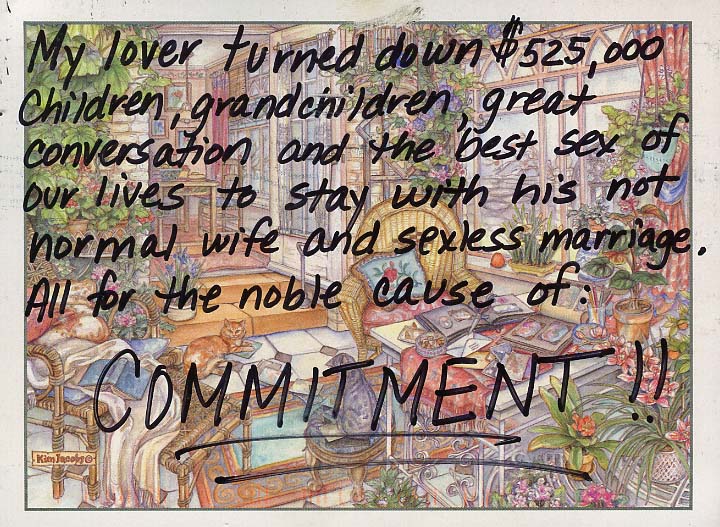
Courtesy of Post Secret this week.

The concept of commitment is a fantastic utility for women. Men can be simultaneously shamed for not sticking to a commitment that benefits them and still be shamed for steadfastly adhering to a commitment that doesn’t. The social convention is so developed there’s even a cute term for it – “commitment-phobic” or “commit-o-phobe”.

There’s an interesting control of the message here; the principle of commitment is cast in feminine-centric perfection. The idea is that commitment should only have meaning in a feminine defined reality. Ironically, it’s Men who commit far more readily to ideals, family, military, business ventures or partnerships, and servitude than women have the capacity to appreciate, because recognizing this doesn’t serve their imperative. In other words, a commitment to anything that doesn’t directly benefit the feminine isn’t commitment; answer? Redefine commitment to reflect feminine interests.

Whenever I  get into these debates about infidelity (albeit usually from the male perspective), and it becomes an immoral / amoral / moralist ménage à trois, I wonder, what is the greater “moral” imperative; to remain faithful to your morally obligated commitment with your spouse in spite of a loveless, passionless, sexless partner, or to break that commitment in order to pursue the obligation and commitment you owe yourself as a “superior” Man deserving of a better “quality” partner?

What has moral priority, a commitment to yourself or a commitment to marriage? You see it’s easy to wave the flag of self-righteousness when the issue is a right vs. wrong issue. It’s much more difficult when the question is right vs. right. I have no doubt that all the answers to this will be entirely circumstantial, rationalized twisting in the wind, and maybe that’s what decides for you, but think about it for a moment in the terms of what one must sacrifice for the other.

Whatever you cannot say No to is your master and makes you its slave.

This is a favorite go-to trope for moral arguments where there’s a clearly defined right and wrong, however, by this definition then, does not commitment make you a ‘slave’ by default? If by the circumstances of a commitment you cannot, figuratively, say “no” to the that (or due to that) commitment, are you not then a slave?

You can even take marriage out of the equation; if I’m in a committed LTR with a GF and over the course of that relationship I realize that she’s not what I’m looking for (for any number of reasons, not just sex), even though she’s 100% faithfully committed to me and the LTR, should I then break that commitment? If I do, am I then being unethical for having broken that commitment irrespective of how I break it? Should the commitment to my own personal well being and future happiness be compromised by another commitment?

What’s my obligation; neglect myself in favor of a bad commitment or to the principle of commitment itself?

It’s my take that commitment ‘should’ be a function of genuine desire. Ideally, commitment should be to something one is so passionate about that the limiting of one’s own future opportunities that come from that commitment is an equitable, and mutually appreciated trade. This is unfortunately rarely the case for most people in any form of commitment because people, circumstance, opportunity and conditions are always in flux. A commitment that had been seen as equitable sacrifice at one time can become debilitating 5 years after depending upon circumstance.

So what I’m getting at is where do you draw the line? People go all kinds of crazy when I suggest a guy NEXT some girl that’s obviously showing all of the indications that she’s using him (or has proven so) and then two comments down suggest that it’s Men’s obligation to vet women by “walking away.” If I have one life to live and one precious lifetime to do it in, what is more important; a commitment to oneself in learning and securing the best options for a lifetime or being committed to the principle of self-sacrificing commitment?

In the community we brazenly tell freshmen chumps to dedicate themselves to self-improvement; to seek out and accomplish what’s best for them – in other words, to uncompromisingly commit themselves to their own cause in as positive a manner as possible. I’d argue that genuine desire is a necessary precursor to this, but in advocating this self-concerned improvement, are we not then doing them a disservice if their duty ought to be focused on the principle of commitment, even when that commitment is (or becomes) deleterious to their commitment to a positive self? What holds more water, being a martyr to chivalrous commitment, or a steadfast dedication to ourselves?  Should we not then hold AFCs in the highest respect when they selflessly sacrifice their futures due to their devoted commitment to a ONEitis girl who’ll never reciprocate on, much less appreciate, that commitment? We’d call them chumps, but in contrast to their devotion to the principle of commitment, maybe they’ve got it right? You can’t doubt their (albeit misguided) dedication to their convictions.

Humanism, Behaviorism and the Amorality of Game

Our great risk in life is not that we aim too high and fail, but we aim too low and succeed.

I think one of the major hurdles guys new to Game encounter is an inherent discomfort with experiencing just how raw and uncaring the motivators are behind intergender dynamics. I can’t entirely blame this on a naive, White Knight dependency on wanting to have things fit into their perspective, it’s something more than that. For men with some sense of honor or duty there also comes with it a need to enforce a perception of morality. Understanding the evo-psych roots that drive what would be considered ‘immoral’ behavior by their mental frame is often enough to have men reject Game and the red pill altogether. They believe that even attempting to understand the roots of that immoral behavior is tantamount to rationalizing a way to excuse it.

For all the accusations of being a moral relativist, it’s still very hard not to see the latent purposes behind the behavior itself – this is cause for a lot of internal conflict for a morally predisposed man newly discovering the foundations of Game. In War Brides I made a case for women’s propensity to establish new emotional bonds after a breakup or a widowing with far greater ease than men due to a hard-wired psycho-evolutionary sort of Stockholm Syndrome. You can read the details in that post, but the implications of that is one of rationalizing a cruel, heartless bitch’s actions that could very well be considered amoral, if not immoral. There are plenty of other illustrations that to a newly Game-aware Man seem deplorable and duplicitous behaviors. Why can’t women just say what they mean and mean what they say, right? It seems like a horrible inefficiency to have to rely on women’s behaviors in order to really see their true motivators. What’s ironic is that much of what men have invented as moral considerations were designed to keep these behaviors and their functions in check.

All that said I can’t help but see a want for a higher order of self-image in understanding Game and how the visceral world of sexual dynamics operates. It’s raw behaviorism clashing with a desire to find a humanistic meaning in the cosmos, all set in the theater of intergender relations. I could simply take the easy way out and advise men to drop the pretense of morality altogether since it’s always subjective to whomever’s benefit the moralizing is done for. But that doesn’t remove the desire to see what we think is justice; the key being the desire for it, not necessarily the application of it. While I can certainly respect the aspirations of the nobler prospects of this approach, overall it’s a bit Pollyanna to nuts & bolts behaviorists. That’s not intended as a statement of fact, it’s just an observation.

From the humanist perspective you have to follow a linear, chronological advance in human understanding in many different realms – math, art, cultural ritual, science, societal conditions and any number of other ‘advances’ we’ve made from our hunter gatherer, tribalistic beginnings to our globally connected present. And while it is very ennobling and self-satisfying to see such achievements as evidence of our high-minded progress, it’s far too easy to overlook the root motivations for these advances that are anchored in the very evolution that the humanist perspective would like to claim triumph over.

For example lets consider Pablo Picasso. Not my favorite artist, but one of them and one most people recognize as a considerable personality in art. The humanist would hold Pablo up as the banner of human achievement – a fantastic artist as the result of our progress as a race and a tribute to our overcoming our brutish past. To which the behaviorist would ask, “why should it be that art is so highly valued among human beings?” For that answer we have to go back to the root causes for creative expression. Cavemen painted pictures of animals they’d killed on cave walls for millennia before Pablo arrived on the scene. Now you can argue that these drawings were communicative in nature, but the function of them was to convey a message – “Here is how we killed an antelope and you can too thusly.” Language then springs from this methodology and we progress, but the base function is communication that benefited the survival of the species.

Then you may ask why would Pablo personally want to be an artist? The humanist replies, “to fulfill his personal need for expression to become a self-actualized being” and the behaviorist answers “to make his life’s function easier.” I sincerely doubt that if any manifestation of creative intelligence wasn’t a precursor for sexual selection there would be so many “artists” throughout history. I could easily make similar arguments for famous inventors, scientists or even Benjamin Franklin. It all returns to root motivations.

The self-actualized man still finds himself aroused by the Playboy Playmate irrespective of how much he convinces himself he should reserve his ‘feelings’ for his wife or girlfriend to “morally” conform to his higher-order of self-expectations. Powerful establishing operations such as deprivation virtually ensure that he will have an ‘inner conflict’ and to remedy this he will behaviorally condition himself to act accordingly. Regardless of the method, it’s still the biological root that has been hardwired into his head millennia ago by his hunting ancestors. Whether or not he acts on an opportunity to cheat on his wife, the base desire is still present and an undeniable motivation. A wife can close her eyes and imagine she’s fucking Brad Pitt when she’s with her husband – the motivation is still the same.

2/3rds of the American population is overweight, why do you suppose this is? According to the cognitive-humanist we’ve solved our hunting/gathering needs and can devote ourselves to ‘higher pursuits’, but yet statistics confound us here. The behaviorist sees this and notices that our own evolutionary psychology predisposes us to over-eat since in our evolutionary past we didn’t know whether or not we’d eat at all tomorrow or the next day (thus the ‘gathering’ was invented I suppose). Our bodies process this food in such a way that we burn fat far slower than carbohydrates and protein is reserved for muscle building. All of this in an evolutionarily efficient manner to preserve us, but now once we’ve (more or less) mastered our environment and food is convenient and plentiful it becomes a disadvantage. It’s not right or wrong, it’s just our innate biological mechanisms motivating us to behave in a manner that will benefit us best.

Every vice you can point a negative finger at operates in precisely in this dynamic. Our morality, our intelligence, our sexuality and the behaviors that are manifested by them are all motivated by this base. It would be a pleasant fiction if we could all remove our consciousness from this and be these enlightened, self-actualized beings, constantly operating in a state of peak experience, but this damn testosterone in my body keeps pulling me back down to earth. It may be morally reprehensible for a woman to break her marriage commitment, divorce her husband and remarry a rich entrepreneur, but from a behavioral perspective it makes long term pragmatic sense.

The problem that moral relativism poses to the humanist approach isn’t so much in recognizing this primitive base motivation, but an unwillingness to embrace it and live with it and use it.

I want to run, I want to fuck and I want to fight – I want to feel the blood, testosterone and adrenaline pumping in my arteries. I also want to write a sonata, paint a masterpiece and be a loving father to my daughter.

Behaviorism is the antithesis of putting angels wings on our backs and claiming we’ve evolved ‘above all of that.’ I haven’t, you haven’t and no one has, and our behaviors will make hypocrites of us whenever condition and opportunity facilitate it for us. It’s not that behaviorism would have us all living like animals in the bush as an ideal state, nor does it deny that people have very ennobling qualities; it simply accepts the whole of what prompts us to do what, why & how we do things and explores the reasons why in a far more fundamental way than a romanticized humanism. I’m sure this is akin to atheism for people invested into humanism, but nothing could be further from the truth. It’s simply a more pragmatic, efficient and realistic approach for explaining behavior.